魔女の宅急便 Book Club - December 2025

I don’t have any particular mnemonics, unfortunately, but going to drop links to Bunpro’s entries for some of the adverbs/conjunctions found in this chapter. Just in case it’s helpful for anyone else getting stuck on these or who hasn’t studied them yet.

Grammar

Vocab

4 Likes

Thank you this is very helpful!

1 Like

I have a mug just like that which I bought in Kyoto!

2 Likes

A sentence pretty early into the second chapter is tripping me up –

いまさら、魔女になりたくない、なんていうんじゃないでしょうね

Kiki is saying this to herself. I read this as roughly “surely there’s no way, especially at this point, that I’d say something like ‘I don’t want to become a witch.’” That interpretation seems to be supported by what comes after.

But grammatically I struggle to differentiate “real” uses of じゃない with “isn’t it?” usages.

As an easy example:

いいんじゃない?

Obviously じゃない isn’t negating いい , just using the negative to pose the direct sentiment “it’s good” as an “isn’t it good/fine?” question.

But in the sentence from the book it definitely seems like the じゃない is in fact negating the action of 言う. So if someone could help me better understand when じゃない actually negates something and when it just poses a sentiment as an “isn’t it?” question that would be great. It feels like it’s largely decided by whether or not something is grammatically posed as a question with か (implied or otherwise) or a comment with something like ね.

1 Like

I think this is actually this grammar point: んじゃない (JLPT N3) | Bunpro

I think she’s saying “After all this, don’t go saying something like you dont want to become a witch!” or like “you can’t say something like you don’t want to be a witch!”

In other words, I think Kiki is kind of scolding herself for waffling over the decision of when to leave?

2 Likes

That makes sense, and thanks for the link to the specific grammar point.

The grammar point suggests it’s only for verbs, so is it just a matter of remembering that Verb + んじゃない is something like “don’t (verb)” but if there’s a か (implied or otherwise) at the end it would probably be the じゃないか (JLPT N4) | Bunpro grammar point?

In that vein, if someone could let me know if these examples make sense, that would be appreciated.

見られたら逃げるんじゃない 。(Don’t run away if you’re seen.)

見られたら逃げるんじゃない? (Isn’t it that if someone were seen, they would run away?)

Or

礼を言うんじゃない。 (Don’t say thanks.)

礼を言うんじゃない? (Are you not going to say thanks?)

2 Likes

Ahhh I forgot about ん also appearing in じゃないか… I wish it was mentioned more explicitly in that grammar page

Reading over this section, I think it’s actually Jiji saying this to Kiki and being a bit cheeky.

Or, the ひとろごとのように言いました is applying to the previous sentence.

So in this section, it’s more like Kiki says to herself that it would be best to set off soon. Jiji then makes a remark along the lines of, “Yeah. You’re not going to say you don’t want to be a witch now (after such a long time), are you?” Kiki then replies, “Of course not!”

1 Like

Ohhh wait that makes much more sense… I had a hard time with telling who was saying what hhhh I should go back and reread

いまさら、魔女になりたくない、なんていうんじゃないでしょうね - The ね particle at the end of this sentence is also a clue right? You usually seek confirmation from others with this one afaik. So you don’t use this to refer to yourself? (Correct me if I’m wrong tho :sweat_smile:)

1 Like

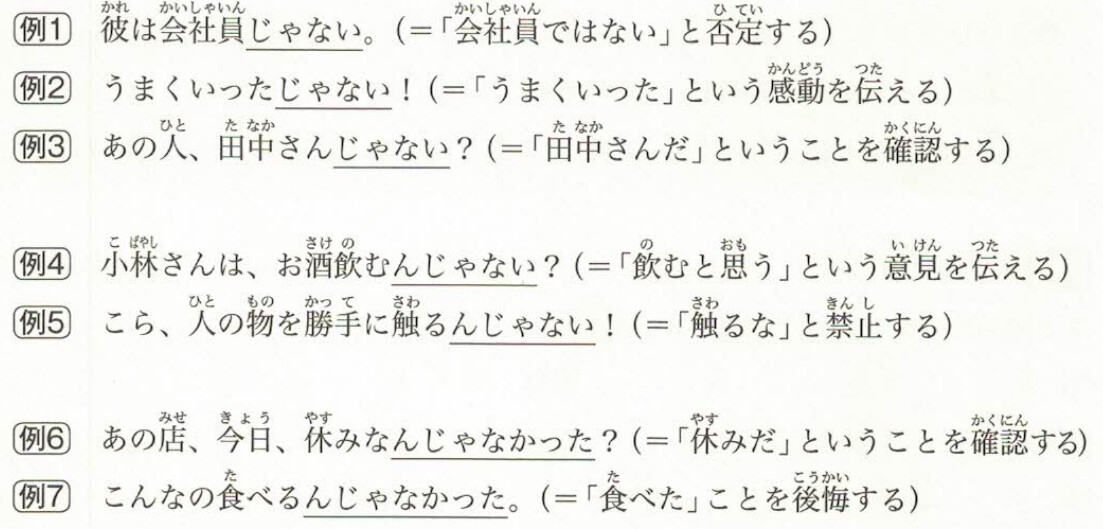
The Shin Kanzen Master listening book actually has some good examples of different ways an end-of-sentence じゃない can be used, hopefully this is a small enough section to be okay to post but I can remove it if not:

3 Likes

I’m a bit late to start but thought I’d provide a little grammar teaser, so that we can think slightly more deeply about the writing choices.

If we take a look at the first couple of lines, we can see that the town is marked first by が and then by は.

あるところに、深い森となだらかな草山にはさまれて、小さな町がありました。
この町は南へゆっくりさがる坂の町で、こげたパンのような色の小さな屋根がならんでいます。

But why use specifically が and は like this? What function are they serving here?

1 Like

Done with chapter 1 ! I’m planning to go through chapter 2 this afternoon, my Japanese association is holding a chill event that’s perfect to read or chat.

There was that one grammar point I couldn’t find anything about : 大きいのと小さいのと. I guess it means something like “the big and small ones” ?

1 Like

Happy Saturday/Sunday!

How did everyone find the second chapter? This week’s was a little longer, so good job to everyone that read through it! I personally liked this chapter, as you start to see more of the characters’ personalities.

For those two struggled getting through Week 2, don’t worry, Week 3’s reading will be a bit shorter! In the Fukuinkan version, we’ll be reading around nine pages. As always, if you’d like to confirm start/end sentences, please reference the Pace section at the top of this post.

For those wanting to double check their comprehension after reading this chapter, please feel free to read over the summary below:

Week 3: Chapter 3 - Part 1 Summary (SPOILERS) This chapter opens up a few days later on the day of the full moon, the day Kiki will be departing to a new town. The scene opens up with Kiki trying on the new black dress her mother made her, with both her and Jiji standing in front of a mirror preening. Kiki asks her mother Kokiri to make the skirt a bit shorter, but she refuses, saying it's more elegant this way and that it's best to look demure. Kokiri then hands Kiki a bento and explains that she put herbs in it so it won't go bad as quickly. She also recalls the bento she received from her own mum on the day of her coming-of-age day and how she had used magic to prevent the bread from going bad or hard. Unfortunately, she say they no longer know how to do this.

This starts a conversation between her, Kiki, and Kiki’s dad, Okino about why magic is disappearing. Kokiri explains that some people think it’s because nights are no longer as dark or quiet as they used to be. Kiki disagrees, saying that she thinks the reason magic is disappearing is because witches are holding themselves back too much, worrying about what others will say. Kokiri reminds Kiki that, back in the day, witches were considered bad luck, and they had to form a give-and-take relationship with normal humans, being sure to moderate their magic use, but also helping out when they could.

Kokiri notices that it’s already dark out, and the conversation shifts to where Kiki will live, with her dad hoping that she’ll find a good place. Kokiri tries to impart the importance of carefully considering before choosing a town to live in. She cautions her not just to pick a town just because it has a lot of shops or seems lively, as people in big cities are often too busy to care about others. She also reminds Kiki that when she first arrives in a new town, she can’t be shy and should smile to help put others at ease. After nodding along to her mum’s warnings, Kiki suddenly turns to her dad and asks him to lift her up into the sky like he did when she was young. After struggling a bit, he does. The scene ends with Kiki laughing.

The scene shifts to later in the evening, with Kiki preparing to leave the house, with her bag on her shoulder and the red radio her dad bought her in her hand. After talking a bit, Okino opens the front door and, to Kiki’s surprise, some of the townsfolk are waiting outside to say goodbye. They wish her well, telling her to come back soon. Kiki picks up Jiji to hide her face (so she doesn’t start crying). Okino looks up at the sky and remarks that he’s glad the weather is good.

Hope everyone has fun with this week’s section!

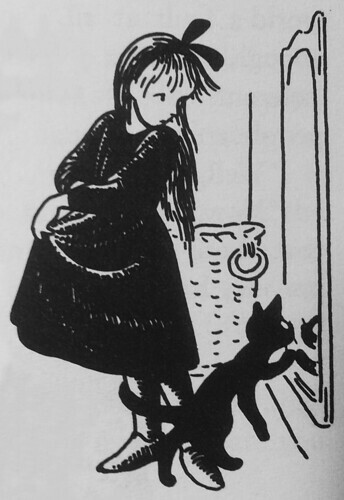
Here’s a picture from the first page of Chapter 3 from the Fukuinkan version, which might be helpful to look at when reading that page:
image

5 Likes

I think this is an example of this grammar point: の (JLPT N5) | Bunpro

Or, in this case 「ほうき」 is being omitted, as it was introduced earlier in the sentence. Looking at more of the sentence, 「木の枝をたばねたほうきが、大きいのと小さいのと、二本ならべてかざってある…」, you can translate it roughly as, “two brooms made of bundled branches, a big one and small one, were hung there.”

3 Likes

I tried but is still too difficult for me! Have fun, I will try again in a couple of years!

2 Likes

Aah I see, the added と tripped me off but I should still have made better use of the context :sweat_smile: Thanks for taking the time to explain ! (and posting those summaries and grammar points too, it’s a pretty useful read after each chapter)

2 Likes

Thank you for the hard work in keeping this going :pray:

Finished week 3 and enjoying it a lot!

1 Like

I’ll try to catch up. My version is a bit broken and shows 1000 pages :smiley: That is not motivating.

There’s a version that includes all the volumes in one, maybe it’s that?

1 Like