魔女の宅急便 Book Club - December 2025

Echoing what @someoneyoudontknow said, but I think it’s pretty common to mix up what level of politeness you use, depending on the situation and the person. For example, at my work, when we’re talking about work stuff we mostly use 丁寧語 or 敬語, but as soon as we start talking about random stuff, we all switch to タメ口.

This is just one random hinative post, so take it with a grain of salt, but someone asked about the use of different level of speeches within families and the responses said it depends on the person and family, and that in general, polite speech was more common in the past. I can’t find the link to it at the moment, but in another discussion about politeness levels within family, there was someone who was saying that they used polite speech when talking to their parents when they wanted something or had done something wrong, and also mentioned that you often see more polite speech in literature/movies when they’re trying to show the family is loyal or high class.

So TL:DR, I don’t think it’s unusual for politeness levels to vary? (Bunpro native speaker staff members can correct me if I’m wrong though :sweat_smile:)

In terms of Kiki using いらっしゃる to the お姉さん魔女, I do think this is appropriate considering the situation. The witch is older than her, her 先輩 in magic, and it’s their first time meeting. While I don’t know if you’d hear a 13 year old speak like that today, you’d definitely hear adults use that sort of terminology when talking with people they don’t know. Since it’s Kiki’s coming-of-age day, she could also be trying to use 敬語 to seem more mature? Those are my thoughts at least!

2 Likes

I haven’t checked in to this thread yet but decided now is a good time, I’m glad we’ve got at least one book club going.
I will mention though that I’m now ahead, I’m a person that doesn’t like stopping in the middle of thoughts, so I ground all the way through chapter 3. It’s so weird how long it is compared to the first two.

4 Likes

All these points sound reasonable. What I’m taking from this is it’s better to not adjust accumulated modern-day intuition based on a book written 40 years ago depicting the world 60-100 years ago.

Kokiri (mother) sometimes even uses it towards 10 year old Kiki.

She went with tameguchi for the whole conversation except for this one いらっしゃる though.
The slightly older witch did remark 「ちょっとおてんばさんのようだけど」 so maybe she was actually expecting a full senpai treatment in this situation.

At least later in the chapter Kiki speaks politely with strangers, as expected.

I caught up! Honestly a lot of week 3 went over my head but now the descriptions of the scenery are easy to understand. I enjoy reading the English summaries here to check my understanding. It is a bit above my level, but I want to keep reading. Mining words and improving regardless

2 Likes

I see, it seems like the sentences that could have gotten me from “Kiki is looking at the broom in secret, because it’s her parents’ departure present that she ended up finding” (what I assumed to be true at first) vs “Kiki is looking at the broom in secret, because it’s something that she has been working on herself” were all sentences where I missed a few elements of grammar/vocab and didn’t get the entire meaning. That’s what you get for relying on imagination to fill-in missing vocab :joy:

2 Likes

I spent all of last weekend outside for a friend’s birthday so I’m still behind, however I did get a random magical sight there telling me not give up on the book :eyes:

Summary

ジジちゃん!

2 Likes

Hello hello!

How did everyone find this past week’s reading? We were finally introduced to a bit more of the world outside Kiki’s village and to a new character, which I thought was fun.

Since Chapter 3 is weirdly long compared to other chapters, it’s not as easy to break into 10 page chunks. Due to that, this week’s reading is a bit shorter, at only 7 pages. If you’ve fallen behind a bit, this week may be a good chance to catch up! As always, if you’d like to confirm start/end sentences, please reference the Pace section at the top of this post.

For those wanting to double check their comprehension after reading this chapter, please feel free to read over the summary below:

Week 5: Chapter 3 - Part 3 Summary (SPOILERS) Kiki and Jiji continue their flight looking for both a new town and a glimpse of the ocean. Gradually, the mountains they were flying over give way to fields and towns, with the river they were following growing larger and larger as well. Too caught up in looking at the scenery below, Kiki doesn't realize that the ocean has come into sight until Jiji points it out. Enraptured by the sight of the ocean, Kiki looks over the landscape. It's while doing this that she notices a large town situated near where the river meets the sea.

The two of them decide to go check it out, and as they draw near, they realize it’s a bigger town than they first realized. Kiki quickly gets excited and decides that this is the town she wants to live in. Concerned, Jiji reminds her about what her mother said about big, busy towns, and warns her that another witch may already live here. Hearing this, Kiki decides they need to go find out and starts to descend towards town.

Landing on a cobblestone street busy with afternoon shoppers, Kiki startles everyone around her, causing various reactions. Some people run away, others hide, and the rest quickly form a wall around Kiki. Remembering to put on a smile, Kiki introduces herself as a witch. An old woman interrupts her, saying that witches are rare nowadays. From this, Kiki gathers that there is no witch in town and asks the townsfolk to excuse her intruding in their town (which we learn is called Koriko).

Hearing this, the townsfolk start talking one after another, making remarks that aren’t particularly kind. Kiki clarifies that she would like to live in Koriko, as it’s pretty and she likes the clock tower. The townsfolk continue to talk a bit, telling Kiki she can do what she wants, before dispersing. Kiki is hit by a wave of exhaustion, having not eaten anything since morning and discouraged by the lack of a warm welcome from the townsfolk.

In comparison, Kiki can’t help but think of the people of her hometown, who were glad to have a witch living in their town. It wasn’t uncommon for people to stop by and share things with Kiki’s family, and in return, Kiki’s family would do things for the townspeople, such as sharing medicine, teaching them the names of medicinal herbs, playing cat’s cradle with old folk who lives by themselves, and using their brooms to deliver lost items. Having grown up used to this give-and-take relationship, Kiki is at a loss on how she is supposed to live in this new town.

Dejectedly, Kiki moves to the side of the street and starts walking, dragging her broomstick along. Muttering on her shoulders, Jiji remarks that Kokiri was right and big towns aren’t good. On the verge of crying, Kiki nods and wonders what they’re going to do, as it’s starting to get dark and she’s unsure if an inn would let a witch stay the night. Jiji reassures her that something will work out and, in an attempt to cheer Kiki up, he asserts that back in the day, witches would have grabbed the town’s tower and put the whole town on a mountain or something. Silently, Kiki just shrugs her shoulders.

3 Likes

The が serves to answer the implied question: where does this story begin?

The は, I think, serves to set the village apart from other villages: what makes it different, how would you know it’s Kiki’s village, etc. But I’m not sure if that’s a contrastive or just descriptive function.

1 Like

I barely understand any dialogue but the descriptions are fine. That matches my geenral Japanese ability :smiley: I always feel behind and like I don’t have the time to truly analyze all that dialogue. Hoping it will still get easier

1 Like

That’s actually really interesting as I find I struggle with descriptions way more than dialogue. Maybe just because I’ve spent so long reading manga where there’s far less descriptions and way more dialogue back and forth.

I haven’t yet done my reading for last week since I had a English book to finish for a different club (well, Korean originally but translated into English) and then I came down with a cold over the weekend which still has me in its grasp. Hopefully be able to catch up before next week!

1 Like

I’m the same! I personally find dialogue more difficult to parse than descriptions. Or, for me at least, it’s not as easy to pick up the intended tone compared to when you hear someone speaking out loud. I find dialogue also tends to use more slang, contractions, or have regional and personal quirks which can make it more difficult to understand than descriptions.

1 Like

I realized I said awhile ago that I would share some of my thoughts on Week 4’s reading, but then I never got around to posting anything. So here are some thoughts on Week 4, as well as Week 5 since we’re wrapping that up soon.

Week 4 and 5 Notes (Possible Spoilers)

Week 4:

  • I really liked the descriptions of the landscape in this section. I read a lot (~40-70 books a year), so I’m always pleasantly surprised when an author describes something in a way I haven’t read before. In particular, I liked the lines 「やがて、町の光も遠のいて、目の下に見えるのは黒々とした動物の背中のような山ばかりになりました」 and 「赤や青の屋根がかたまって、スープに入ったにんじんやグリーンピースのように見えます。」
  • I thought the お姉さん魔女 character was kind of funny. She’s only a year older than Kiki, but acts (or tries to act) more knowledgeable and mature. Despite this, she doesn’t come off as a bad character to me, as she readily admits that she’s bad at flying and even takes a job helping out a moody cow in exchange for cheese (relatable). It’s been awhile since I watched the Ghibli version of Kiki, so apologies if I’m misremembering, but I vaguely remember the older witch character being a lot more stuck up so it was interesting to see the character in the original source material.

Week 5:

  • Not as many thoughts about this section, but one thing that I couldn’t help thinking throughout is how crazy it is that a 13 year old girl is going to a new city by herself. I know this is a fantasy setting, and that it’s more acceptable in Japan for kids to go around unattended at younger ages (compared to my home country), but I still can’t get over it. With that thought in mind, I felt pretty bad for her when she first arrives in the new town and ends up wandering around alone without any place to stay.
  • I’ll admit it took me way too long to realize that ただじゃおかない is a set expression.
3 Likes

やった! I managed to read the alloted amount :smiley: I am starting to understand more of it, even the dialogue. To be fair I am reading with a pop up dictionary and check a lot with AI translation. But my understanding is not so far off anymore. Makes me happy to see a bit of progress.

1 Like

Hi all!

How did everyone find this past week’s reading? In this last section, we ended on a bit of a cliffhanger, with Kiki aimlessly wandering the city as it starts to get dark. Make sure you read this week’s section to find out what happens to Kiki :eyes:

Which brings us to this week’s reading! This week, we’ll be finishing off the rest of Chapter 3, which ends up being around 11 pages. As always, if you’d like to confirm start/end sentences, please reference the Pace section at the top of this post.

For those wanting to double check their comprehension after reading this chapter, please feel free to read over the summary below:

Week 6: Chapter 3 - Part 4 Summary (SPOILERS) Continuing to walk aimlessly through the city, Kiki and Jiji find themselves on a narrow street with small, leaning houses. Suddenly, they hear a loud woman's voice from what appears to be a half-closed bakery. It seems as though a customer has forgotten something important, her baby's pacifier. Thinking that the woman is talking to her, Kiki stops and listens. However, it turns out the woman is talking to her husband. The woman tries to convince her husband to go deliver the pacifier back to the customer, but the husband deflects saying he'll do it in the morning. The woman insists he deliver it tonight, since she's a good customer who always comes from far away (and with a baby too!). Since the husband continues to insist he'll do it tomorrow, the woman declares that she'll do it instead.

At this point, the woman comes out of the bakery and Kiki sees that she’s pregnant, looking like she could give birth at any moment. The husband insists she can’t go in her condition, and that he’ll just deliver it tomorrow, but the woman, indigant, starts off to deliver the pacifier herself. Spontaneously, Kiki calls out to the woman to help. She explains to her that she’s a witch who recently arrived in town and, that if the woman is okay with it, she can deliver the pacifier for her instead.

After talking a bit more, the woman, who introduces herself as Osono, agrees to let Kiki deliver the pacifier. Since it’s a bit far away, she draws Kiki a map and tells her to have the customer write her name on it once the pacifier’s been delivered. She says, if she brings the map back that she’ll give her a reward as thanks. Excited, Kiki straddles her broom and kicks off into the sky.

Kiki is able to safely deliver the pacifier back to the customer, who is incredibly thankful and thanks Kiki multiple times. On the flight back to Osono’s bakery, Kiki and Jiji realize how hungry they are and decide that, after this task is done, they’ll find a tree to sit under and eat the bento Okino packed for them.

Arriving back at the bakery, Osono is waiting outside for them. She immediately asks Kiki to teach her how to fly, to which Kiki explains is impossible, as you need to be descended from a witch. The two continue to chat with Osono eventually giving her a bag of five butter rolls as thanks. She then asks Kiki where she’s staying, since she just arrived in town. Kiki is quiet, cuddling Jiji and lowering her eyes. Shocked, Osono offers to let Kiki stay the night in the second floor of their flour storehouse, saying she’s taken a liking to Kiki. Relieved, Kiki accepts.

The next section cuts to Kiki and Jiji in their room in the flour storehouse, having eaten their bento and crawled into bed exhausted. Jiji complains about turning into a white cat due to all the flour, but Kiki points out that the storehouse has a bay window for him to sit in, just like he wanted. Jiji asks Kiki if they should look for a new town tomorrow, but Kiki says she thinks they’ll stay in this town a little longer, as more people might be like Osono and take a liking to Kiki. After making one last remark, Jiji quickly falls soundly asleep.

Sorry that this week’s summary was a bit late. Currently getting over a stomach bug and energy has been low. Hope everyone else is staying healthy!

I’ll add my thoughts in a separate post later, but I noticed some interesting Japanese usage in this week’s section. If you came across anything you thought was strange or interesting in this week (or previous weeks) reading, feel free to share here!

3 Likes

I’ve been catching up slowly to where I need to be :sleepy:

It doesn’t feel too painful, just the occasional word look up here and there. It’s so useful to know the story very well already.

1 Like

遂に追いついた!最近、やる気がない日が多いな。でもやっと追いつけて、気持ちいいんだ。

4 Likes

Hi all!

How did everyone find this past week’s reading?

This week, we’ll be starting Chapter 4 and reading the first 10 pages. As always, if you’d like to confirm start/end sentences, please reference the Pace section at the top of this post.

For those wanting to double check their comprehension after reading this chapter, please feel free to read over the summary below:

Week 7: Chapter 4 - Part 1 Summary (SPOILERS) Chapter 4 opens with Kiki lazing on her bed. It's been three days since she arrived in Koriko, but she hasn't left her room and has spent it lying on her bed and slowly eating the food she received. As she's starting to run out of food, she realizes she'll finally need to go out. However, the confidence she felt after delivering the pacifier on her first day has disappeared and she feels overwhelmed by the city. She even contemplates going back home, but decides she doesn't want to live her life like a bagworm.

Deciding that she needs to find something she can do, she wonders if she could help other busy people deliver things like she did with Osono and the pacifier. When Osono comes to check up on Kiki, Kiki asks her advice on whether this is something that could work. After talking about it a bit more, Osono agrees that it’s a good idea and tells Kiki that she’ll need a storefront for the business. Osono suggests the first floor of the flour storehouse, where Kiki is staying. The two also chat about what the business will be called, and Osono recommends the name 魔女の宅急便, saying a weird name is best, like how the bakery she owns is called グーチョキパン屋 (a play on words of rock, paper, scissors).

The next day, Osono gives birth to a baby girl, so Kiki ends up helping out Osono instead of opening her shop. However, about ten days later, Kiki is finally ready to open her store, having washed the wall of the flour storehouse and hung up a sign advertising the business. In addition to the sign, the inside of the flour storehouse has been tidied up by Osono’s husband, who also made Kiki a desk made out of bricks and boards. On top of the desk, Kiki placed a new red telephone, and hung a big map of Koriko on the wall. Finally, on the pillar that people first see when entering the storehouse, she hung up her mother’s broom, which in hindsight she is glad she brought with her instead of the new broom she had made.

However, a week goes by without a single customer. When visiting Osono and the baby, Osono apologizes, saying that maybe calling the business 魔女の宅急便 was a mistake as people may distrust witches. Kiki pretends that it’s okay, but when she leaves and goes back to her desk, she is so sad that she forgets to eat lunch. She complains to Jiji about how people assume witches are bad even though they’ve done nothing wrong, just because they don’t understand them. Jiji says that they need to teach people that this isn’t the case and suggests they need to start advertising. He suggests writing lots of letters, telling everyone that she’s a cute witch. Kiki decides this might actually work.

Getting up, Kiki opens the window and is greeted by a gentle spring breeze. Feeling it and the sun on her face, she feels like a mole blinking in the sun, and the feeling she had of being stuck slowly fades away. Looking out the window, Kiki notices a girl up on the third floor of another building waving her hands in a beckoning fashion at her. Confirming that the girl is gesturing to her, Kiki decides to go her, grabbing her broom before she leaves.

We’re now almost a third of the way through the book and things are starting to pick up! If you’re still reading along, good job!

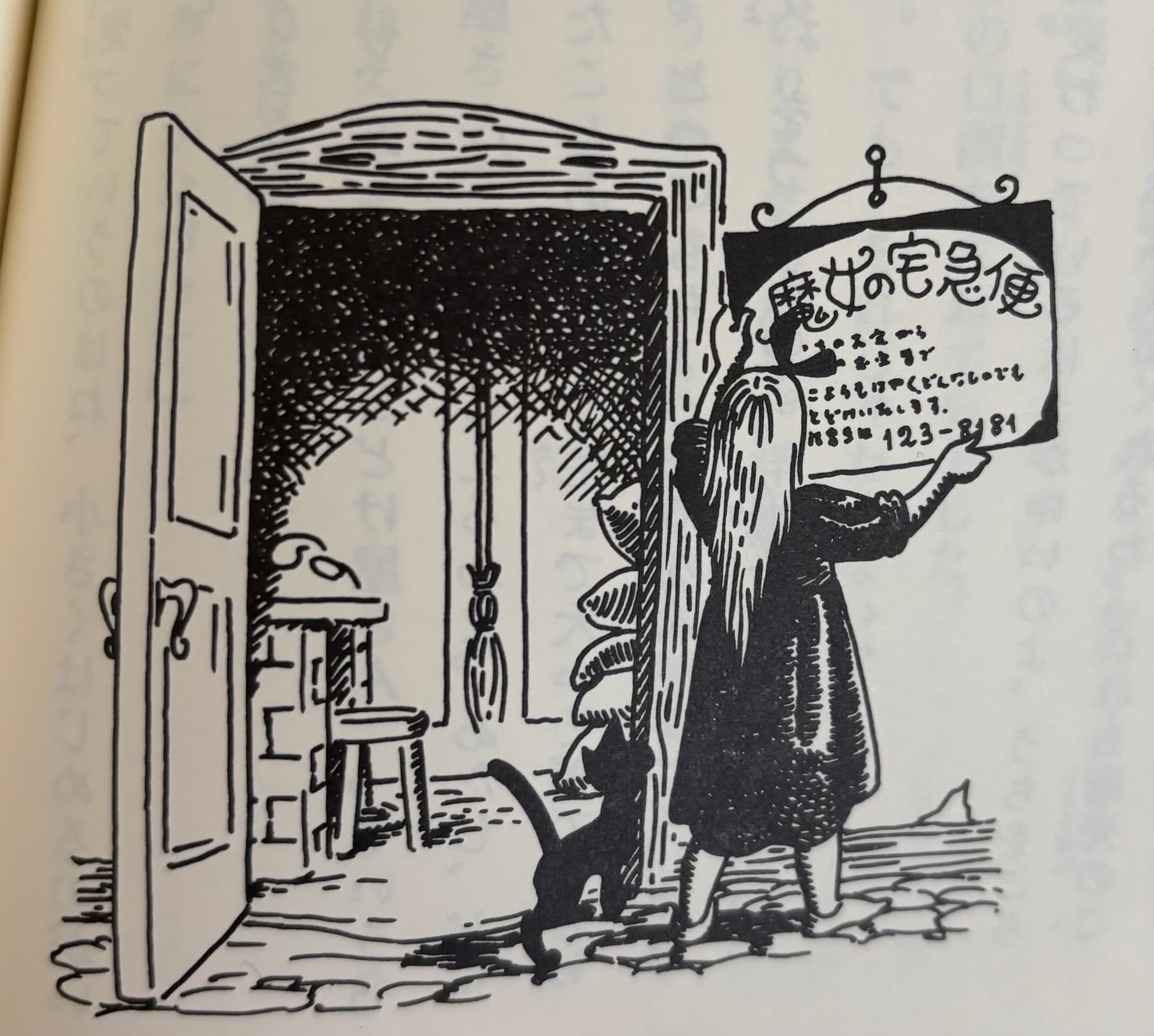
Also, here’s a picture of Kiki hanging up the sign for her new business:

6 Likes

thank you for the summaries! apparently I didn’t understand the setup of kikis shop correctly, but my reading speed has greatly increased. I mostly read everything in one go and have to stop myself from reading ahead :slight_smile: I see that as a success

4 Likes

Glad to hear your reading speed has increased and that you’re enjoying it enough to read ahead :blush: Anything in particular that’s stood out to you in the book so far?

I mentioned a little while ago that I noticed some interesting Japanese usage in week 6’s reading. Here are some of the things I found when reading through week 6 and 7.

Week 6 and 7 Notes (Possible Spoilers)

Week 6:

  • When Kiki gets the rolls from Osono as payment for delivering the pacifier, I noticed that they used the term バタパン. I found this interesting, as I usually see butter written as バター (for example, the bakery near my house calls their rolls バターロール). Apparently, バタ is an old way of writing butter, and while バター is now more commonly used, it’s still written as バタ in certain words such as バタ臭い and バタピー.
  • Earlier in the book, @casual noticed that the politeness levels used by characters were kind of inconsistent. In this chapter, the author actually specifically seems to call this out. Or, on pg. 62 when Kiki is first speaking to Osono, it says:「いえ、ほんとうなんです。ですからあたし、とどけることならかんたんにできますから、お役にたたせていただきますわ」キキはていねいにいいました. But then shortly after on page 64, when still talking to Osono, it says: 「わー、やったあっ」キキは思わず友達にいうようにさけんでしまいました. The fact that the author is explicitly calling out Kiki’s inconsistent language use really does make me wondering if she is trying to drive home the fact that Kiki is still figuring out how to navigate things in an adult work, and unconsciously still slipping into タメ口.

Week 7:
Osono sure loves her puns! Puns I noticed in this week’s reading:

  • When Kiki gets her new phone number, the last digits are 8181 (八一八一) and is written as はいはい. I’ve never seen 81 written with this reading before, but I’m assuming they used it here to be a play on words for 配達.
  • When suggesting a name for Kiki’s business, Osono says she can’t call it a おとどけ~ (delivery) because it sounds too similar to おとぼけ~ (someone feigning ignorance).
  • Osono’s bakery is called グーチョキパン屋, which is a play on words of グーチョキパー (rock, scissors, paper).

If I missed any other puns from the past few weeks, let me know!

Just a heads up that week 8’s start and end sentences have been updated in the Pace section. We’ll be reading ~8 and a half pages this week. I haven’t had a chance to sit down and write out a summary yet, but should have it posted in the next few days. In the meantime, let me know if you guys found anything interesting when reading through things so far!

4 Likes