As far as I can tell, some of the text-to-speech for example sentences are done with AI. The other vast majority of it though seems to be human or traditional TTS.
IMO, AI could be useful in bulk processing content already on the site. For example, cross-populating example sentences. Currently there are lots of vocab outside the core that don’t have example sentences, but they show up in other example sentences so we can reuse those.
First use a deterministic algorithm (like the one used by TenTen reader) to find good candidates, then use an LLM to check if it is good (because homonyms exist). To be honest depending on the amount of work the latter part could also be done by a human.
I think if you’re going to implement AI you should do your best to get as much out of it as possible not just a lazy half baked service that you can sell. There are things that you can make without the traditional AI but at some point it’s just not worth the time and effort it takes to get to the same solution. Would some things be better done manually, absolutely but there also a lot that won’t be and or can’t be (with a realistic amount of time or effort)
I’m not against using AI to help learn languages. I use Google AI to help parse sentences and explain grammar points when I screenshot something I don’t understand.
There is definitely a place for it.
I also agree that a lot of AI’s poor reputation comes from the sheer quantity of slop and poor implementation.
However, I like that Bunpro is written, developed and curated by humans. AI is good for donkey-work, but I feel that the human touch is better for something more bespoke like Bunpro and its features.
A cheap, bulk option like Duolingo uses AI poorly (see the number of times ha is mispronounced as wa in words like hajimaru)
I also agree with the concerns about costs of AI and getting locked into a system or pricing structure that is then difficult to get out from.
So, there are pros and cons to using AI. I am free to use AI in other locations and sources, but I would prefer Bunpro to remain with the humans.
deterministic, select all existing example sentences that contain the new vocab item as a non-variable, and replace the existing variable with the new vocab item. This will work better than every single existing AI.
And don’t get me wrong, I use lots of AI, for AI-usecases
That’s why I said you use an LLM as a backstop, to keep things like homonyms from sneaking through. The full pipeline in front of it uses a much more efficient deterministic algorithm (like 10ten reader’s word splitter)
Literally at the end of the pipeline you ask the LLM: does the word X mean the same thing in this sentence as this other sentence?
I agree I also really like how Bunpro feel and is made for and by people. But I also think you could add features with AI that don’t take away from that by not merging the two. I think having a clear seperation of AI allows users to know what to expect from each part of the site while also still giving them the best experience they can! Also AI really is not expensive at all, if you’ve been told that it’s probably in an attempt to sell something to you for more than it’s worth. Also switching AI is very very easy I promise it takes little to no effort. Also thanks for the insight!
Im just now catching up to everything but to sneak into this here. Words dont work like that, even in English. In Japanese, one word can have SO many different meanings that simple asking “Is this word the same as this sentence” the AI itself wouldnt be able to answer because of context alone. but anyway
A solution that I think would be REALLY simple for them to implement would be that users can take words from those with sentences and assign them to another word within that sentence if that word doesnt have any sentences yet.
EX. Words A and B exist in sentence A. However, word B doesnt have dedicated sentences. You take Sentence A and move it to Word B and now it only appears for you there.
Also, you can add your own sentences, so if you use any general dictionary or JLPT book, they come with example sentences and you can add your own.
AI can be useful, and Bunpro doesn’t need AI and definitely not immediately.
However, I can see Generative AI being useful in an application which does the following features:
Picks 3 grammar points.
Picks a topic/article.
User then writes sentences using grammar points and AI is then used as a grammar/spell checker.
That’s how I’m hoping to practice and improving writing with AI tools, or at least give it a go.
Just on the principle that AI is unpopular including AI in Bunpro is a bad idea. It also clashes with the brand of Bunpro being reliable and trustworthy.
I think a lot of AI gets a bad label because of the way we’ve seen it used but I promise there are amazing applications of it in things like medical devices where being reliable and trustworthy are the number 1 priority. You just need to build your systems to show what does and doesn’t use AI, and to not ship services that are of low quality. I also agree I’ve used AI to help with grammar and writing and it’s been an incredible resource. Even if AI gets things wrong from time to time it’s a drop in the pool of sources of learning I have so it doesn’t really stick. I mean people make mistakes when speaking all the time, but I still learned how to speak English.
Can we be clear that when you say “AI” people are mostly meaning GenAI, not Machine Learning. The latter which is the basis for most reliable AI applications these days? GenAI is not reliable and results in very different results.
Conflating the output of 2 different products is like comparing apples to oranges.
I mean I think there is a good case to make for both. I like the idea of smarter scheduling and resource recommendation. I also like the idea of small stories that are made to help with grammar and vocab I’ve just learned to add to the amount of content there is to practice with. They both have different uses and I think they could both be good for Bunpro.
Yes, but not distinguishing between the two leads to confusion. Most people don’t care about machine learning. Many people are incredibly passionate about generative AI and what it means for an app.
I’m not confused. I’m asking you to distinguish between GenAI and ML (machine learning). You claim AI is used in medical devices, but this is primarily machine learning. Claiming that “AI” (which most people understand as GenAI) in medical contexts is reliable conflates the performance of ML and GenAI which is very misleading.
Yeah I think if that’s going to happen I am going to be quite happy.
An alternative approach
I think a even better idea would be to embed a dictionary inside the review system. Like when you hover over a word it shows you its dictionary entries. You can pick an entry, and it automatically makes an example sentence for you, with the hovered word highlighted.
For example, say I have an example sentence like:
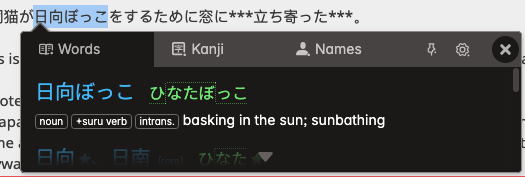
飼猫が日向ぼっこをするために窓に立ち寄った。
This is an example sentence for “立ち寄る”. But I am also interested in the phrase “日向ぼっこ” which means sunbathing. This sentence can also serve as an example sentence for it!
So I go click on the word, and it would show me something like this (this is 10ten reader, by the way):
Then you click a button on the dictionary like: “Add example sentence”. And boom, it reuses this example sentence for “日向ぼっこ” as well.
The shortcoming of this is that all the created sentence stay private
This means two things:
Duplicated effort: Two users making the same example sentence for the same word.
No network benefit: I don’t benefit from other people’s work. I have to mark all the words myself.
I wouldn’t call it a problem per-se, because like I said earlier, I’d be quite happy if even this is implemented. But it has more potentials, what if we can …
Make all of those sentences public, and implement proper quality control
With user generated content, you can’t just publish it without a thought. You’d need some measure of quality control. Bunpro is a paid platform of nice users, so collective filtering make sense. For example, you could make it so that if a given number of users over level X has created the same sentence for the same word, you make it public.
There is also the issue of compensation for labor. The obvious solution would be to award B-points or offer small credits for subscription.
Finally, on the capability of AI
I don’t think AI is necessary in the arrangement above. But I still would like to address the following objection:
Based on my own experience, LLMs are quite capable of differentiating word meanings if there is sufficient context. By “context”, I mean the example sentence itself. In doubt, you can always make it issue a “inconclusive” verdict. What I say is you give it a prompt like this:
Does the “bat” in “I need a new bat for next week’s baseball game.” mean the same as the “bat” in “Bats are generally found in caves where it is dark and humid.”?
I would say any model (even the cheapest ones) can confidently say “No, they are not the same.”
Of course, were it ever to be used, it is obvious that we need to test it and see how often it makes mistake.
I think both are being used in medicine with things like patient care and diagnosis assistance along with estimating vitals and predicting future ailments.
Anyone can already ask an LLM of choice about anything.
Bunpro can focus on human-created content.
Somebody else can trivially create a browser extension to “ask LLM about this or that on Bunpro”.
Saying that “just adding LLM” is cheap is naive.
The tokens are still heavily subsidized by tech giants competing for market share.
Implementation and maintenance takes away developer time from actually useful features.
I would say even in a production environment at large scale it is cheap to add AI even with the cost of developer time. Maybe you’ve had a different experience when doing it yourself and in which case then I agree it would be best to take that into account. From my experience it’s similar to most other forms of development and adds very little expense.
Because of that I think it could be really nice to add some AI powered features to Bunpro but everyone is allowed to want different things for the platform. That’s a big part of why I started this was to see what the other people thought!
Also I’m curious what other features you’d like to see in Bunpro