
I would definitely second this.
I took N3 and, even though the mock tests were significantly easier, it was really nice to build confidence and ability with these easier tests first.
I guess that’s more of a motivational factor, but it definitely helped!
1 Like
This is a really important point which might be getting overlooked. It might not be that the tests are necessarily “easier”, but at N1 there is a lot of ground that could be covered. Statistically speaking, there might well be topics in the test that you are less familiar with. It doesn’t help that there is no JLPT syllabus per se.
If it is any comfort, my wife had this same frustration taking English tests (although they’re even harder and more prone to randomness because you have conversations as part of the test).
This is a good point, but the readings were also just significantly shorter on the Bunpro tests (for N2 at least). From that aspect, the mock tests gave a false sense of security about reading speed/time and definitely were significantly easier.
2 Likes
Ah, that’s a big difference then!
I agree that N2 is not supposed to simulate the difficulty of N1, but it doesn’t matter that we cannot understand what not interpret it (well, we cannot because one person cannot take N2 and N1 with little gap in time like a well)
But if person for example takes test N1 which feels as difficult as N2, scores like 160 (90% for Bunpro test) and then scores 110 on the real one. So if person used 100% of their brain capacity for both test, that would mean that it’s a max amount of points they managed to get on both, and we can say that the level of person with 160 points on the Bunpro test is roughly same as 110 on the real of.
Of course there are a lot of things except the real level of Japanese that can make this not as correct, but if we can get more results we can create somewhat accurate average picture with closest/furthest points on the scale.
That’s why I’m asking specifically about the numbers and not about the felt difficulty
I don’t think I’m mistaken them, I’m rather interested in the first one.
I already understood that N2 and N1 tests are somewhat much easier then the real ones, but now I wonder how easier they are, so when I use them I’ll know what % I need to have chances on the real one
Took and failed the N1 four times in a row (I’m a busy worker). To me:
The reading part of the mock test N1 bunpro is significantly easier: slightly shorter, easier style, and correct answer quite obvious to distinguish from the incorrect ones.
Listening part is of similar difficulty. Voc/grammar only slightly easier.
Otherwise, the care brought to produce the tests deserves to be noted. Nice job.
5 Likes
How many points have you managed to score on Bunpro tests/real one?
I tried one N3 mock late November:
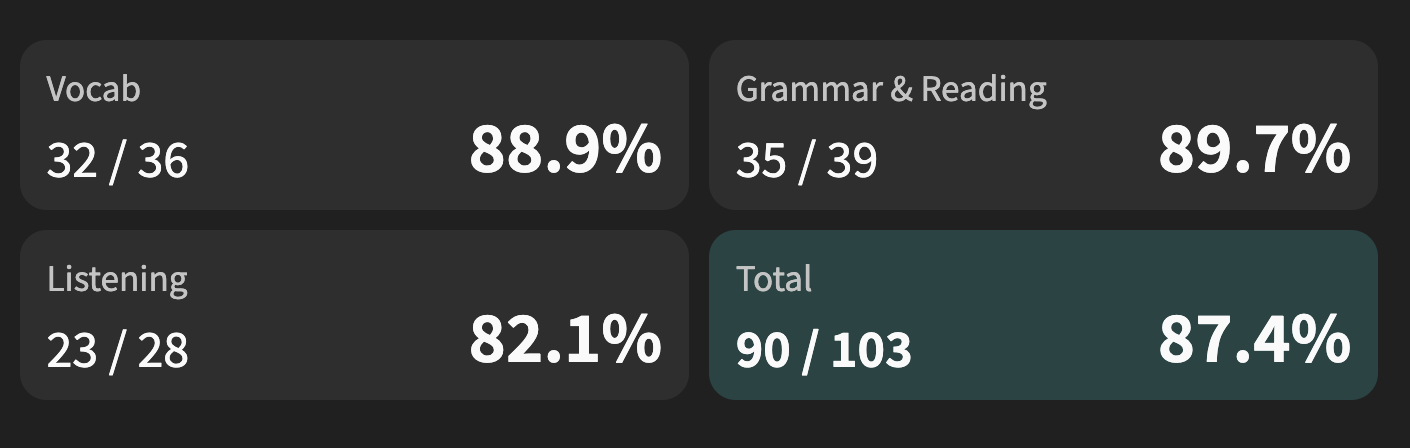
I passed the real test in December with 108/180.
To me:
- Vocab & Listening were comparable to the real test.
- Grammar on the real test was harder
- Reading on the real test was MUCH harder (and WAY longer)
3 Likes
75% on mock bunpro’s N1 test 1 (I was rusty). Real test between 80 and 95.
After thinking a bit more, vocab/grammar is also significantly easier,
and reading is definitely easier (text harder to decipher, four proposed options harder to distinguish). Listening part is quite similar I think.
2 Likes