
Hello all!
Here is the summary for Chapter 9, which covers Week 18 and 19. Like the previous summary, this one is a little more brief, so if you have any questions about particular details/wording in this chapter that aren’t covered here, please let me know!
Week 18+19: Chapter 9 Summary (SPOILERS)
With only four hours left until New Years, Kiki is trying her best to deal with the fact that this is the first year she hasn't spent it in her home town with her family. Having finished cleaning her house, she is now making meatballs in tomato soup (a tradition in her town), while thinking of her family and the New Year's Eve customs from her town. In her town, when the clock strikes 12, it's customary to hug the person next to you and say a greeting. Kiki suggests to Jiji that since it's just the two of them this year, they should try to follow their hometown's tradition together. Jiji agrees, and reflects that, depending on how you look at it, the past year wasn't that bad.As she’s taste testing her dish, Kiki wonders at why the streets outside seem so busy compared to usual. As she’s thinking this, Osono comes into the shop holding her baby. To Kiki’s bewilderment, when Osono sees Kiki she says, “Let’s listen”. After staring at her blankly for a moment, Kiki asks what they’re listening for. It’s then that Osono realizes that she hasn’t taught Kiki about Koriko’s New Year’s traditions. She explains that on New Year’s and New Year’s only, the bell rings at 12 o’clock 12 times. When that happens, starting from in front of town hall, the townsfolk run a lap around town to signal that they’re running into the new year. As a result, “Let’s listen” has become the greeting people use on New Year’s Eve. Kiki realizes that this must be the reason why it’s so busy outside, as people are already gathering. She asks if she’s allowed to participate in the run as well to which Osono says of course, and that Kiki can run with her, her husband, and the baby.
Cutting ahead two hours, the scene shifts to Koriko’s young mayor, who’s finally finished all his work. Although he was only elected this year, he has been doing his work well and the townsfolk’s thought highly of him. Determined to prove himself even more reliable, he decides that he’ll do whatever it takes to make sure he’s at the front of the race tonight. After stretching a bit, he opens the window and shouts out the town’s greeting. However, to his surprise, instead of hearing the usual tick-tock sounds of the clock tower, he hears what sounds like yawning. As he looks up at it, the clock lets out one last sound before the hands stopped moving, at 10:36 pm.
Jumping over to the phone, the mayor calls the clockmaker who’s been taking care of the clock tower for generations. He tells him to come quickly and that, whatever he does, don’t tell anyone that the clock’s stopped. After hanging up the phone, the mayor rushed to and up the clock tower. Since being built, the clock had never broken down. The mayor wondered why this year of all years it had broke, and worried about whether it would ended up being written in the history books, which would be a huge disgrace.
After a little while, the clockmaker finally arrives at the top of the tower and, worrying that he overlooked something when he did the pre-NYE inspection, sets about inspecting the clock. Quickly, he realizes the problem – the largest gear is broken. He assures the mayor that it’ll be an easy fix and goes to get a new gear from his bag. However, when he looks in his bag, the clockmaker starts to tremble, realizing he doesn’t have a spare one. The mayor tells him to go get a new one, but the clockmaker explains that they would need to order it and it would take up to 53 days. Staggering back, the mayor asks if there is nowhere else they could get one. The clockmaker says that he’s heard that one of the towns over the west mountains has a clock similar to theirs. The mayor suggests that they “borrow” a gear in secret. Realizing that they’re running out of time until midnight, they discuss how to get it in time.
The scene cuts back to Kiki’s shop, where the phone is ringing. Picking it up, she uses Koriko’s NYE greeting. On the other end, the mayor very rudely asks her if she can pick things up as well as deliver. Telling him off, Kiki assures the mayor she can pick things up as well. More politely this time, he asks her to come meet him at the clock tower. Grumbling about having to fly tonight of all nights, Kiki sets off with Jiji.
Arriving at the tower, the mayor explains the situation and asks Kiki to go “borrow” the other town’s gear in secret. Reluctant to steal, Kiki asks why they don’t just ring the bell themselves at midnight, since no one can see the clock’s hands well anyway. The clockmaker explains that the bell will only ring if the hands are in the 12 o’clock position. While looking like he’s going to burst into tears, the mayor begs Kiki to go. Without saying another word, Kiki purses her lips and flies off.
Flying over the three mountains to the west, Kiki sees the town shining like a glass necklace along the valley. Jiji wonders if what they’re doing is okay, to which Kiki replies that maybe they really will be able to borrow it if they just explain. Although much smaller than Koriko, when the two arrive at the town, they see that there is a large crowd gathered in front of their clock tower, with people stretching and bending their right hand’s pinkie finger. Kiki is surprised when an old man greets her with a similar saying to Koriko’s, except here it’s “don’t forget midnight.” Kiki asks him about the town’s tradition, and the old man tells her that, in this town, at midnight people pinkie promise to get along well in the new year.
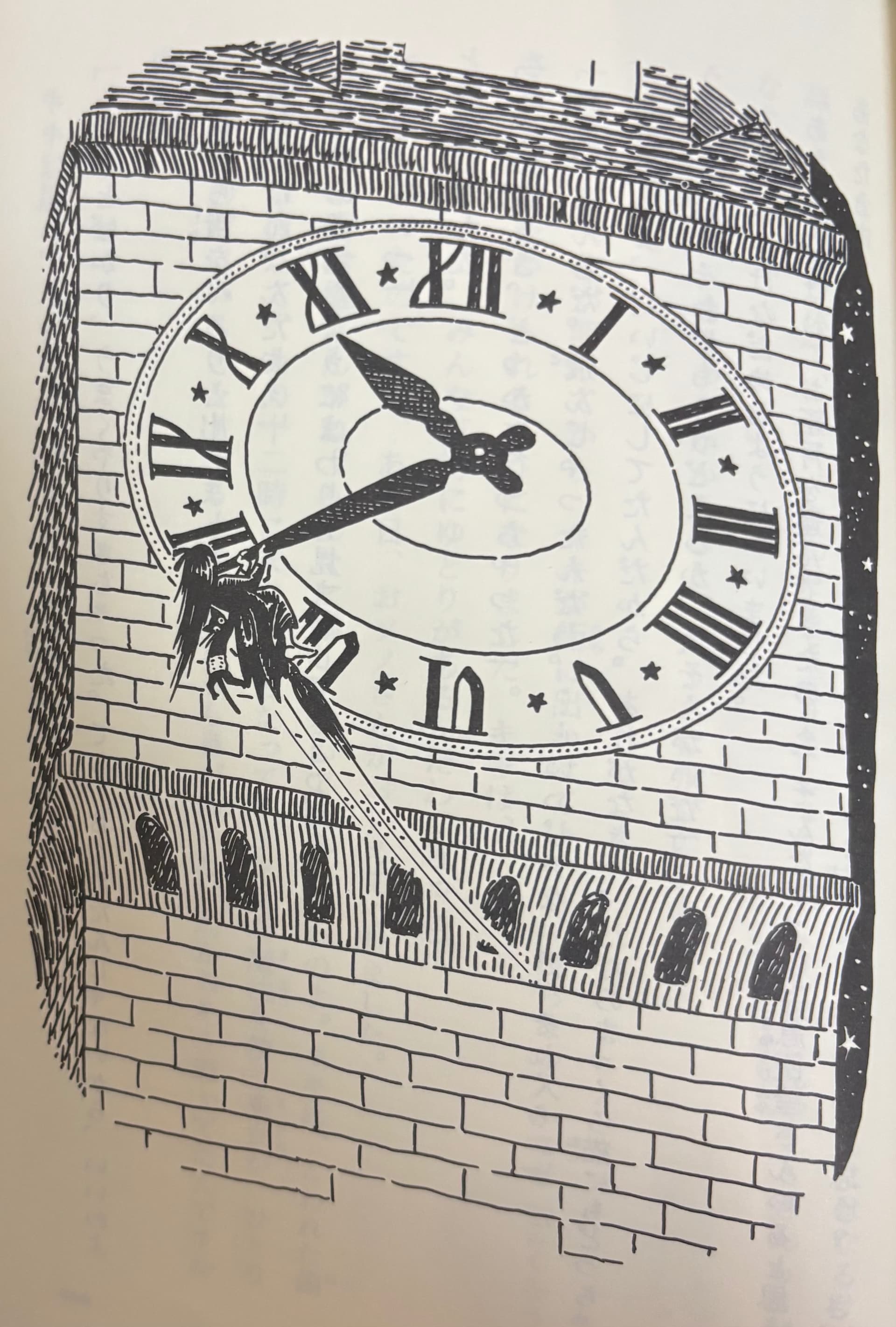
Realizing that this town is just like Koriko, Kiki tells Jiji that they can’t take the gear but that she’ll think of something. Arriving back at Koriko’s clock tower, the mayor urges her to quickly hand over the gear. She tells him not to worry about it, that she’s a witch and will handle it, and tells him and the clockmaker to leave. Then, she tells Jiji to help her, to hold on tight, and push her with all his strength. Straddling her broom, she takes off at top speed to the edge of town before turning around and, speeding up even more, rushed towards the face of the clock. Just as she was about to crash into it, she grabbed the big hand pushed it upwards until it hit 12 o’clock, causing the bell to ring out. At the same time, a roar came up from in front of town hall and sound of feet could be heard echoing.
Releasing the clock’s hand, Kiki is flung back to the outskirts of town before she is able to soothe her broom. She heads back to the top of the clock tower, with her hair all standing up and her brain feeling like it’s all on one side. Looking down at the town, Kiki watches the townsfolk running, with the mayor in the lead. Kiki and Jiji start talking, but then suddenly, he screams. His belly warmer fell off during their flight! Although devastated, Kiki convinces him it’s okay and that a normal black cat wouldn’t have been able to do what they’d just done. Taking off on the broom again, the two set off to run with Osono and her family, and to try to find Tombo and Mimi.
After the new year, strangers started coming up to Kiki and thanking her for a good job. Although she thinks it’s just because people are in a good mood, Osono explains that the clockmaker has been going around and telling everyone that Kiki fixed the clock and that it’s helpful to have a witch like her in town. Osono then adds that she’s proud too, because she’d already thought that about Kiki from the beginning.
First, a moment of silence for Jiji’s belly band.
Second, how did everyone find Chapter 9?
One thing I noticed was how the author described both the boat from Chapter 8 and the clock from Chapter 9 with the word あくび. In Chapter 8, the boat is described as 「…ぽかんぽかんというあくびみたいな音を煙突から煙といっしょにあげていました」 and in Chapter 9 the clock is described as 「まるであくびでもするように、コッチン、アッチン、ポッチンとなさけないひびきをたてているではありませんか。」
The reason this stood out to me is because typically in English novels, these types of noises would likely be portrayed as coughing or gasping, which would further emphasize that something is wrong with these machines, as coughing/gasping is generally associated with sickness or being unhealthy. Yawning, on the other hand, has more of a connotation of being sleepy or lazy, and being used in the context of machines, doesn’t immediately signal to me that something needs to be fixed. This got me thinking a bit about how certain behaviours and sounds have different connotations in other cultures (for example, how slurping noodles is fine in Japan, but bad manners in others, etc.).
I tried searching a bit on the internet to see if there were any particular article or discussion about あくび in particular in Japanese, but didn’t come across anything conclusive. I might ask some of my friends next time I see them if they have any thoughts. For all I know, it could also just be a style choice by the author! Anyway, if anyone has any thoughts or insight on this, let me know!
Also, here’s a picture from this chapter of Kiki and Jiji (before he loses his belly band!) saving the day:

 I’ve got N1 coming up in a few weeks as well, so hopefully all this reading is going to help me finish that in time.