
How do you deal with troublesome words/leeches/words you keep forgetting?

I don’t pay attention to these specifically, just keep learning them.
I remember some of these grammar points or vocabulary with the feeling like “oh I was struggling with this and now it is easy and I have something more complex to struggle with”.

I agree that up to intermediate level, things are simply to frequent/important, you need to get through it. However, if it takes too much time to learn it and you know another way to express the same matter, the ROI of learning that specific vocab or grammar plummets, it does not worth it anymore, you can ditch it. Otherwise you sink energy into learning something you do not need, instead of using the same energy to learn something new.

Once you get over intermediate level and start consuming the language, things will just line up like a puzzle, apparently by themselves. Obviously not, but this is how it feels.

I remember learning the tenses in English, especially the perfect tenses were so hard. Even when I went and passed the intermediate test, I knew like max 4 tenses. There are I think at least 12 :sweat_smile: Once I started to read in English a lot, like hundreds of books, my brain picked up the patterns and now I don’t understand how I could not understand the different tenses before.

For me the moral of the story is: first, trust the process, second, context, context, context, third, use the language.

Good luck!
1 Like

To elaborate further on this:

I realized this morning, while doing WaniKani reviews, exactly one example of this. I used to get 動 and 働 mixed up. So last time that happened, I created a new mnemonic: the first symbol is a subset of the latter. Meaning the latter is essentially the first one with couple extra strokes added. Then I noted that movement is also a subset of work (i.e. moving is a basic human executive function… working is more advanced/complex). And this morning when I got one of those for review, I remembered that comparison, and I nailed it.

Sometimes if I already have a “story” mnemonic (i.e. a silly picture I have in my head like all of the stories that WaniKani suggests), then I add another one on top, based on syllables or even simply characters in common (or rhyming) with an English word which is a synonym. I do not remember a concrete example here, but there was a kanji-based word that meant “foobarbaz” in English, and I had repeatedly answered (incorrectly) “quux” (but had “foobarbaz” also in mind, and I felt like I was picking between the two of them by chance). Well, the last time it happened, I noted that the kanji-based word was 3 syllables, and so was foobarbaz. So I added that as an alternate dimension of mnemonic, on top of the story based one I already had.

I’m at a point now where I realize mnemonics are expensive, and not every new item requires one. So I often just skip the mnemonics and blaze ahead, seeing how many I’ll just remember for free. When I get stuck, that’s when I start adding mnemonics. It doesn’t even matter what it is… I think the act of creating a new one forces your brain to make space.

It was kind of common for me to rush through vocab and brute force leeches. Sometimes I would take time to learn more about the word by looking it up on Youglish, Google images, Japanese Stack Exchange or find news articles with that word.

I started Wanikani and Bunpro in 2017, I have learned the majority of the vocabulary I know before the release of AI like ChatGPT. I now find it very helpful to use ChatGPT as a language learning tool for the moments when I really need it.

Often my leeches would come in pairs based on similiar words like:

  • 大西洋 - Atlantic Ocean​
  • 太平洋 - Pacific Ocean

ChatGPT was able to instantly provide a way to remember the difference by looking at the etymology of the words. 西 meaning west as the location in respect to Japan and 平 meaning peace (which is where the English word pacific comes from based on the calmness of the ocean).

These could have been worked out on my own by looking up the etymology but I now find it very easy to blast through leeches this way. Putting aside AI here is what you actually need to tackle for a word/grammar point you struggle with.

  1. Context - By far the most important. Look for the word in contexts that it’s actually used, now just example sentences but articles, books, scripts, movies, etc.
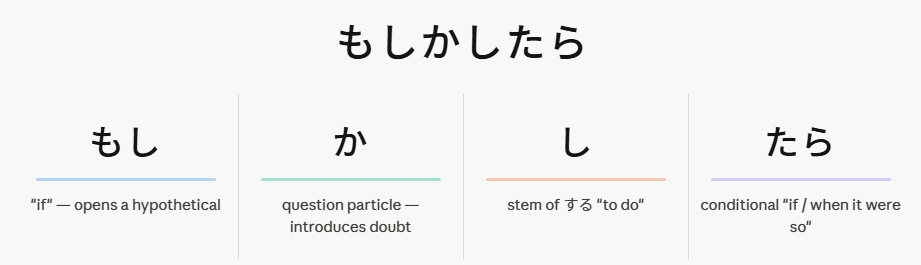
  2. Structure - Break down the structure of a word or grammar point into the smallest parts you can. Look at もしかしたら for example:

  1. Common collocations - Memorise the most common collocations of a word to see how it is used regularly. Here are some examples for ~する when used as verb meaning to to wear:
Japanese English
ネクタイをしている wearing a tie
メガネをしている wearing glasses
イヤリングをしている wearing earrings
マスクをしている wearing a mask
  1. Contrast - How does this word/grammar compare to others? Look for similar words, synonyms and antonyms. A lot of grammar points can be grouped in similar types (conjunctions, conditionals, etc.) Study similar words together and identify the differences.

  2. Make it relevant to you - Try and make sentences using the new words you’ve learnt. Try and use the words in a way that is natural to you that you would actually use in a conversation. Use your own experiences, interests or hobbies in your examples so that you can actually use it in a real life conversation.

2 Likes

agree it is far easer to remeber voca with some context. trying to create my own sentenses helps greatly too.

1 Like

Not the topic, but I feel like the good practice to avoid leaches is to add words that you need, and can immediately create sentence with. That’s how my Italian deck is being created, with a great success by the way, except that I don’t really do it much.

2 Likes

Recently I’ve been using anki to study some of those confusing words (either the ones that have similar meaning and I have trouble understanding to nuance and so they all blend together or just the random ones that don’t stick) and I used Jisho to look at a bunch of sample sentences all at once and then picked some to stick into my anki decks. Like others have said, seeing things in context helps you build more neural pathways to it and having a specific example can help you remember the word better in general. I was also using a transitive/intransitive anki deck recently that had pictures to accompany the example sentences and that absolutely was the best anki deck I’ve ever had.

1 Like

I haz been thinking about this one for a bit.

Somewhere around, I have a list a causes of troublesome learning items created by Piotr Wozniak who created Supermemo. A couple of big ones are the conflation of two similar items, and that a particular learning item is not truly atomic.

For myself, practically, I try to further atomize difficult items. So like, I very much struggle with complicated tenses. So things like the なくてはならない auxiliary verb that give me continued problems, I create a bunch of extra cards, breaking the item into parts.

Another interesting strategy by Wozniak is to completely forget about your leeches, and realize that if they are important you will find a reason and way to learn them in the future. As leeches, they are just sucking up too much time and energy. (I may be off in what Wozniak actually advised, but this is the way that it has stuck with me, and how I have continued to do things, decades later.)

I’ve adopted this approach with a category of items that has caused me similar problems: synonyms.

I’ve come to realize that when there are two words that are very closely related and separated only by subtle nuance, I’m not going to learn the difference using an SRS. A half dozen example sentences and/or an explanatory hint won’t get me there, and I’m just going to end up spending a ton of mental energy to no purpose. When I reach the point where I need to know the difference between 随分 and 大分, I’ll be in a place where that will make sense to me. For now, it’s not really necessary - close enough is good enough.

3 Likes

TL DR;

  • write sentences with this word
  • try to find some mnemonics you can associate with it
  • when you learn that one, try to recall it in shorter intervals
1 Like

Many people have already said what Ive done which is, if its important, it will be remembered. Ill use 点く as an example. I know what it means, I can read it, and when looking at the Kanji reproduce it. I can even hear it in context and understand it. But, because of my circumstances, I NEVER speak it. Its like a week one verb. Its a leech to me. As such, I keep very specific examples floating around in my decks because there will be ONE day I will need to use it and because of my examples I will remember it, and then NEVER forget it. Has happened a few times to me where Leeches just become known. But they are annoying.

As someone who is becoming an ESL teacher and learning Japanese from a Native Japanese person who became a JSL, we truly are lmao. No amount of learning really helps as being an outsider sometimes having had to think about the language and conform it into my head. Ill sometimes hit my N1 friends with questions too if Im really struggling with a grammar point.

1 Like