
I am mostly using Claude to sense mine books, based on a list of grammar points I know, if it is not on the known list it will mine up to 5 senses per grammar points.
The idea is to increase the engagement I have with the language, as soon as possible. here you can see the cards being created. Also, as soon as a grammar point is pick up by Claude as being on the book I intend to read. I add it on bunpro to get more info.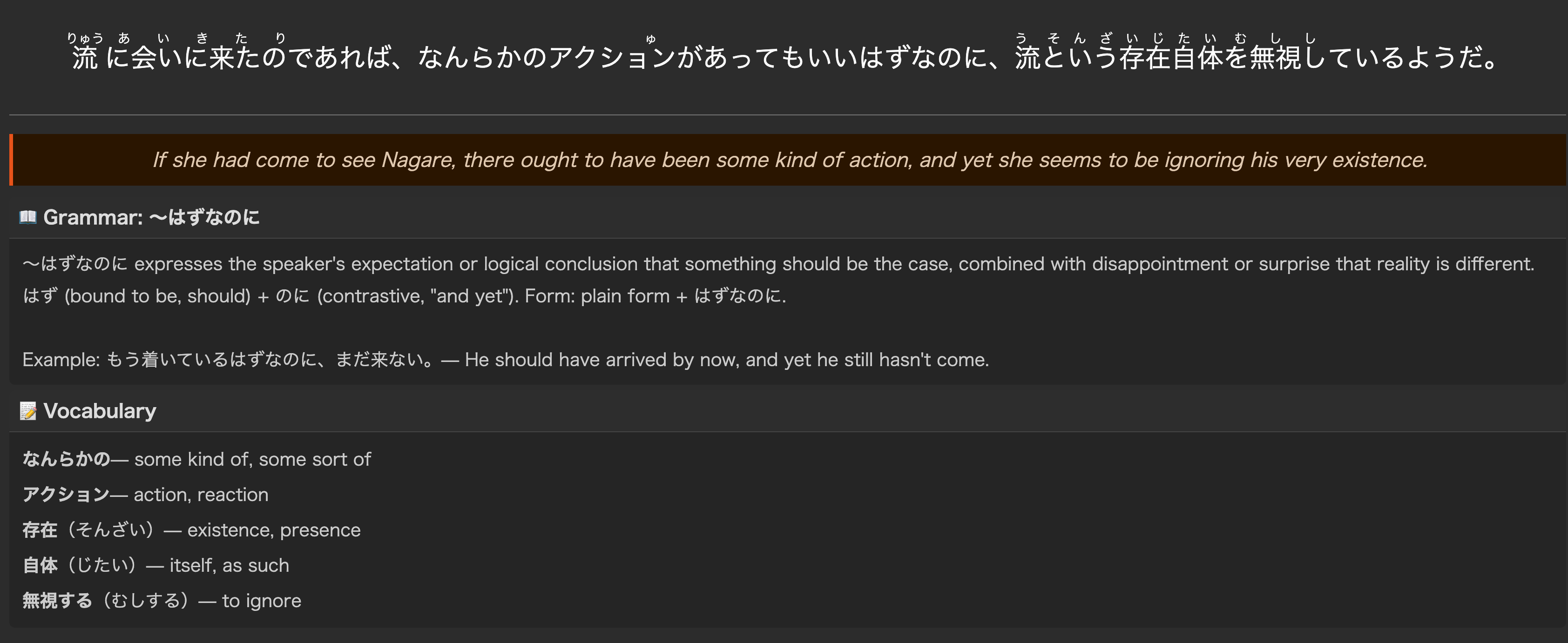
1 Like
Most people are non technical people, and I think that is the primarily factor of AI hallucinating for them in a language. If the prompt is constructed in a right way it almost never hallucinate, unless it’s rare slang or high literature expressions used based on books context, but there hallucinations are to be expected.
If one asks only one question at a time, about one entity, in a coherent manner, with no assumptions, it’s almost always correct
2 Likes
I agree with your point, but the problem is that I don’t really want to do a first pass because I find that boring. To me, it feels a bit like seeing the ending of a story before you actually get to experience it.
I am doing something similar with AI, I am giving a list of all the grammar points I am confatable with and noting to point any no on the list. I imaging it is imperfect and problematic, but it someone same be time, I am, in the end trying to spend as much time reading the book as possible.
1 Like
I would have agreed in the past, but reading in Japanese is so difficult that trust me, you won’t feel that way… not if you’re reading anything with any depth, that is. The first pass is more like scratching the surface and removing some mental load for the second pass. Ofc I wouldnt be bothered reading a whole book twice, but reading a page or two twice, definitely worth.
4 Likes
I use AI as a part of my learning and understanding process.
I am (slowly) working my way through Frieren manga in Japanese. For each panel, I see how much i can work out myself first. I write out the Japanese in a workbook, then try to diagram the sentence.
When I get stuck, which is most panels, I take a picture with Google Lens, then ask it to “translate into English and parse the grammar”, and it breaks the sentence down into what i need.
At that point, I’ll take the bits I didn’t know and look them up on Bunpro or KanjiStudy.
So, I’m far from reading at a native speed, but I’m reading to learn as well as for pleasure, and AI helps with that.
2 Likes
Fable 5 (which is a safeguarded version of Mythos) from Anthropic. Not from the US but it wouldn’t matter, the way the dept of Commerce worded their order, the only possible way to implement it is to pull the plug for everyone
No you’re not. I’ve clicked on that topic for the same reason
2 Likes
I actually only use Bunpro, google translate, and ChatGPT at this time. I cycle SRS with Bunpro. I farm the examples given as the sentences are usually way more difficult than the n4 level I’m studying and translate words in Google Translate individually. I then farm the sentence in GPT for a general translation. I think if I’m ever to progress I need to reed longer text.
1 Like
Yes you definitly need to read more.
Here is a good thread with a lots of resource (mostly free of all kind).
1 Like
I mean, there are two (minor) hallucinations in that screenshot. Like, neither would cause a huge issue, but if that’s just like a random screenshot, it’s probably happening often and with bigger things. (Usage of past perfect in center clause totally unmotivated by anything in the original sentence, アクション has an extra sense that is not accurate, which i even verified in my j-j dictionary.)
E: and this is a paid, “good” model that “hasn’t had these problems for years.” It’s genuinely funny that money guys looked at the AI business model and said “well this is the exact wrong way to build a tech business, this means cost margins increase at scale which is the opposite of what you want” and the AI guys were like “uhhh but it’s uh magic. Maybe it’s even alive, we don’t even know. We have to put safeguards on it (even though the only thing it can do is construct statistically probable sentences, which is true to this day, agents are a marketing gimmick) but don’t let it hear us” and the money guys were like “whoa, let’s commandeer the global economy to funnel you guys money” and then years later it can’t even give you an accurate list of vocab words.
7 Likes
As said earlier in this thread, properly writing prompts is a big part of extracting value from AI. It seems that most people can’t even effectively use google, which explains why so many people ask questions that could be answered in mere seconds with a google search. Figuring out how to word questions the correct way is apparently not as universal a skill as I would have assumed.
If you use a paid model and it starts hallucinating on you for simple requests, I’m more inclined to assume skill issue over the machine being faulty.
Though, sentence mining seems to be a waste of money for token-based AI services to begin with. Especially if you’re writing bad prompts for it.
1 Like
Well, he just didn’t use the right model and the right prompt obviously 
1 Like
Ngl I hate this idea that if chatgpt or whatever fucks up it’s always the users fault. Smacks of corporate apologism.
6 Likes
Its kinda like google. You’ll ask someone why they need you to google something for them. They’ll swear they tried, but when you google it, the answer is literally right at the top and you dont even have to open the link to read the answer written out for you in the title.
AI is just another tool to be learned. It really is user error most of the time at this point. The early models hallucinated most of the time but the products out there now are amazing if you use them right.
Google is also a horrible entity that deliberately obscures Web pages so I don’t know if the comparison holds up so well
6 Likes
I mean if one group of people can reliably get technology to give them what they want (google or ai or otherwise) and the others cant, I really dont see any other conclusion than that the difference must be user error.
As a software engineer, I remember early on in my career realizing some of my peers just could not solve issues on their own by googling what was going wrong. I cant imagine that many of those folks ended up sticking with SWE as a career. Being able to google correctly is definitely a valuable skill. Nowadays, that is more of being able to properly use AI and I think the same skill overlaps quite a bit.
Just observations from my experience, though.
How can you know you badly used an AI or prompt in language learning though?
That’s the main problem, as pointed by @prolezone there are a few mistakes in the anki card show above.
Even with good practise there is always a rish of error on the side of AI.
1 Like
Thank you, just this weeks a switched my audible account to japanese, and plan to listen to about a book a week at least. fingers cross that I will build my Japanese air slowly.
There is a saying in spanish “El que no sabe es como el que no ve” mean, he who doesnt know is like he who doesnt see. we all been on this suitaiton when someone has to point something obvious.
When it comes to the Topic at hands, I am aware of the issue with ai, and for learning japanese is one of many tools I am using, every informations has to be taken with a grain of salt. Poeple will tend to give various answers when given simple directions, or what about the worst of the all? the mandella Effect, in other words I trust AI as much as I trust poeple, lol not very much. but it is a usefull tool to keep me going. I will fixes what ever it gets wrongs as I learn the language more.
1 Like
Ok but there are SO MANY resources out there for Japanese learning that do not have any mistakes, or if they do have them, they get fixed by people who actually understand what they’re doing. This does not even seem more convenient than them. Jiten.moe lets you customize premade decks for stuff you wanna read, and when the text parser gets stuff wrong and links an incorrect definition (which are normal definitions from, like, a dictionary, written by people), there are people who can go in and fix it.
It seems to me like the only way to “extract value” from an LLM, as it was put earlier, is to understand exactly what it is. Which is not a thinking machine, but an algorithm that produces a statistically likely series of sentences based on text that is input. That’s not the product that’s being sold. They are selling thinking machines. So they add in a layer of traditional software to affect the image of a thinking machine, but that software can’t make the model capable of more than what that software is already capable of elsewhere. In the end you’re still left with what it is: juiced up predictive text.
Now, you can see why that’s useful for a coder. But coding is genuinely unique in this. There is a tolerance for the errors an LLM might make because first of all the program has to compile, second, you still generally have to document the LLM code as if it’s yours, and finally, the key thing, really, there is an existing infrastructure to test the output. There’s QA, there’s a polish phase, all that.
Nothing else has, or even can or should have, an infrastructure like that. So you’re left with a product that’s really only useful for a very small group of things that’s being pitched as the omni-product. The ultimate answer to the tendency for the rate of profit to fall. Virtually the entire apparatus of finance capital has bet its existence on this. It put the final bullet in the back of higher education. It’s permanently poisoned the information environment and turned every teenager into a plagiarist. What happens when people realize what it’s actually capable of doing? How limited it is?
What about when people realize how much it actually costs to use? People just repeat over and over “well costs will go down because of economies of scale.” They genuinely will not. The scaling curve is inverted. I have been talking about this for years. The first time I saw someone within the industry say it was this calendar year. People have only recently been made wise to what inference actually costs. It was essentially covered up. But really, that shouldn’t have mattered. You would expect people whose job it is to invest money would know how much stuff costs, and say “well that doesn’t make sense.” Too late now.
5 Likes
AI is an amazing tool for a lot of use cases but I don’t see the benefit for language learning because information that had effort to find and process, means you interacted with it more, hence it sticks.
I occasionally ask AI when I don’t understand something, but after having been learning Japanese for a while, I can confidently say that whatever was explained by AI sticks much less than things I looked up and processed manually.
I have custom GPTs for text correction. Like if I need to send a DM or an email or something in Japanese, I type it out myself, then I have a custom GPT ““app”” where I can paste it in and it’ll point out the issues. However, in about 30% of the cases, it messes up something in a different way.
Hence my trust in AI for EN<->JP related tasks is extremely low.
4 Likes