Its been a month since my initial post and that means I’m right in the halfway with my grind, ~3 months left. Dropping a small update in case someone is interested.
It turned out a bit long, so be warned.
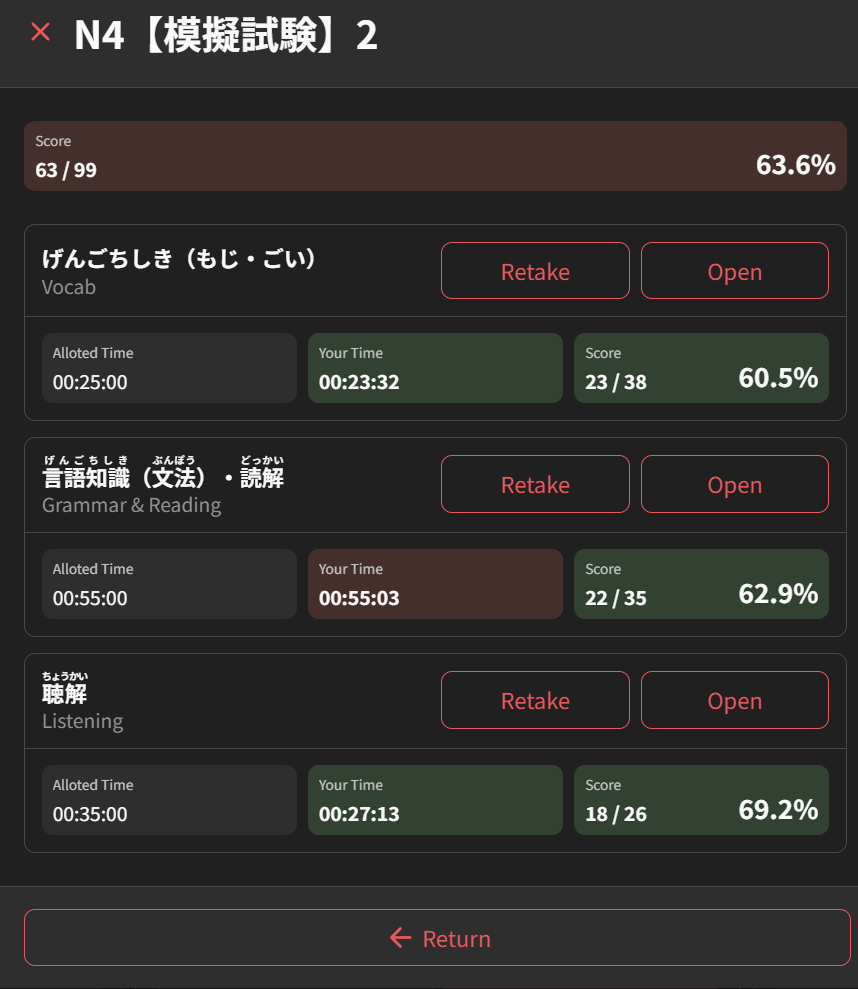
Closed the “chapter” by trying another N4 test, it’s nice to see some progress there.
Grammar
Since I already got the basics, I don’t emphasize rushing through N3 content that much. Lowering from doing 1X to just 4 new points / day sounds just fine and I expect to cram though N3 grammar points by end of February that way.
Vocab
I’ve finished my basic decks and It feels really good when daily review count for January went from ~180 down to 90 cards.
I’ve also recently found jiten with vocab bank for every episode from a lot of anime, so I’ve come up with this flow:
- Download 85% of the most common words used in episode
- suspend all cards with words that I could recall + cards for names and some rare words that i find not worth studying at my level
- go through the episode deck and “let it sit” for a few days
- watch the episode and see how it feels.
I’ve already went through vocab for a first episode, and will prob try to watch it sonn-ish.
Reading
I’ve picked up an old novel I tried reading long time ago (where I was trying to brute force with translator and dictionary). The difference is huge. Now I try to only look up the words I couldn’t guess from the context and sometimes I doublecheck more complex sentences on a translator if I get the meaning right. Trying to read 1-2 pages of it daily.
Kanji
Kanji was the star of this month, I wanted to reach 1000 kanjis on Kanji.garden and I’ve ended up seeing ~1050 of them. I think I’m familiar enough with 200-400 of them to be able to use them in the wild, of course.
While learning isolated kanjis might not be optimal way, the way the site works makes it really enjoyable for me and I do not find it tiring or troublesome at all. The exposure to that helps me greatly to differentiate kanjis in actual words on vocab review and of course guess the meaning AND/OR reading of words I have not seen before.
Listening / Immersion
I’m still trying to passively listen to some random japanese podcasts or J-Music whenever I’m not actively studying. Comprehension rate of couse varies on the content I get varies depending if its a “NX graded podcast” or some more natural stuff like street interviews.
I also try to watch 1-2 episodes of anime without any subtitles at all, to simply just go with the flow and accept that I won’t be able to comprehend 100% of the stuff going on there.
I’ve also tried gaming in Japanese. Arknights came out and the controls were pretty intuitive, so besides option setup it was rather smooth. While I could guess what was going on with the story with dialogues, which wasn’t that hard to understand, rest of the stuff had a lot of custom names and tech-related terms, which made no sense tryharding at it. I’ve reverted game lang to English and kept voiceover in Japanese. I simply try not to read subs for dialogues and it seems good enough.
Writing
Every night, I’m having a chat conversation with AI in Japanese where I try to talk about myself, state my reasons, give a short summary of what happened today or replying to questions to keep the conversation going and so on. Also I’m getting a quick check for mistakes and weird wording with suggestion how to make things sound more natural.
Since I’ve already got the base vocab and grammar going, It turns out surprisingly well. It’s not perfect, but it’s quite easy to understand.
I’m also slowly filling up my section of “Sentences that might come in handy”, but I find it more fun to talk with chatbot 
Speaking
I’ve tried some shadowing, but for me it’s the most tiresome not-fun part of my learning grind. Sadly, I still can’t produce japanese in my head quickly enough to be able to freely speak, but if I take a longer while to prepare a sentence or two, it kinda works.
From time to time I still practice by example sentences an read out the chat messages I’m writting. Even if speaking is my ultimate goal, I was more focused towards other parts of the Japanese, since its the foundation to be able to speak correctly.
Fun stuff
There is a Japanese school nearby that was recommended for me. Since they start a new group 2 times per year and I was kinda late on on fall group, I decided to attend a example lesson 2 weeks ago.
Of course it was about absolute basics, but after lesson I explained that I’ve started learning by myself 2 months ago and that they offer a test to measure my current level and also invited me to attend the group that started last fall.
On that lesson it was the first time I saw a textbook, been asked to do some exercise and actually speak for the first time to someone else (Was harder than expected). I tried really hard to hide “my power level” to not discourage others, and I think I did pretty good there. Ended up giving up some easy to learn things that were outside of the scope of the lesson though 
As for the exam, they measured my level to be somewhere around unit 30 for 皆の日本語 book, but as I’ve expected, my way of studying is not compatible with classroom experience. Neverthless It was a very fun one though.
Plan for February
- Finish N3 grammar (~4 grammar points/day)
- more native content without subtitles (I won’t have them in actual conversation)
- keep up with novel reading
- shift focus for this month on writting / constructing sentences
- more speaking practice
- Get 2 - 3 calls with Italkie to see how my speaking and pronunciation is (still pretty confident in Polish baseline )
3 months left, I’m curious how that gradual shift towards speaking will turn out.

 - on the other hand I took preply lessons once a week mainly for conversation practice because I felt like I otherwise have no way to practice output whatsoever.