Any dangers in speedrunning Japanese? I went too hard during a party and basically woke up with tickets to Japan

Hello there,
Yes, topic name is a bit clickbait-y but long story short, that’s what happened :sweat_smile:

I started my learning journey in early November and the deadline (actual journey) is on May 2026. So it is around 6 months to learn the basics.

Goal? Having to rely on apps like Google translate in every interactions sounds too frustrating for me, so I’ve decided to get as proficient as possible. Basing on absolutely zero research regarding that, I guesstimated that N3 level is something I want to be able to go with.

And here goes the main question.

Aside from obvious cases like burnout or getting overwhelmed by SRS reviews. Are there any risks in trying to learn too fast? My guess is that some kanji/grammar that I’m learning would mix with each other and slow down learning rate. But then again it still should be faster than limiting the items studied. Is there anything else that comes to your mind?

As for my prior experience with Japanese:

  • I watched a lot of anime, but didn’t focus on language, just enjoying the show w/ subtitles
  • picked up a Doulingo course and been doing it for like 500 days, but I don’t feel like i’m learning anything significant there, it’s just green owl guilt tripping me to keep the streak going. I learned katakana/hiragana and absolute basics there though .
  • found an 1,5k words Anki deck 1 year ago, but I eventually got bored after 5 months or so. In hindsight the biggest mistake is learning just words back there. With zero grammar knowledge I still couldn’t understand or produce any meaningful sentence and ended up dropping it.

And now here goes the speedrun. In nearly 2 months:

  • unloaded my 1300 card Anki backlog while adding 10-15 cards a day
  • actually started to learn Kanji, adding 15 or so per day.
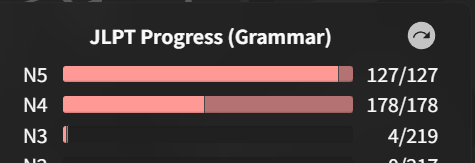
  • Found Bunpro and rushed through N5 and N4 during my trial period that expired yesterday :smiley:
  • not interested in actual JLPT exam, but went with Bunpro’s mock N5 and I had around 90% things right. Maybe I’ll try N4 tomorrow or so to see the gap.
  • tried to watch some anime and translate 90% of the dialogue to test myself for comprehension and Anki vocab mining, but after 1 series (blind pick on 四月は君の嘘) I limited myself to ~10 words / episode. One episode took me around 4 hours and that was too much even for me.

Also beware. The more time you spend on episode, the more attached to story you might get.

As for other things, I’m trying to cut some corners for now.

Kanji

Full skip on kanji writing practice. Trying to learn 10-15/day of them via SRS. (readings/meanings only)

Pitch accent

Skipping on pitch accent for now, I hope I will be able to replicate it by mimicking the native speak. If not then I’ll simply evoke my 外人 card and job’s done.

Speaking

Skipping speaking practice for now. I feel like Input is way more important early on. I need to be able to speak in exactly May, not ASAP, so I’m going to utilize that. I think I will book few sessions with a native later on and see how things stand.

Listening

Trying to listen passively Japanese music or some random podcasts while I’m not actively studying. It’s aint much, but its a honest work. However’ its hella satisfying when you listen to the same song for 90th time and every time you manage to recognize a new word or understand a verse from lyrics.

Writing

Taking it slowly, I’ve recently started to write one sentence per every Bunpro grammar point. I’m trying to write down sentences that I might actually use later on. Memorizing X phrases sounds like good idea. It’s something to practice speaking later on.

School stuff

  • no private tutors
  • no classroom learning
  • no textbooks

I bet you are wondering how much time do I spend on my studies, so it varies between 3 and 18 hours a day.
Yes, I have a job, and Yes, I have trouble sleeping :smiley:

going back to the topic

Is there anything I should look out for, that I have missed there? Any tips would be appreciated.

Thanks to anyone who went through and actually read all of that. That mix of bragging and venting out was really refreshing. I feel like I’ve did a some kind of self-therapy by accident

If you any questions feel free to ask, but I can’t say I’m experienced learner. English is not my first language, but I learned if from video games and school, so it doesn’t count :upside_down_face:

3 Likes

Bro you’re in a hurry that’s crazy :sob:
But the thing is to answer and maybe help you a bit if i can is :

  1. There’s multiples dangers into speedruning japanese, such as accidentally burn yourself or even get to resent the language (you don’t want that to happen).

You’d maybe ask yourself "Why?"

You know when you eat too much? You can’t eat anymore and don’t want anymore food? Same thing as japanese. If your brain eats too much grammar/vocab, it will just resent at one point or another (hope that won’t happen to you before your deadline comes tho)

Also, another thing to keep in mind is SPEAKING :

  1. Speaking is actually super important, you don’t wanna miss that out (at least for me : I always stutter when trying to speak, even if i know the grammar and vocab). I don’t wanna look bad to people stuttering over words, and i guess you too, so I would say if you have the time for it, go train to speak, even a little.

BUT you already have a good “foundation”, with all that anki and duolingo stuff, even if this is only basics. Just remind yourself that the japanese learning process is a “marathon” not a sprint.

Now about aiming for N3 by May ー it might be too ambitious, to be honest with you.
I see you’ve got some bases with Anki and Duolingo (you’re not starting from zero), but N3 requires a pretty solid understanding of grammar, reading, listening, talking and vocabulary.
I wouldn’t say it’s impossible, but the timing you’ve got is very tight (6 months is not a lot for a N3 level)

But look : if you keep your regularity, you can get a solid understanding of N4 by may, and I found that this is already quite good for everyday conversations. Thinking like you’re in a run isn’t “healthy” for your brain. Japanese needs regularity, and if you’re regular until May, you could easily reach N4 as I said just before.

You got this :muscle:

1 Like

Is your goal to use Japanese as part of your daily life? Or is it to be as proficient as possible before your big trip? Both are fine goals, but if yours is the latter, I would recommend scaling back your expectations and adjusting your study habits accordingly.

Bunpro, Anki, etc. are great for studying the language holistically, but are not super efficient at training output or understanding within contexts that you’ll be placed in during your time as a tourist (directions, buying something at a store, small talk etc.). I would honestly recommend textbooks if that is your primary goal.

The vast majority of tourist spots in Japan have been 100% 英語 friendly in my experience. You probably won’t miss out on any important communication by knowing minimal Japanese unless you’re just aiming to chat up locals for a couple weeks.

I would say it all just depends on your end goal. If your end goal is to have a rough feel of the language and to be able to read random stuff with a low confidence rate, frequently mix up kanji and readings, this is a good path.

However I think this is going to be have a negative long term impact for your language learning. I would say this is going to set you back in the long term. You are likely cramming to much in to be effective at forming long term memory, you are going to be more likely to learn things incorrectly and have to relearn things later on. Which makes learning a hard language even harder.

Putting off speaking is a bit confusing. It seems like you want to possibly speak Japanese while your in Japan however speaking is one of those things that are easy to put off but turns out harder then expected. I would recommend 1/4th of your time spent should be just doing speaking so you are at least able to utilize what you know.

I would recommend learning as many popular phrases as possible either way.

Coming from someone who went to Japan for the first time earlier this year, you can easily get by in the tourist areas without knowing any Japanese. Train stops are spoken in English. Most restaurants have English menus. ATMs have English options. I’d follow what charlezu said:

No clue the best way to do that, though.

Yes, burning out is a real thing. It kinda happened once for me before, but then it was a YOLO attempt without goal. Now I have a clear goal and you even with things being 5 times as intense as before you know what?
I find it actually fun
I find it fun seeing how that funny bar was filling while I was loading up on extra lesson image

I find it fun when treat words and kanji as a mini riddles.
I’m honestly having fun when for example when I realize that 写真 copy-truth actually means photo. Or when one chinese person 9999 years ago decided that a 氷 ice + 妻 wife means terrific 凄 .
I like the dopamine boost in my head when I cram in 20 kanji over the day just to “unlock” them and see how the number goes up. Of course it takes extra time to “digest” them later on but it is what it is. I think gamified my Japanese learning experience to the next level :joy:

I figure out that I might be lacking on speaking part, but there are 2 things for me:

  • It turns out that my mother tongue (Polish) in pronunciation overlaps in like 90% of cases. When I speak to myself with some basic phrases (and record) I feel like I sound “good enough” to not embarrass myself in that matter.

  • I find it less “fun” than the parts above, so it’s a bit harder for me to get myself to do it. but around sometimes I find myself imagining a situation that could happen on my trip. Technically its not speaking, but I feel like speaking using my “inner voice for thinking”. It feels round a bit roundabout, but with hand gestures in that imagined situation I think that anyone that actually wants to understand that type of speaking would get it no problem.

  • I’ve tried some shadowing too, but it didn’t clicked for the same reasons same as above. I kinda feel bad when I have to use someone else’s words. voicing you own thoughts and feels 999 times better, even if its really hard atm.

@pringus @charlezu
As for my reason to learn, here is a list of them in random order:

  • I feel like it’s extremely unpolite to not try to speak in basic local language in country you are going to

  • I have a bit of spare time in life and I wanted to challenge myself

  • Japan is praised and is highly rated for its culture and how vastly different it is compared to EU or NA. Since I decided to move my lazy a**, so its best to experience in most immersive way possible, that includes basic cultural nuances and crawling around izakayas and getting along with locals. I don’t like the idea of watering it down with English, if possible.

  • As Polish is a really hard and niche language. Every time we see a foreigner who is trying his best to utter a simple phrase in our language everyone feels happy and praises that person on how good their speaking is. I think Japanese people feel the same way when someone goes in and tries to say “ありがとうございます”.

During my studies I noticed that the moment when a word/kanji/grammar point appears in System A (for example Anki) and then later on I spot it in System B (Dulingo), quite often it clicks for me instantly and then I suddently start to recognize that word in anime songs, and so on.

Back in November I decided to divide my time in 3 parts. End of 2025 is grammar/vocab focused with N5-N4 grammar and watch anime.

In Jan/Feb I plan to start working on output more, ( In fact, I started today). One sentence that might come in handy for each grammar point. It will be a solid compilation of “graded sentences” to learn speaking from. And grammar reinforcement of course. Goal is to write new sentences while practicing the existing ones.

And I want to do Bunpro N3 grammar over these 2 months (~4-5 grammar points per day should be a breeze after having 16 - 20 of them daily) and watch some anime.

I also plan to read a one light novel that I have my eye on, but its more because I want to do that, not that because I might learn something from it :smiley:

As for March - May, my time will be greatly limited, but there I plan to keep my SRS rolling, attempt mock N3, get in touch with some natives to finally have someone rate my output. Aside from that I plan to watch some anime, but idk if I mentioned that already.

Long story short. I know its overblown and probably not the most optimal way, but it looks fun! As per your feedback. I will try to emphasize speaking more, so I won’t be blindsided by it :smiley:

You’ll get a speeding ticket from the learning police /s

But seriously, if you want to make the most of the trip, I’d skip N3 grammar, LNs, anime, manga, and instead focus on phrases and vocabulary you are likely to encounter and use when speaking with people.

Mine sentences from all kinds of “everyday conversation” youtube vids, try to write your own dialogues, imagine you are trying to chat in an izakaya, tell a story about your cat, plug all vocabulary and grammar holes you run into.

Make it a habit to speak keigo/tameguchi where appropriate so as to not make people too uncomfortable.

1 Like

I’d skip N3 grammar, LNs, anime, manga, and instead focus on phrases and vocabulary you are likely to encounter

Knowing myself that would be a recipe for a potential burnout :sweat_smile: I think that having diverse sources of content is what allows me to run at that pace with a smile.
Everyday conversations is my go-to side screen video while I work.

As for keigo I didn’t mention it, but luckily, my language have a very clear formal/non-formal separation in language with different sentence structure, verb conjugation and so on. It’s not as broad as Japanese, but I think I’m covered on that aspect

1 Like

The thing we speedrunners miss is usually that quality bits quantity.

Learning 15 words a day by simple smashing them with SRS is one thing, but learning 5 in many context, by slapping them directly in your long term memory to what you already know will reinforce most stuff there is and make this new connections super strong.

Don’t just learn any kanji. Learn only kanji from the words you know, where of of the thing you test yourself is recalling the word.
By learning random kanji you are just creating small connections that won’t work fast enough and will be easily brakeble.
Writing is super beneficial as well, maybe only once every time you review a card.

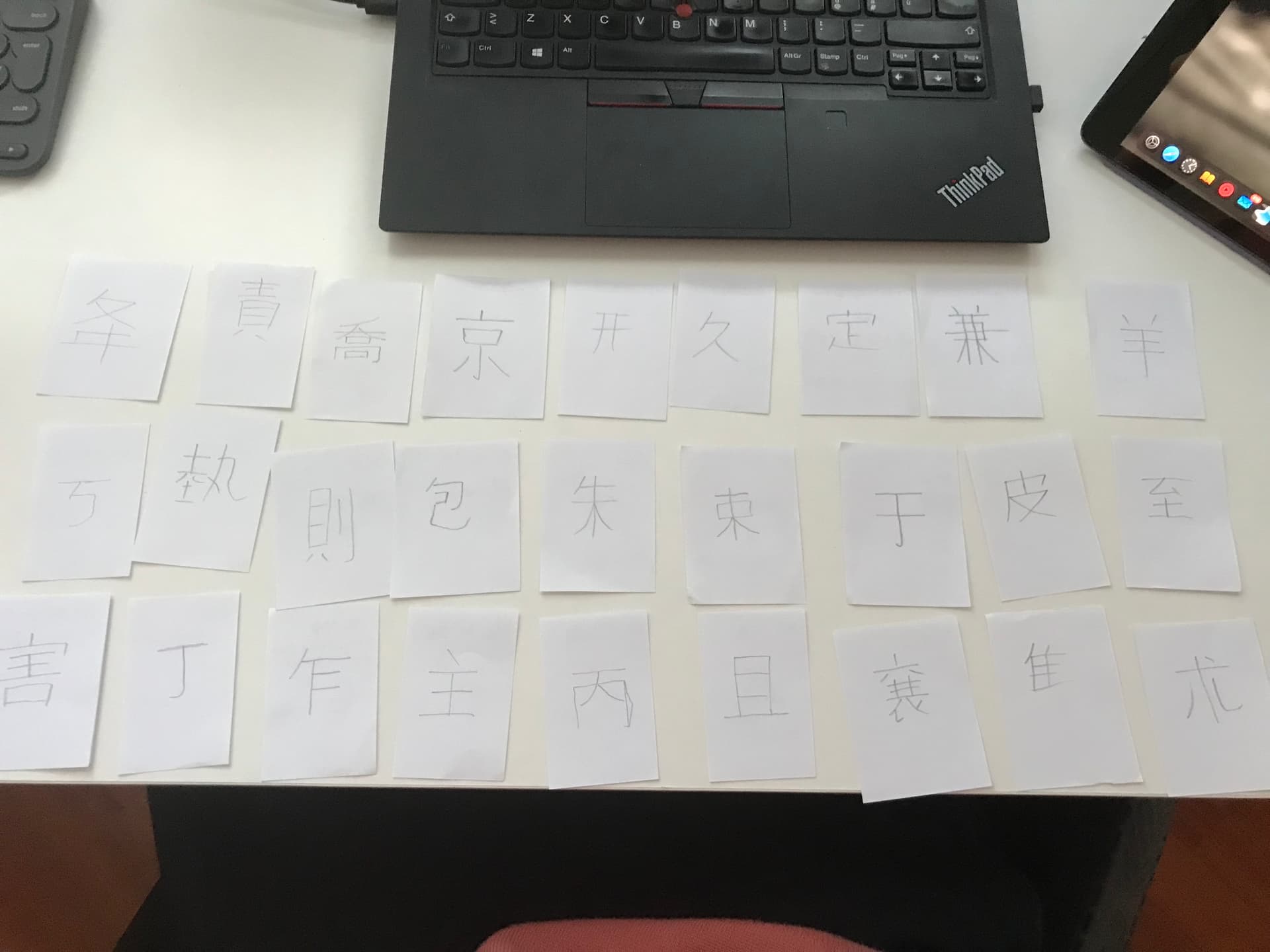
Learning most popular sound components by themself can help thou. For example like these once:


It’s just my list of what I wasn’t quite sure recently.

If you learn a new word, the most critical thing that people miss is the place, place where you’ve meet the word. If you see the word and can remember “I’ve seen this one in that text 2 days ago” it will benefit massively, immensely.

Reading/watching material with only 1 new word per every few minutes should work the best I believe. It’s again about quality over quantity.

Speaking helps getting much better with recalling words, and generally with words, which has a great effect on the ability of remembering words. If you can pull out of yourself a few words that share the root with the new word, it means it will be very easy to learn and it will make sense in a scheme of things.

1 Like

I am speedrunning, myself, and it’s totally possible to be successful with the right motivation.

Bunpro is great for many things, but it isn’t going to give you what you probably want as a tourist looking to engage with people around you.

For context, I live in Japan. I was in Tokyo for five years and now live in the middle of nowhere in Ehime.

Hands down, the fastest way to get strong with Kanji is Remembering the Kanji. It’s a textbook that many have used with Anki to build a very fast system of knowing kanji (not their Japanese pronunciation, but English meaning). I’ve heard people doing around 3,000 in 90 days (there is definitely context for that that I encourage you to look up).

As for speaking, you want words in context. Bunpro sort of has that, but it’s not at all memorable. Something like Migaku or Fluent Forever does an amazing job with this. Migaku syncs with shows you watch, and Fluent Forever is a bit more customizable.

Bunpro is pretty much the best for JLPT prep and arguing with people who think they are grammar gods.

I don’t think wife has something to do with meaning here. It’s rather just a sound component as in:
凄 【セイ (サイ)】: bitter cold, miserable, dreary
淒 【セイ (サイ)】: bitter cold; miserable, dreary
棲 【セイ】: perch; roost; stay

By the way it’s origin meanings.
On the other hand this kanji is fun by itself:
“ 妻 【サイ】 depicts a woman (女) and a hand (彐) pulling her away by the hair, indicating the original meaning “wife.” This refers to the unhappy ancient practice of taking women from conquered peoples and bringing them back as wives.”

If you’re at 90% of N5 you know more than enough Japanese to get by as a tourist and impress locals.

I went to Japan a couple months ago and had the same idea as you, but I was utterly delinquent in my studies in the months prior. It would be self aggrandizing to say I was N6 when I went. Still, the Japanese people I spoke to were so grateful for my attempt to speak their language and observe their customs that I came home with a greatly improved motivation to learn their language out of gratitude for their treatment of me. I expect you’ll have the same experience.

I really got the impression that most tourists don’t learn even the most basic of Japanese before visiting. I mean just being able to say excuse me and thank you in Japanese puts you on the right side of the bell curve.

In my experience, I got the most use out of gesturing towards pictures on a menu and saying “kore o kudasai”. That let me eat at some restaurants that weren’t super touristy. I was also able to ask people if they spoke English (please do this before talking to a Japanese person in English) and if there was an English menu. I also got some use out of being able to gesture towards something and say “sore wa doko desu ka”. This was more than enough to have a great time as a tourist. Japanese people seem to not expect foreigners to speak any Japanese. You’ll be warmly received. I went to Tokyo, Osaka, Nara, and Narita . Maybe more rural places will give you a colder reception, but I couldn’t say for sure since I didn’t stray too far from the well traveled areas.

Keep studying, don’t stress out about your Japanese level, don’t burn out, and I’m confident you’ll return from your trip with greatly improved motivation to study.

But ye, I guess the only thing that metters is if you can concentrate (means you are having fun on the process, it’s interesting, hard enough, and not too hard, etc). So if you feel like Bunpro or anki are making your brain fly away, it’s probably time to give them up for something new for the time being (my experience that worked out really well)

@homa @Shneeki
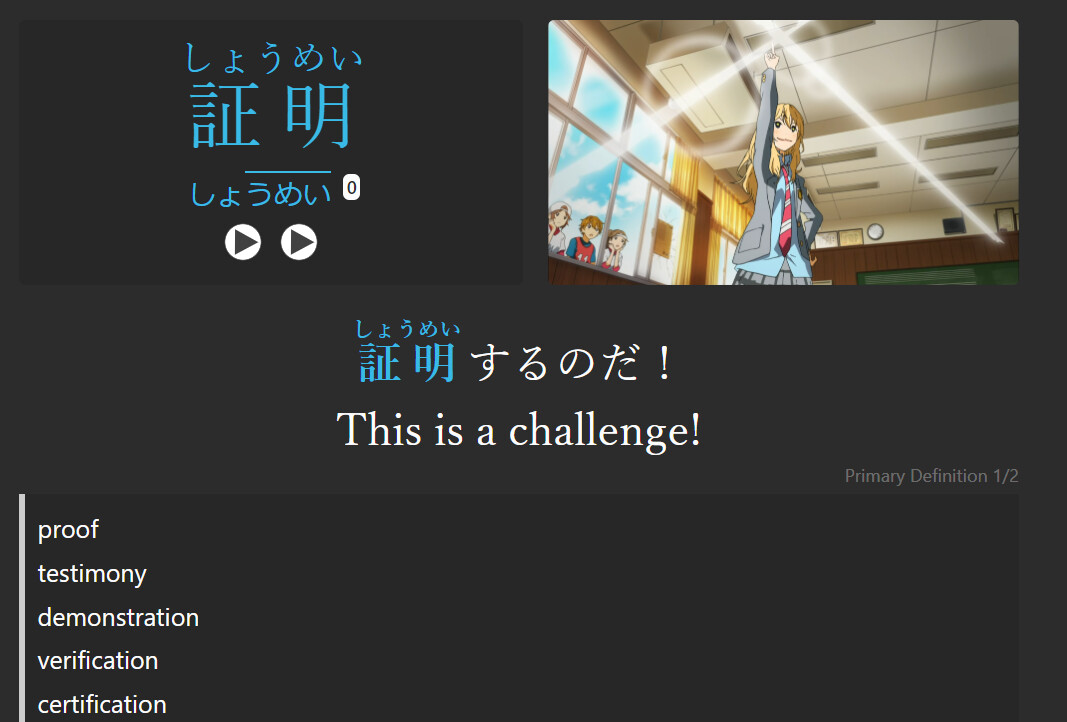
Getting the context associated with the word works wonders, I 100% agree! I’ve cooked a solid setup for mining myself. Using Netflix, Langauge reactor chrome addon and yomitan. gives me a quick way to fill up my deck.
example card:


back:

I end up with screenshot from the scene, audio clip of the word from JMdict and audio clip from the anime in it’s “natural” context. When i see a word added like that i tend to remember the anime/episode first and then actual context :smiley:
Not sure if if sticks like that 1 month in.

Self repeating during Anki review feels like an obvious thing to do, right? especially when you have audio clip that is not synthesized or AI-generated.

I don’t think wife has something to do with meaning here. It’s rather just a sound component as in:
凄 【セイ (サイ)】: bitter cold, miserable, dreary

As for kanji learning, I’ve randomly found an Kanji.garden website. Kinda got hooked on that because numbers go up. I’ve noticed some kanji radicals have either semantic or phonetic tags, or just there are without bigger context. The good thing there is that their learning order is not ordered by N5 then N4 and so on, but they tend to group kanjis that look similar next to each other. like these: 使 更 史 便 吏 丈 and forces you to learn to tell the difference right at the start. Like with other sources. When I encounter a kanji/word I’ve initially found somewhere else it clicks with 5 times the effectiveness. To me, I feel like the word has been “Acquired” in exactly that moment.

@coltrez that’s very reasurring to hear. Getting that “not very touristy” experience is exactly what I’m aiming for. Especially that I plan to travel around solo for 75% of the time there, roaming around the Japanese Alps.

@homa

So if you feel like Bunpro or anki are making your brain fly away, it’s probably time to give them up for something new for the time being

What do you mean, having 4 hour long session with dictionary in hand for 23 minute anime episode is the content I thrive in.

Also sometimes, I tend to pick the song that youtube algo keeps bringing up to me and try to translate the hell out of it for comprehension.
Reasons:

  • fun
  • they often drop particles in songs and they are more vague overall (extra challenge)
  • if you keep listening to the song after that (for me its 2-5 times a day, because my youtube is weird) you have graded content tailored for YOU, where you have encountered the meaning/translation of every word there
  • it’s a chance to picking up up vocab that’s outside of your regular graded vocab.

you just need to be careful to not end up saying some weird stuff like
“このは恋人の手の温かいみたいにパンをください” in grocery store :laughing:

1 Like

So in short: it’s pretty unrealistic.
If you don’t plan on taking the JLPT and youre just using it as a guide, understand that each level is exponentially harder than the last. So N4 (most likely) will take you double the time to fully comprehend than N5. and N3 and will take at least double the time for N4. Just for reference, if you were to take Japanese at an American University, to get to N4 would probably be about 3 to 4 semesters (almost 2 years) This is just a generalization, and yes I personally think it’s too slow. So maybe you’re a lot more motivated. That being said, getting to N3 in 6 months possible but quite unrealistic, especially if you’re not in Japan. I personally went to a Japanese Language school in Tokyo for 2 years, and the best advice I’d give for learning the most in the shortest amount of time is build habits. You NEED to study/learn everyday. I didn’t even study that much when I was in Japanese school, and I really felt myself slip behind my other peers, even though I had full Japanese immersion and going to class 5 days a week. You’re motivation level is not the problem here. Burnout and bad habits are your real enemy. You really don’t wanna speedrun this. This is marathon not a sprint. You NEED to pace yourself. Of course, I don’t know what that’s gonna be for you, but in general make habits that make you study everyday (however long that needs to be without overdoing). In addition, talk to yourself in Japanese, maybe write in a diary about your day or literally anything.

I also think that you really don’t wanna skip out of speaking. When you don’t live in Japan, i know that options are limited, but actually talking to people is where you’re gonna polish your fluency and learn the words and grammar that are actually useful. But if private tutors (like italki) really aren’t an option, then skip the anime. Watch mostly reality tv (like terrace house on netflix), youtube vloggers, or people that livestream on twitch or tiktok. You want to be listening to real people talk. What people don’t explain is that in anime and even a lot of jdramas, they use a lot of “flowery” language is almost never used in real life. It’s good for immersion but not practical at your level. This mainly has to do with the fantasy writing culture. In general, find media that is more “realistic.” Listen to actual japanese people talking. not a character. Copy them. copy how they sound and all the tone, pitch, inflections. JapanesePod101 has good podcasts for learning and listening to audio conversations.

Overall, do NOT look at N3 as a deadline you need to me. Give yourself time and give yourself grace. Learning will not be linear. Some days/week are going to be harder (much harder) than others. But it will be okay. You’ll be okay. And you’ll have so much fun in Japan. Just keep at it.

1 Like

I like your approach, it’s pretty standard but seems healthy enough if you can control it so you don’t overwork.

What I wanted to convey is that it’s rather the work of the brain.
Connecting new stuff to what you know.
For example if you know word 基本 you can notice that the sound element here is 其 which gives キ sound for like 6 more kanji and ゴ to one.

  • 期 【キ (ゴ)】: period of time; date; time limit
  • 基 【キ】: foundation, base
  • 旗 【キ】: banner, flag, streamer
  • 棋 【キ】: chess; any game similar to chess
  • 欺 【ギ】: cheat, double-cross, deceive
  • 碁 【ゴ】: chess; any game similar to chess
  • 箕 【キ】: sieve; dust pan, garbage bag

Sometimes it won’t be that obvious but it will be comething like きょ、げ、げき (劇、慮、嘘 etc, all have slightly different readings, but it’s all from 虍 (コ I guess). You don’t have to learn each of them to make it super useful while learning vocab, just know well one and other will stick to it (knowing well meaning if you see it’s component somewhere its better to recall the word and kanji, and better visualise it in a split second)
And the meaning is almost always comes form the meaning complement.

If you can create strong connections for just a few kanji, it opens doors to many many other kanji, with not much effort.
I really go against learning kanji in isolation, it really cuts of the benefits of place context and word context which are very fundamental. I can not recommend it if you connect one kanji to it meaning and reading just by brute force memory or mnemonic that is not based on existing knowledge and making that knowledge bigger so it gets easier to learn new stuff. Deep connection remain for long long time, but learning a lot of kanji on a surface level can lead to a los of some time (for me it’s like 150-200 hours, no regrets thou)
Basically what I’m trying to do here is to make reinforcement feedback loop work.

By the way this article helped me to understand kanji a lot better: Kanji Radicals in Japanese. Don’t Do It. – Outlier Linguistics

1 Like

Oh ye, another thing.
As a speeedrunner I can recommend against anki.
I feel like it has a critical flaw that makes it unusable (in effective way) more then 2-3 weeks if you like more then 30 minutes. All cards are the same, when you review your brain basically deels all the time with the stuff it has already seen many times, cards do not evolve and do not change while you do (huge W to bunpro here btw, but still can be much better I feel).

If we agree that context and place of the card is the thing that makes it click, we could use anki just as a storage of contexts for word. Adding every word in sentence you did understand (you have to know why it was said and remember this moment well for this to work) and next time seeing this a new word, you’ll look it up and see that it’s already there, so you can think for a bit and try to remember the place, then check.

This way you always del with something new (content) while having sentence example for words and it’s context saved to learn them when meeting again.

Unfortunately I don’t have one deck with a bunch of words, I have like 40 deck with some words in different stiles, but I’ll be trying to create one like that and maintain it, interesting how it will turn out, definitely better then doing it without that. And ye, I guess I’ll be adding word every time I couldn’t remember it, even if it’s already there (to have more context and sentences)

Anyhow, I feel like anything you do will work out for you so keep it up!

1 Like

Thanks for the article, it made me realize the difference between the Component and Radical :smiley:. Up to now my understanding was:
Radical - a component that does not exist as individual kanji
Component - a component that actually acts as a standalone kanji

Sorry for the confusion :smiley:

First first attempt with anki was 100% vocab, 0% kanji. I was kind of brute forcing through and had a lot of issues. usually i went with something like this:

Okay, this one looks like a face, and it usually is something about emotions or sensations, and it’s something like かん or たい

back then I actually wasn’t even aware of kunyomi and onyomi readings, so you could guess how bad it was.

After starting again seriously I intended to not do the kanji, but my friend sent me that (https://kanji.garden/) and it feels fun to click through.

Having my initial vocab in hazy memory made it even easier to process through the kanji. In exchange, getting over these +1k plus reviews was way more productive because I actually noticed some kanjis are really the same and I know all of their readings now.
Before that I was hard to tell difference between 待つ and 持つ so it was easier to be frustrated

Right now its VERY satisfying when you encounter a new word and you actually manage to guess the reading and meaning, because you saw these 2 pieces in different words.

it really helped to sort out my anki, I’m processing through it like 3 times faster than before.
Pardon the interface language, but if you used it you know what’s written there :smiley:

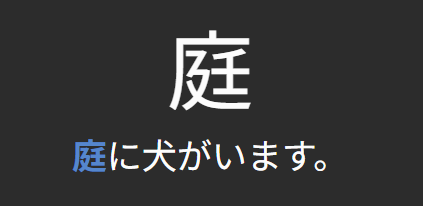
Regarding that context saving in Anki. Our brain is a very very lazy guy and will employ all the tricks to get the job done. In a case like this one: image
I might not exactly remember that 庭 is a garden, but for brain sometimes its easier that “there is a sentence about dog in a garden” and cheats with it.
Thats the Kaishi 1.5k deck I found online.
My personal deck doesn’t anything but just word on the front side, so I can’t cheat through it, but I tend to notice them in different contexts more often.

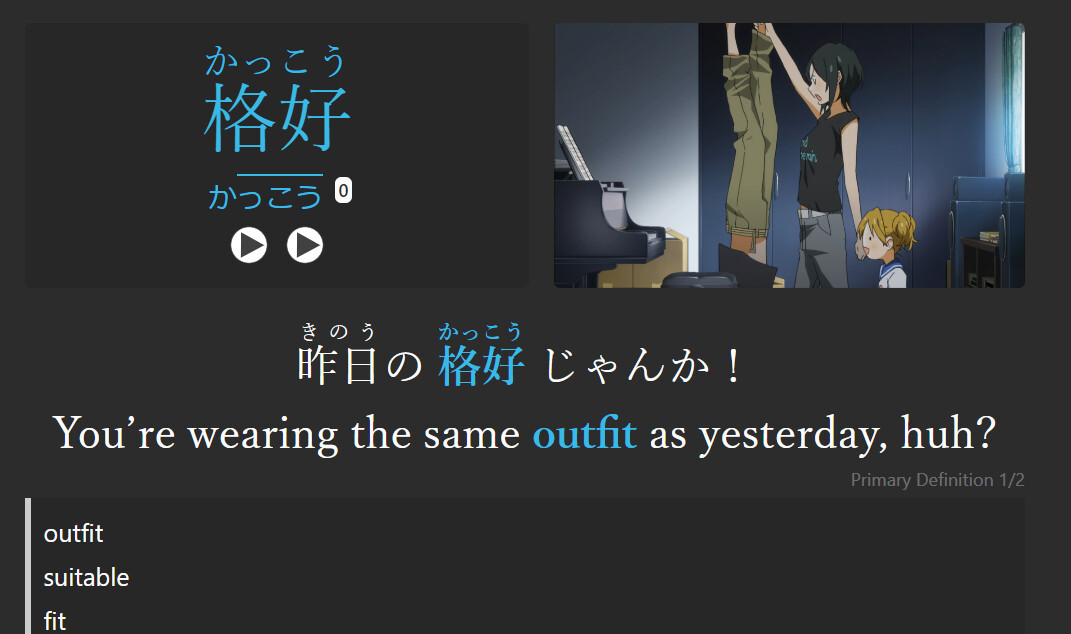
as for the example:
image

And while I agree ”hat first few days just by looking at the word I’m like “Oh, she said that in that scene where…” but gradually it turns into “Oh, it’s an outfit”. Even later I’m like "yeah, that is こう like in 恰好”

As for having multiple sentences with the same word (like in bunpro). I think I read somewhere that you tend to memorize things the best when you are about to forget it. And Anki employs an algorithm that picks up you memorizing habits and adjusts to you, increasing effectiveness. I’ve heard that this algo works bests when you have the same cards and contexts, multiple contexts for same word might be problematic there.

Anyhow, I feel like anything you do will work out for you so keep it up!

Yeah! As long as you don’t stop, you will get there eventually!

1 Like

While I feel like it’s true for something like a phone number where it’s pretty much random, with words you can do it for 10 reviews and still get low understanding and sticking of the word.
Well, I just don’t think anki is a very good tool, it makes it easy to study, and there it is really good. But on the other hand it’s more about trying not to forget stuff, and cram a vague representation of a word into the head, while that time could be spent acquiring new contexts for words, associating new words with old once, automating everything to a better level, etc.
it’s like, the word will be acquired if it was understood, because now it’s concept has it’s place in a head representation of a system, even if it’s very rare and we don’t place it in anki.

But my biggest concern is that my brain gets tired of repeating same cards and cannot work with 100% capacity, and here it doesn’t matter if it’s 1 2 or 3 cards, my brain just takes everything it can from those sentence after the first meet and then drops attention with everything else dropping as well. I have to keep it engaged for productive learning, and now anki are not making it for me (I’m still freaking trying to do something with anki every day for some reason, I guess it’s some kind of curse)