
how about just having them hidden by default?
2 Likes
I still dont think they really add much value tbh, seems like a lot of extra work
also I think translation often leads people astray
you know, i thought i heard somewhere that this year’s JLPT tests were going to be “different” somehow. i guess we will know soon.
Translations would be hidden by default and only available at the same time one receives hints for the answers, so it wouldn’t be taking anything away from the experience from those that want the harder, more realistic experience anyway.
4 Likes
TBH I dont even want the temptation HAHA but fair enough
2 Likes
After the N4 exam last December, I gave a little bit of feedback in this thread. My conclusion was basically that the difficulty of Bunpro’s N4 mock tests was precisely right, though the Bunpro listening questions about times were harder than the one on the real exam.
If I recall correctly, there were many sentiments that the N3~N1 mock tests on Bunpro were too easy compared to the real exams. I also recall, however, that some were wondering if the 2025 December JLPT was an outlier in terms of difficulty. Some were wondering if it was a strangely hellish exam that doesn’t properly reflect average JLPT difficulty.
I just took the 2026 July N3 and thought I’d share my experience on how it compared to the Bunpro N3 mock tests. I reckon the more data/feedback there is, the better Bunpro can finetune.
My experience was:
- Vocab section - Bunpro tests were almost spot-on, but ever so slightly easier
- Grammar section - Bunpro tests were a little bit easier
- Listening section - Very big discrepancy between mock test and real test. Real test was a great deal more difficult.
Detailed descriptions:
For the vocab section, I don’t think any changes are needed. I believe the reason the real test was slightly more difficult is simply that the Bunpro tests mostly follow the Bunpro decks, which I studied extensively in preparation for the JLPT. The real test contained a handful of words I did not know, but I’m somewhat convinced this is just unavoidable. It’s probably impossible to accurately account for every single piece of vocab the official exams throw at you. Interestingly though, one of the words that was specifically tested for is a word that Bunpro has listed as A8. The word happens to be in my review pile.
For the grammar section, the star questions tested some grammar I was not familiar with, and one fill-in-the-gap question specifically tested for a grammar point that is in the Bunpro N2 deck (!). I happened to have only just studied it in the week before the exam. The long texts were about the same level as the Bunpro mock tests, though they might have used slightly harder vocab, I feel. No real discrepancy there. I feel the biggest differences were in the fill-in-the-gaps and star questions.
For the listening section, the discrepancy was very big. The real test had much faster speech and much more high-level grammar and vocab. The Bunpro mock tests are not reflective of this summer’s N3 test. However, talking with people in the JLPT July 2026 thread, the general concensus seems to be that the listening section was extremely hard, so maybe it was a bit of an outlier this year. No way for me to know.
All in all, the Bunpro mock tests were still a fantastic help in preparing for the JLPT. I sure would have been so much more ill-prepared if I hadn’t had Bunpro.
8 Likes
I took the same N3 test as you did too. I concur with everything you said.
For grammar sections, I feel that the texts were all almost twice as long as the ones in Bunpro.
For listening, I felt like they were using vocab I’ve never heard before although I’m at 10k words with my Anki.
The mock tests definitely helped me prepare and anticipate the structures of the real tests.
7 Likes
I wanted to revisit this thread after taking summer 2026 N1.
In my estimate, the reading section was much more difficult than in Bunpro’s mock tests.
This difficulty for me came from three sources:
- Larger reading volume. There was just a lot to go through.
- More advanced vocabulary.
- Less obvious answer options. In Bunpro tests it seems to be easy to identify 2 or 3 definitely incorrect options. In the real test, more options seemed plausible.
All these combined ran me out of time by a large margin.
Cannot comment much on listening, because I found real test listening to be fine.
Bunpro’s tests are still an amazing preparation tool.
I would just perhaps advise others preparing for N1 to make sure you are comfortable with them with time to spare.
6 Likes
Could you post how your mock vs real scores compare when the results come?
I did 72% on the first for the December jlpt preparation, and now I wonder how much I will have to grind after that to pass the real one with a margin
It’s been a year now, how are these coming along? I assume they won’t be done before the December test so I won’t be able to take advantage of them either way, but I am curious what Bunpro’s harder tests would look like. At least for N1 I get the feeling they are a bit on the easier side especially in terms of vocab variety in the reading section compared to the real tests. Not sure what criteria are used to make the tests, but if you were to compare all the unique words in one test with one of yours and how many are considered a part of the JLPT decks I think you would agree (basing this entirely on feeling though).
2 Likes
I appeared for two N3 mock test before JLPT and scored around 69% in both, and in the real exam I scored around 53%.
I passed jlpt N4 this july with score 100/120 language knowledge (all sections are A) and 44/60 in listening. Overall, 144/180.
I did all 5 bunpro exams for N4, my results were all 78% - 85%, which with official jlpt results came really near. I passed official n4 with 80%.
But I heard before that N5 and N4 bunpro mocks are similar to real exam and that N3 - N1 are easier.
1 Like
At the moment, it is not our primary focus, as we are working on tools that will integrate the whole Bunpro system a lot better and give users a wider range of activities at all levels. Articles that were released recently for N5 was one of those things, and we have another major product coming out likely this month.
In saying that though, I personally would ideally like us to have 15 tests available at each JLPT level, or perhaps 20 for N5~N3, and then 10 each for N2 and N1, so it is something that we will definitely continue working on. Regarding the difficulty, we have already implemented a difficulty notifier on the test page in preparation for this next step, and have built up a library of content that we are able to draw from for more accurate difficulty scaling going forward. The ones that we make that will be ‘harder’ than the real tests will still be highly comparable to the actual tests, as we don’t want them to feel too innacurate.
9 Likes
great news, keep doing great work" i am really happy i bought lifetime
4 Likes
I’ll second this. My lifetime Bunpro sub isn’t just access to a static repository, they keep giving me more useful stuff!
3 Likes
I feel like I almost owe a second lifetime subscription LMAO
1 Like

I submitted this as feedback, but I also wanted to share it here because I found it pretty amusing. My Japanese native partner found one of the “trick” listening questions in an N5 exam to be impossible. Which definitely made me feel better for getting it wrong. I’m currently trying to ace all the N5 exams quickly before focusing more closely on the N4 exams to prepare for December.
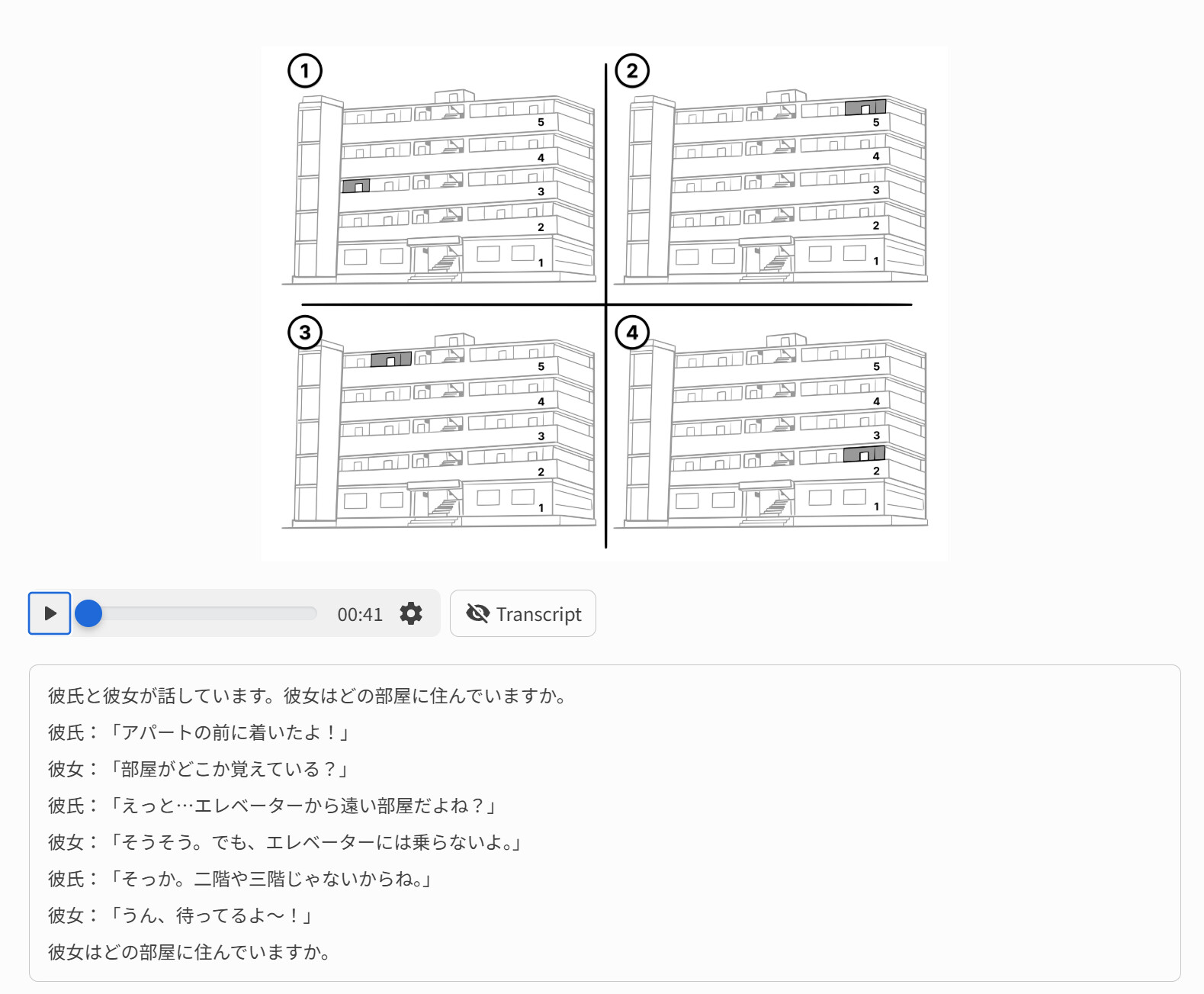
the confusion, and my partner's logic
For me, it’s slightly weird that they talk about not taking the elevator (this is unnecessary info). But it is mind-meltingly misleading that the word から is included the way it is. That implies that his reason for not taking the elevator is that he knows she’s not on the 2nd or 3rd floor. This isn’t just unnecessary info, it implies a cause and effect that has no basis in reality that I can understand. My partner was sure the answer had to be “the first floor” since he said he wouldn’t take the elevator. I pointed out (a) that this wasn’t an option and (b) that a staircase existed, after which she changed her answer to [4] (second floor). Her logic was that none of the answers made sense, and that even though he said he wouldn’t go to the second or third floor, he also said he wouldn’t take the elevator and wanted to be far from the elevator. She couldn’t satisfy all 3 of those conditions, so she chose the answer which was closest to the ground and furthest from the elevator. I really hope the real JLPT tricks are not this diabolical. I took the N4 last year, but I was extremely unprepared for the listening sections so tricks were kind of irrelevant because I was getting lost before the end of the first sentence usually.
1 Like
I’m sorry for the intrusion, but since I did this mock test a couple of weeks ago and still remember this particular question, I thought I would add my two cents, if you don’t mind.
I think the most confusing thing about it is the way the elevator is depicted in the illustration: namely, as a separate door near the stairway in the middle of the building. I’m not sure how elevators are built in Japan, but where I’m from and where I’m living now, they are usually placed inside the building. So, that was a bit confusing at first.
But once you identify the elevator, the only logical answer to the question is indeed answer number 2. The room is situated far from the elevator and it’s neither on the second, nor on the third floor. Which only leaves the room to the right on the fifth floor, since the other one is situated close to the elevator 
1 Like
I actually interpreted it differently. I thought the elevator was the column on the far left of the image. Regardless, I still think the word から (and the discussion about not taking the elevator) was the most confusing part. Even without any image, that would have made no sense.