
Hello!
Just curious if anyone has taken or is planning to take the BJT.
I’d love to hear your opinions about it.
3 Likes
I know someone who did take it. She took it because, and I quote “I could put on my resume that I passed the BJT. But everyone passes, they just give you a score.” She had lived in Japan for about 4 some odd years and just never studied Japanese so I think it was just that. A way to put on her Resume that she had “passed” some type of proficiency test.
I have heard though that it is pretty strong on the 敬語 though so if you are to take it and wanna get a decent score, you should be really proficient in polite speech.
4 Likes
Thank you for the info!
I basically want to take it to get a job/improve my business Japanese 
4 Likes
hmmm… interesting… usually in vacancies they call “business Japanese” JLPT N2 and N1.
How much specialized and different is business Japanese from regular language you test on JLPT N2 and N1?
It seems harder than N1, but to get still a pretty good score (J2) only N2 level seems to be needed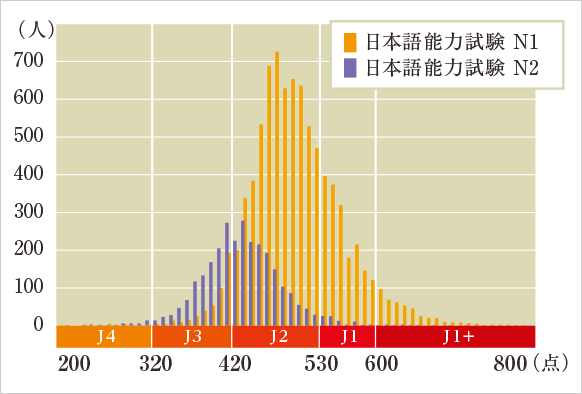
Also, it looks like it’s organised by Kanken so anyone interested I recommend playing their Kanken Training games.
2 Likes
I think thats more because it’s expected that at those levels you are able to use business Japanese, not because they actually show proficiency in business Japanese
Ofc the JLPT does include business Japanese in its content, but it’s a generalised test.
I guess by taking the BJT, even though it’s not technically necessary for work as I have N2, I hope to test my own business preparedness.
It is 8,000 yen so I don’t know if I necessarily want to spend that kind of money, but I guess I’m curious about it as a tool to motivate me into studying business specific Japanese and a metric to see how far off the mark I am.
I do currently work in Japan but with my current Japanese ability I don’t feel confident to be able to work in the kind of job I want (not necessarily predominantly English speaking).
1 Like
I took the BJT a few weeks ago, primarily to check what score I would get on it without studying.
You are allowed to take the BJT once every 93 days.
The test center near me operates Monday through Friday. I signed up for a Monday test on Sunday and took it the next day.
It is very heavy on keigo and keigo phrases, and I learned some Keigo on the exam.
One of the most difficult things for me was that you take it on a Windows computer and it uses that old Windows Japanese font where some kanji are barely recognizable.
On the recent July N2 I got a 80/180, and my score on the BJT was around what you would expect looking at the distribution above.
Overall I would highly recommend it.
5 Likes
Thank you for sharing your experience!!
I’m encouraged that you recommend it.
I’m also considering taking a business Japanese course, but they are so expensive haha… Though taking another test won’t give me the same benefits as a course, I am thinking it will help with my confidence and job search a bit.
1 Like
There is an official practice test book which I was able to find at a bookstore.
Even just browsing the book will probably help you prepare a bit for the exam.
Some of the questions are like looking at a relatively long email, and the question is just like, “does the customer want to cancel the deal or not?” and you have 10 seconds to answer.
Some people don’t like that kind of high pressure exam but since I didn’t care about my score too much I found it entertaining
2 Likes
ooh that’s an interesting aspect. I like that they do that as it tests your real world proficiency as it would be tested in the workplace.
1 Like
Based on what I know from your study log I think you would get a score that you would be happy with if you took it today.
2 Likes
Thank you for the encouraging words 
I may just give it a go…
Will report back if so!
Have to wait for my next paycheque tho as I think I’ve spent quite enough this month FML
1 Like
I have never taken but based on what I know, and assuming you were serious about trying to get a good score, and you aren’t already working in a fairly corporate Japanese environment my strategy would be as follows:
There are a few BJT-specific books out there, so I assume it would be best to read and study those quite thoroughly.
It would be good to start reading the Nikkei (日本経済新聞). It’s quite expensive to get an online subscription but I had a free trial of it for a while and it was pretty interesting. You could also read the more economy and business focused editorials (社説) from other newspapers which are free.
Learn about keigo. Definitely one of the most over-looked aspects of Japanese learning, and there is basically an English-language black hole when it comes to keigo, sonkeigo etc. I have studied it a bit, and it’s hard to remember everything, and quite unintuitive. However a lot of it really is just knowing set phrases and specific vocabulary and when you have to use them. But I think even native-speakers struggle to break bad habits, and might even not know what vocabulary or phrase to use especially if they don’t use it regularly.
The main thing I found is that you have to be careful about who you are keigo-ing so to speak. What I mean is, it’s easy to accidentally mix up talking about yourself or other people.
As for listening, I have to imagine there are a fair few corporate, office-based J-dramas out there which might be good. Also, watch Japanese TV, especially the roundtable discussion shows about current events and the economy that they have.
Overall my impression of what I know about it suggests that to get a high score is a level beyond the N1 and like Kanji Kentei and learning keigo etc is probably beyond the scope of what most people talking online about Japanese are studying for.
Good luck!
4 Likes
After taking the BJT I searched ビジネス尊敬語 on youtube and found this channel.
I think if you watched a few hours worth of her videos for a few days, your score on the exam would easily increase by 40 points or so if you didn’t know much keigo before

4 Likes
I’m definitely planning to take it. I’ve kinda started prepping but not with dedicated BJT resources yet. I’m doing a bunch of interviews right now in Japanese, so I bought various business Japanese keigo, manners, and culture books (can recommend some if anyone cares for this stuff) aimed at natives but havent yet looked for BJT exam stuff yet.
From what I’ve seen, though, I think I’m likely to shift away from caring about the N1 and instead just do BJT. I know a bunch of people that have N1 and essentially cannot speak at all, cant really keep up with listening all that well, etc. And while JLPT is undoubtedly the standard for proof of langauge, I just feel like if the goal is functional Japanese, the BJT will probably end up aligning more usefully while studying.
That’s just my impression, anyway. I don’t ever really see anyone talking about it, though.
2 Likes
Yeah, I don’t see anyone talking about it either…
I already signed up for N1 this December, but maybe I’ll take the BJT depending on my results for that, though I guess it still would just be better to have N1 in terms of brand recognition
N1 definitely has more brand recognition, but I can’t see having BJT as well hurting you. I’m personally considering it as something to take after N1 if only to give myself another concrete study goal
1 Like
sounds like we are in a similar boat!
1 Like
I’m kinda debating whether to make the BJT or the kanji kentei my next goal after N1 (will probably still take me a good year or so lol), so i’m definitely interested in what people have to say here about the BJT
3 Likes
I am also considering going for kanji kentei just for the heck of it. I have a friend I met in uni that has kanji kentei 1, I have no clue why he had it going into university from HS. Doubt I’ll go for 1 unless I just really, really enjoy kanji once I finish up WK (currently at the end of level 58 so just about done with learning from WK)
2 Likes