
Confusing logic/phrasing in the "Fun Fact" part of ございます grammar topic

Am I the only one having trouble comprehending the “Due to this” part in the end? Due to what exactly? You just mentioned that いらっしゃる is preferred when referring to other people, and now you say “due to this” ございます will often be used in reference to people. If you meant that “due to the fact that ござる can describe both animate and inanimate things” then why not leave the “however” part to the end?

English is not my first language but it does not explain the logic of the order of these sentences.
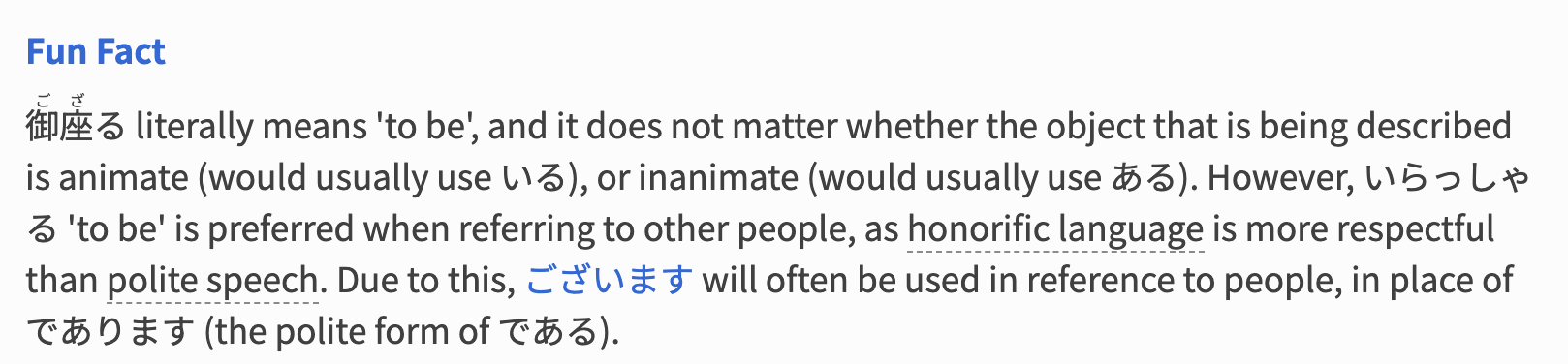
2 Likes

oh, thats a good point. English is my first language and that doesnt make sense to me either.

2 Likes

Had to look at the grammar page for this. I think it’s trying to say ござる is used over であります because it’s slightly more polite (mentioned at the beginning of the page). However, from the wording in the Fun Fact section alone it makes little sense. Seems they’ve removed it!

Thanks for the reply and reassurance! I started to think that I might not know something about english grammar

1 Like

Sorry I’m not sure what you mean by “they’ve removed it!”. The “Fun Fact” is still the same for me if you were referring to it

My bad, I was looking at でございます

I haven’t gotten to this grammar point myself yet as I’m still working on N5, but I just looked at it out of curiosity, and I think I understand what is being communicated. I think the “Due to this” statement is referring to the directly preceding sentence.

I believe it’s saying “Due to the fact that honorific language is more respectful than polite speech, ございます is used since the います at the end implies a reference to an animate (living) thing, as opposed to であります which would imply a reference to something that is inanimate”

It did take me a couple of times reading that section before I came to that conclusion though, and I could be wrong entirely :slight_smile: