
As I’ve been immersing, I’ve come across these two grammar patterns a lot, but don’t really know the difference or what they really mean. Can anyone help explain the difference to me? Thanks in advance.
3 Likes
The comparison on the grammar pages is not helpful? It’s all about direction of movement.
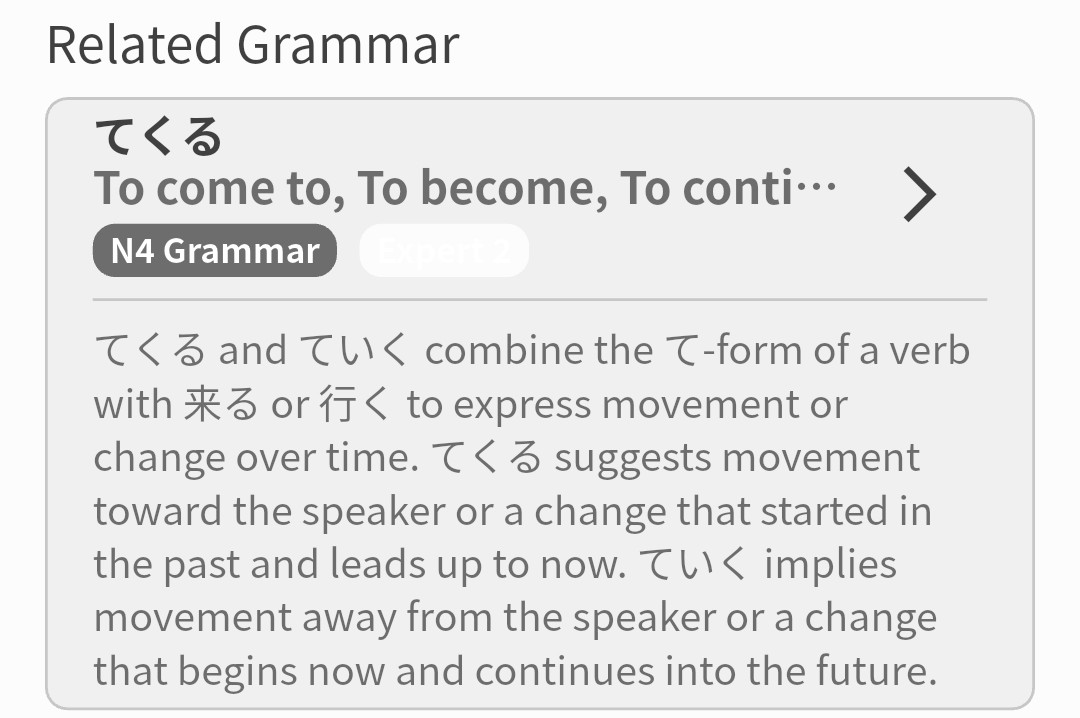
In a way, I think it’s similar to てあげる and てくれる, which in the case points towards the “receiver” of the verb.
4 Likes
Yeah I read that but I’m still confused as like how to use it. I’m sorry, but that just doesn’t make much sense to me 
1 Like
Could you give an example that confuses you?
3 Likes
like this: お金かねがなくなってきた. I don’t really understand what te kuru is really doing here. I could just be being stupid but I dunno
2 Likes
Just to check, do you know the verbs 行く(いく)and 来る(くる)? I think the grammar points make a lot of sense when you equate ~teiku and ~tekuru with going and coming.
傘を持っていく to go (outside) and take an umbrella
だんだん私の料理がおいしくなってきた gradually my cooking came to be tasty. Or: became tasty (!!)
[Edit]
Ahh yes, this is a bit of an abstract usage. It conveys the idea of a situation that has come to be.
7 Likes
Yeah I understand the first part but I shouldve specified that I didn’t get that specific usage of it. Mb
1 Like
The example sentence お母さんになって来ましたfinally made it click for me.
I’ve become my mother. In this sentence the て来る is like 've. It’s offen used with become.
Or 'My cooking has [てきた]become[なって] tasty above.
And your example I’ve become rich. With have
does that help?
5 Likes
Both ていく and てくる has its emphasis not just on the action itself, but also on the period leading to the moment.
ていく is doing the action (て-form) and move away from the speaker from either location or time aspect (いく) .
お菓子を買っていく。= I will go OUT and buy candies. (location aspect)
ルールが変更されていく。= The rule(s) will be change FROM NOW ON. (time aspect)
てくる is is doing the action (て-form) and move toward the speaker from either location or time aspect (くる) .
お菓子を買ってくる。= I will buy candies, and COME BACK. (location aspect)
ルールが変更されてくる。= The rules HAVE been changed UNTIL NOW. (This is time aspect, this does not convey the meaning of “the rule WILL NOT be changed in the future”)
For sentence like, “お母さんになって来ました” it add an emphasis on the progress of becoming a mother (9 months pregnancy, or learning to care for a child after birth, etc.) not just a moment in times.
Even “行って来る” is also a thing, which mean I will go out and then come back.
There are some more nuances also, but it is just expansion of this ideas for the pair of grammars.
8 Likes
I dont really follow, sorry. can you elaborate some?
Wait Im confused. When you say “ていく is doing the action (て-form) and move away from the speaker from either location or time aspect (いく) .” I don’t really understand that. Who or what is moving away from the speaker? I did understand the te kuru explanation, though; that was helpful, thank you 
1 Like
てくる also has the nuance of not just coming in terms of distance but also similar to the english phrase “came to be”. “It came to be that I am running out of money” “the circumstance of running out of money has come to be true”
Similarly, ていく can refer to an action beginning and continuing from now.
お金がなくなってきた
Money has been running out and now it’s getting low
お金がなくなっていく
Money will keep running out from here on
~てきた: The change walked toward now
~ていく: The change walks on from now
1 Like
@hudpro My point is くる is ‘have’
It has gotten cold 寒いになってきた
お金かねなくなってきた = I’ve run out of money
with out the てきたits more like I’m broke. The have doesn’t change the meaning that much, but you can hear it. I became my mom and I’ve become my mother. It has gotten colder vs It got cold that’s the きた
2 Likes
Wait, but if it just means “has come to be” then why can’t you just use naru? Because naru means to become, and that seems quite similar to “come to be”
So it shows a gradual change instead of a sudden shift?
Yeah. 
1 Like
Oh man, sorry for not being to clear about this thing. It is just how I remember the two grammar points. So let’s me clear this up a bit.
For change location aspect, what I mean with “move away” is simply the speaker will do the action (て-form) while actively moving away from his/her current location.
For change in time aspect, let’s say that “NOW” is when the speaker deliver the sentence. So, in this case, ていく will mean do the action (て-form) from NOW onward. So the “action” is actually moving away, from the time of speech, toward the future. This sets a start point for the (continuous or repetitive) action toward the future.
1 Like
Ah okk I understand now, thanks. If the te-iku also means “from now onward” then does it work in tandem with words like imakara?