Experiments log

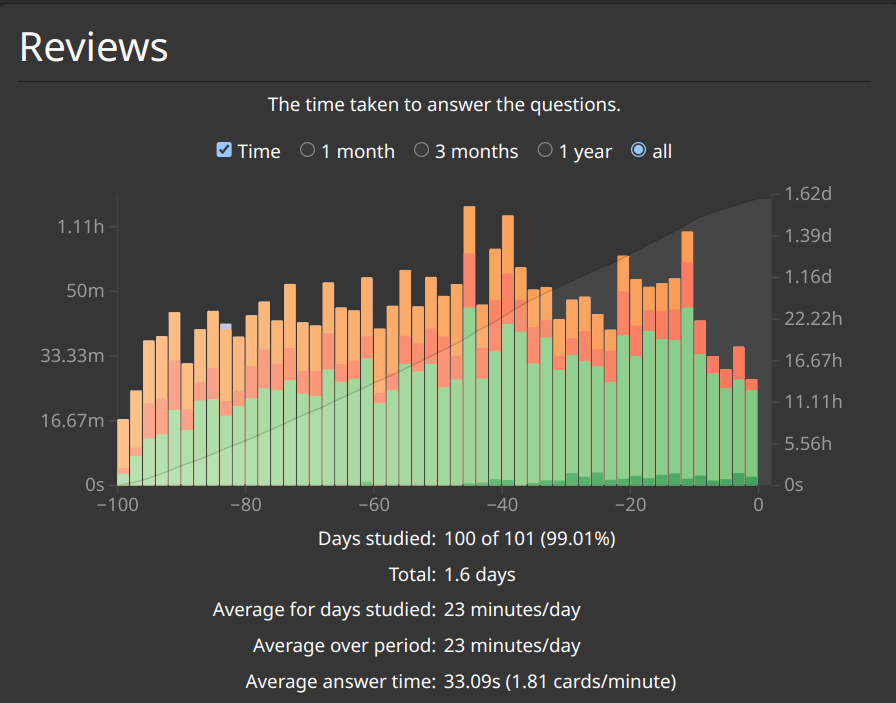
Yesterday it’s been 100th day since I started my 毎日Ankiチャレンジ :partying_face:

Strategy with adding no new vocab is working so far. It seems like each time I do anki, I know it will take less time, and therefore I concentrate better. Yesterday I’ve managed to complete all the reviews in 11.5 minutes! I wonder how much time it takes for it to consistantly take only 5 minutes? What kind of graph progression will there be in 10/20 days :thinking: If you have any decks where you folks did something simmilar, could you share how did the graph went down?

One thing I want to try is to lower my desired retention. Now it’s set to 90%, but I feel like I have some 余裕, becase now I can recognise all the kanji when I see them very easily, and I feel like maybe forgetting how to write them is not that bad in a long perspective, as recognition remains for a much much longer time. But for now I’m sticking with 90% just to see how the graph goes down.

Some achivements

This week was full of new achivements!

  • I’ve invited my Japanese neighbour and we talked for two and a half hours, I’ve even managed to speak teineigo all the time, of course regularly forgetting to add です or ます, but othrewise it went pritty well!
    After the 茶会 I’ve asked what she thinks my week points are, and she said that it’s mostly builing teineigo on another teineigo ますのです. I myself feel pain every time I say it. Another the biggest one is 硬い言い方, by which she ment things like me saying 脳みそにきざまれる instead of just 脳に入れる. It’s true, till this day I want to use 姉上あねうえ instead of お姉さん. Thanks Gintama.
    image
    But also she said that my usage of vocab is good enoguh! Eat that Gemini!

  • I found 幼稚園WARS a manga I like!
    It has a few intresting previews, and its アニメ化 is coming out in 2027. I picked it up because it has Sakamoto Days managa feeling, which I like a lot!
    It does not have any furigana, but when I read, I do not notice any words I don’t know! Well, there were three, and I’ve leared them already:
    お遊戯おゆうぎ - 殺し合い
    遊具遊具 - 遊びの道具 (that can be used to kill some people, but it’s not the main meaning)
    極秘ごくひ - 極端に秘密的な
    And I now when I try to recall there were a few new as well that I’ve leared, but I cannot remember what specifically those are.
    Of course, there are probably more words I don’t know then this, but it feels like my basics, got really good at this point, so I don’t really notice them. It feels like a big progress!
    On learnnatively 幼稚園WARS is L25. Acording to my sense of humor raised by stuff like Monty Python this is super funny ラブコメ

Cool PV!

PV with a song I cannot stop listening!

  • I found myself getting excited about not understnading content! Then I also got excited because I understood that it means I usually understand most stuff without thinking about it!
    And ye, I have times where I kind of “oh I don’t seem to be able to read that, shchit” but it goes more unnoticed now, more simmilar to english.

The 謎のコンテンツ is

I’ve been subscibed to this channel for a while, and it’s still a rock to climb, which I’m exceited about! Even a radio about which I was talking earlier now seems like a doable thig if I decide to crack it.

  • Yesterday, I wanted to do some French in the evening, but ended up watching youtube, reading comments, reading manga, talking on italki, all for 6 hours (23:00-05:00 あんまりに酷いな〜) and everything in Japanese!

I feel that this week was really good one! I’ve even managed to make a post not at 1am but before leaving for the language exchange!

Anyhow, thanks for reading, and good luck everyone in your studies!

1 Like

It’s been almost a month since the last post, but I’m here again!
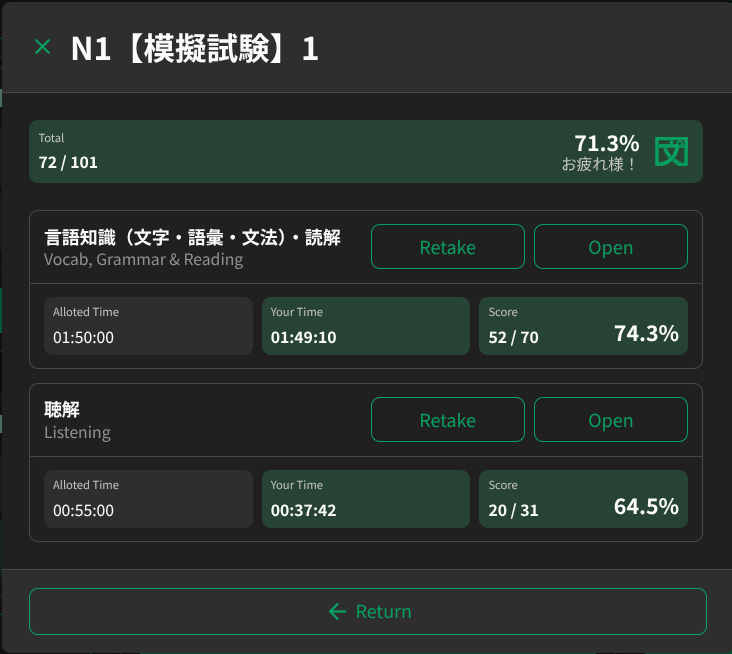
First of all, today I finally got the courage to take the N1 mock test, and here is the result


It’s a ギリギリ pass :partying_face:

Of course, I know the N1 tests here are much easier then the real ones, but still, going from mock N2 75% to mock N1 71% feel kind of good!

The Vocab&Grammar parts were definetly okey, I didn’t know everything but It wasn’t bad. Reading was the easiest part for me, probably it has to do a lot with me doing a lot of random reading with no lookups lately, so it was kind of flowless for the most part (it was one of my recent accivements, that my base reading spead is now listenable).
Listening was really tough though! 40% of what was there I understood perfectly, but threre were so many dialogs that used some field specific words that I don’t know in each sentence! Primarily the vocab used at the office, at work, or 10 sorts of sakura tree in another dialog (sorry for this small spoiler). Listening is a peart of Japanese with which I have problems, I would go as far as to say it’s the best one maybe, as I regularly listen podcasts, watch youtube and anime, talk to people on italki (the last one is not often but if I do I speak a lot), so I was a bit surprised! Probably, it has to do with listening section being on a higer level in respect to another one, as some other users has already mentioned. If you are this July N1 passer, could you please share your experiance with Mock tests vs the real one? How much time did each take, what was the score at the end? Would be super thankfull!

Anyhow, from now on I think I’ll be getting myself prepared for the upcoming December JLPT! With this result as a base 140 days before the exam, I think I might have a pritty good chance at succeeding!

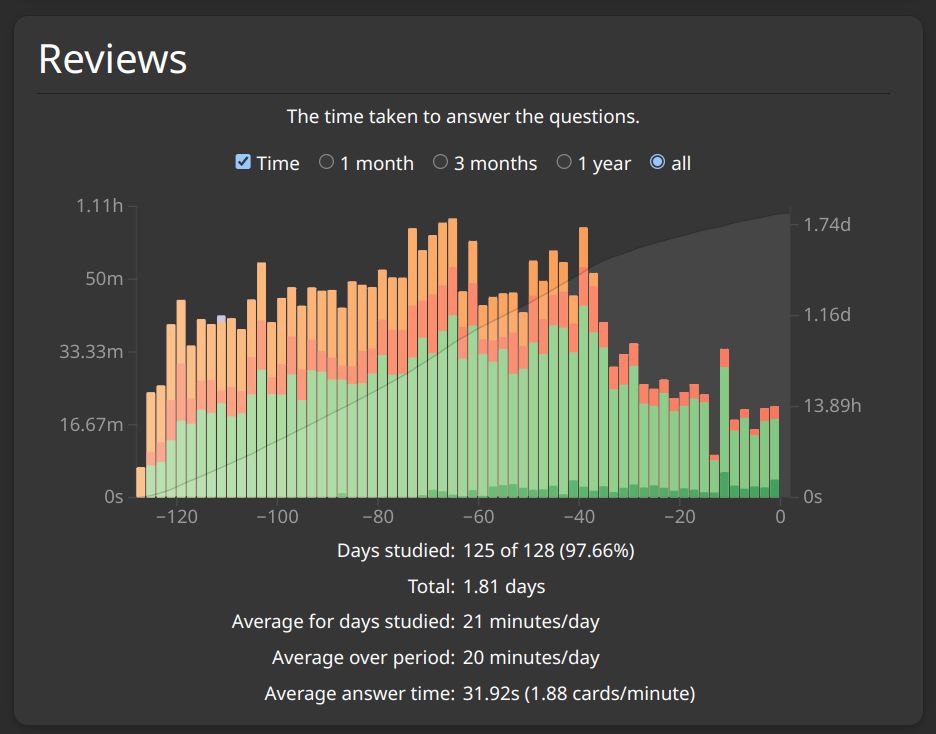
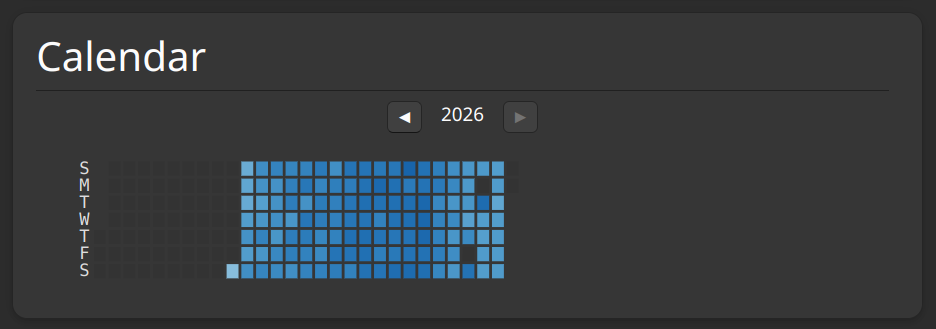
As for my 毎日アンキデッキ it now looks like this:


As you can see I’ve missed two days. I just to do reviews then due to treveling and having so much new stuff.

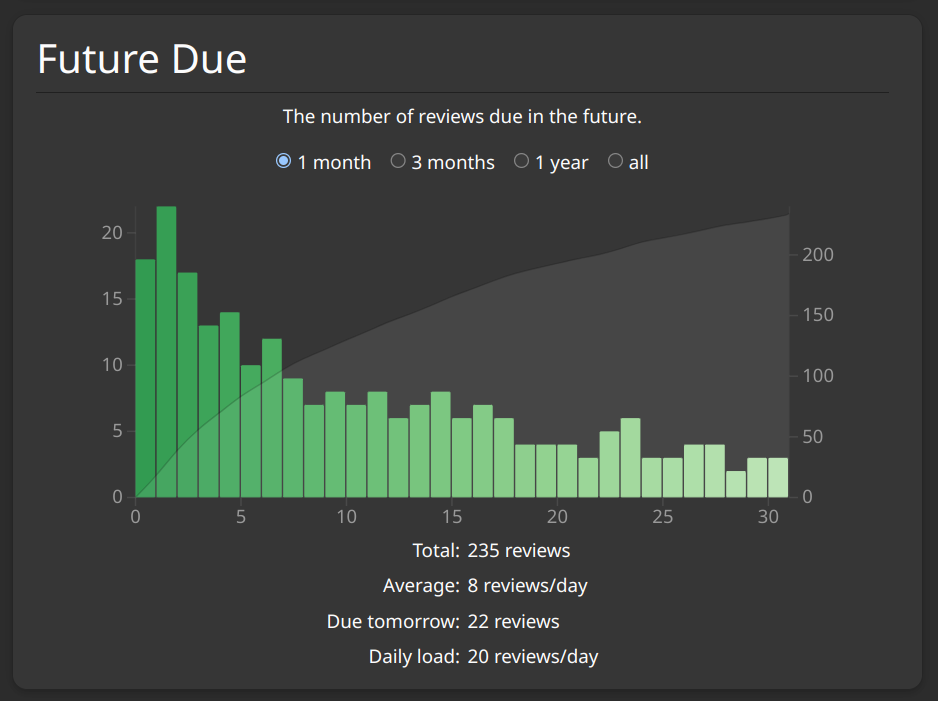
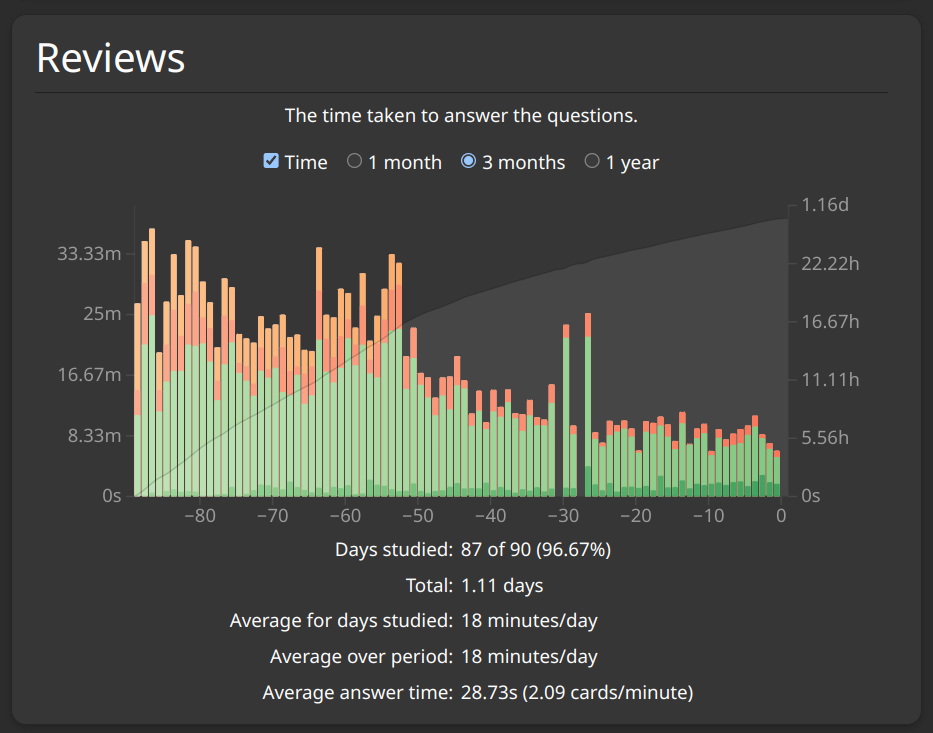
Reviews are getting down but not that fast. Usually now I do reviews for 10 minutes everyday, and there were two days with 6 and 8 minues respectively. Usually there are 20 cards to repeat a day.


On this graph we can see that after 3 days it will go down to 11-14, wich will probably take 5-7 minutes at first. The goal is to get the that spot of less then 10 cards a day, and then I might change the alg a little bit to make reviews more rare, and will start adding 6-7 cards a day, just to see how it goes (again, when it gets to more then 15 minutes I’ll probably stop)

So ye, for now it’s all, I don’t really feel like writing for now, but that could change easily, so who knows!

Good luck everyone :wave:

4 Likes

It’s been 15 days since the last post, so here is what I was able to do:

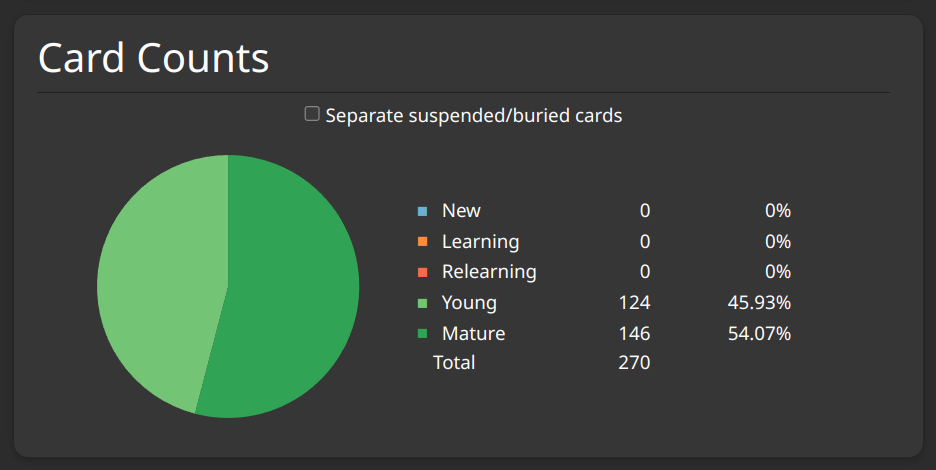
  • Continued doing anki deck as always, it’s been 143 days since the start, now it takes only 7-8 very pleasant minutes
  • Went through the N1 test I did and decoded unknown points, create cloze type cards with a lot of sentences.
  • Did anki 1 hour a day for 9 days, from todays it’s in the vacation mode
  • Read a dozen volumes of a random manga found online
  • I also started doing another anki deck, primarily because I added a lot of N1 words there, most of them are taken from the N1 mogishken, and some from individual Migii practice excersises.
  • Read 4 chapters (1.3 volumes) of これは経費で落ちません! which is super cool manga about 経理部の森若さん who likes her lifestyle and tries to keep it in status quo while some uneven spendings come in, and she deals with them. Also, I’m not a big expert, but this manga seems to be a slow romance with some aspects of shojo manga. Luckily, for now, the most part of what is happening is work, and the mc trying to deduce what is going on with irregular spendings.
  • Did a lot of anime watching, youtube watching, reading comments, basically all sorts of interactions with the language.

From interesting, this is comparacing of reviews prediction 15 days ago and now:
15 days ago


Now

The progression at this point doens’t look that good to be fair. Though I can already feel that after 6 days I won’t have a day with more then 15 reviews, but it’s getting down really without rushing.


This is 3 months timeline.

A week ago or so I also decided to try Japanese amazon, because I just couldn’t find a few books in other places, namely
これは経費で落ちません!The one I introduced earlier

北欧女子オーサが見つけた日本の不思議。About a foringer person getting used to Japanese traditions.

会話の0.2秒を言語化する。A book of 水野さん from ゆる言語学ラジオ about how human brain works within the 会話.
ちびまる子ちゃんの四字熟語教室。A manga suggested by Asher in another thread

So I registered, and even got a 70% discount as a new user for the first 24 hours! I bought all I wanted, all 5 volumes of 北欧女子オーサが見つけた日本の不思議 btw. Unfortunately for some reason they blocked me that same day saying there’s a suspicious activity -_-
They asked for a bank transfer confirmation thing which I gave them, but they didn’t seem to care much about that, so I understood that it’s time to go back to my roots, and not without the help of many people I’ve managed to find これは経費で落ちません!
Other books on the other hand, seem to be really unpopular, I’ve even tried going as far as using some torents, but the books seem to be quite absent. I really want to read 北欧女子オーサが見つけた日本の不思議 it seems to be on pixiv manga but it feels like there’re only piaces of it, or it’s just written that way, anyhow, probably the best way for me to read it now is to do like:

  1. Create new account
  2. Use another card and buy all that manga
  3. Download it to my ipad, turn off wifi, and screenshot freaking everything!
  4. 返品

I don’t konw if it was legit to write the stuff above, but amazon has sucked so much of my time and energy, that the only thing I feel like doing now is to declare war! Heck, it even has sold me another thing I didn’t want to by, by having a simmilar interface to italian amazon that does another thing!

Well, at the end I’m quite happy with these two weeks!

2 Likes

As this topic is called “Experiments log” I think I have to write some of my most recent ideas I came up with to learn Japanese.

D&D based learning

This idea started forming about a year ago, when I discovered that I can learen all the time if the thing I learn is always new, so I just want to learn it, and can concentrate while learning it.
There’s not much from D&D here, but it was inspired by it so I ended up calling Japanese D&D.

The core thing here, is that I have all the ways in which I can study Japanese written down, and every time I want to study Japanese, I can just toss a dice and study whatevery it rolls, or alternatively just choose what I feel like in the moment. This way I’m escaping the trap of routine, and doing every day something same, which inevitably becomes a burden after a week or two.

With this approach every method that takes part in a list is self-sufficient.

I tried creating such a system, but haven’t succeeded, as it appeared to be quite a complicated task. A lot of methods that can be mesured, reliy heavily on anki, bunpro, basically any kind of srs system, which is just not well suted for this method.

Another thing is, if I try to describe an activity, like reading a book, it’s not one activity, it could be at least three or four based on how you read a book

  1. Read a book without lookups (improve fluency, learn better those words you already know, improve output)
  2. Mild lookups, lookup only the most nececery words (like the former one but with learning new wods a little, can already slow down a lot)
  3. Reading and getting into the every detail of each new word, kanji, grammar point, at this point it is already an analysis rather then reading.
  4. Read quickly and lookup only readings of the words (just came up with this one)

When I wrote that down I understood that I need for that 3 different books for each approach or it will be painfull. Then also some kind of questions apear, like do I take notes? How excecively? Only words or also the grammar? Do I write it on the paper or just hilight things? Then I also wrote that down, but it didn’t look good.

So it ended up kind of difficult to build such a thing, and for now it’s just one project that is waiting for it to be taken again. But I feel like this is the way to go in general, having the list of what you can do and do what you feel like, and not do what you don’t feel like.

I though about writing here more things I came up with, but that way it will become to long for anybody to read except a few people, so I’ll just do a few separate posts. The next one will be really fun!

これは道でござる

2 Likes

Not getting a job but getting an interview in a Japanese company

The core concept

This idea came again from D&D and my old thoughts about looking for employment.

It’s about researching the Japanese market, creating a resume, getting ready for an interview and attending it. Sounds like job hunting, but I try looking at it rather from a side of language learning in action, so let’s dive into my mind and see how it might look!

Finding a bunch of related fields

The first stage is a stage where I have to create a resume, I thought. But the thing is, to create a resume I have to offer myself as a working unit of a field, so instead, firstly I’ll start by highlighting all the fields in which I feel I can fool people by pretending to be a part of that field.

My primary fields are language learning, teaching, and backend web development. But for this challange it’s not what I need. What I’m looking for are the fields about which I have quite a wage understanding, but they are still related to the things I’m good at, so if I read a book or two, and then do some interview preparation practice, it should fool an interviewer into thinking that I’m actually a working unit at that field. For me it would be, marketing, finance, human resources, international connections, etc. I’ll have to find more of those. Just write them down for now and be ready to add some more to them while doing other preperation stuff.

Preliminary market research

The next step would be to make a dive into the Japanese market. I think first it’s good to get a good grasp of it in general, questions like “How many public companies are there?” “How many startups are out there?” “How and when do they hire people?” “How many companies are in fields that I wrote down?” “What do they use to find candidates?” “What do companies look out for in general?”

Grasping the core idea of the market in general is a necessity, as well as creating a good understanding of how many companies are out there that can offer an interview.

It’ll be good to have a spreadsheet with all the companies of Japan that could potentially have an interest in my character (base it on the list from the previous point), this makes it more like a game where I see all the stats.

Deep diving into one field

So now, having a grasp of the market, understanding of what I can propose, and a list of suitable companies, I can start building my character.

First I’ll choose one field about which I feel particularly good, and identify companies specifically for that field. I’ll try to research what skills they need, how the CV should look like, and what experience they want. At this point it should go as deep as possible. Also, at this stage I learn the basics of the field and try to learn stuff that will help me look like I’m a part of it.

Creating an image

After having gathered all the necessary information, I can start creating CVs

In my CV blank, which is my character sheet, I can now put anything I want as long as it’s believable enough. As a baseline, I’ll use my actual age (+3-4 years sometimes maybe), ethnicity (unless I want to fool them with it as well), and level of Japanese, but for other things like education, experience, visa opportunities, location, field of course! I can go as far as my imagination takes me!

And of course I’m not making one CV! It’s interesting to see how the reply rate would change according to having just work experience without a degree vs degree but no work experience. Would I be able to make a CV with no work experience, nor education, but make it just so interesting for a recruiter so they would call me anyhow? A lot can be done here!

Getting ready for the interview

And now I’m getting to the essence of all this. After getting to the interview, I’ll have to demonstrate a lot of things like

  • Keigo, and different levels of it in case it’s a multistage interview
  • Understanding of the culture and work culture
  • Understanding of my subject area

That gives me a good framework of understanding what exactly I have to learn now!

For the Keigo I’ll first try to understand the nuances and how it works within a company on different layers, for now on paper. It’s necessary to start listening to the interview recordings, which I have to find in plenty on youtube. Start taking lessons on italky with someone who has worked in a company, so they can give me assistance with that as well, I can try talking to them in different keigo registers and get corrected. Another thing I want to try is going to a random Italki voiceroom, assigning each person there their workplace and title and without saying a word of warning starting to talk like I’m in the office.

Culture and work culture are mostly regular information gathering, which includes reading articles, watching youtube, and maybe reading a fun how-to book.

Understanding the subject area is probably one of the most beneficial things here. First of all I’ll have to learn about it in Japanese. I’ll probably have to write a few articles in an appropriate register and see where I’m getting stuck or switch to a non-professional tone. I’ll probably have to also learn quite a few phrases really well, as a framework.

So this is where I’m getting a lot of Japanese output practice even before attending the interview itself!

Getting to the interview

As one would expect, before getting to an interview, I’ll have to send my CVs to companies, but just sending CVs would be boring, and probably not that effective. Instead, I’ll choose companies where I would want to have an interview, and I’ll create a cover letter for each of them.
(Now looking it up, I understood that in Japan it’s just a part of the resume, not sure how it works yet, but I have the vision so I’ll continue with it)
So yeah, writing a cover letter and personalising a CV is a perfect opportunity to do a lot of writing practice!

But, to create such a letter, I’ll probably have to dive a little bit deeper into each company, go to their page and see what they do, how big they are, see what people online say about it, and question myself if I really should be going for an interview there?

This step is going to be a balanced letter, because as for now it sounds like it takes a lot of time. I probably won’t do it for each company.

Getting through the interview

In this imaginary step I can define three main objectives.

  • Prepare for the interview
  • Get through the interview
  • Get them hooked for more interactions

After getting an offer for an interview, I shell dig even deeper into the company. Knowing what it does, what it needs, and what the customs are there should help immensely.

I’ll also be recording the interview. While it lasts, the only thing I can do is use all the preparations of mine, all the knowladge and language skills I’ve acquired, trying to be as much in caracter as I can, like Odysseus who returns to Itaka, and seeing a shepherd, who in reality is Afina in disguise, immediately comes up with a 5 page story, teling about his origin, who’s son he is, who’s killed whom from his family, and so to whom he seeks vengeance.

Another very important thing here is, to try and use some tricks, to make their side want to interact more with me. Maybe they can offer some kind of guides before the employment, or better some kind of guided courses where the person would explain something and interact with me (and maybe other people who want to get the job), maybe it could be showing me to more people and making them talk with me, as a part of some kind of procedure. I might even try to get a probationary, for a week or two in a rare case? This point is up to my research, I’ll have to figure out what that possibly could be.

After the interview

After the interview is finished, I’m left with a video recording, which now can serve me for further improvement.

First of all I can identify my language weaknesses and mistakes. Then I can work with them by creating Cloze type cards with mistakes – the usual strategy I use for Italian lessons.

Then I’ll have to figure out what wasn’t that good about the content of the interview, what I didn’t know how to answer, where my facade knowledge was too shallow. I’ll have to identify my weak points in understanding of the subject area and make them stronger for the upcoming interviews.

Afterword

Foohoo, I couldn’t imagine this post becoming so long! Everyone who has read it through – 心の奥底から感謝いたします!

This post was probably the most fun to write for me, I really enjoyed it!
If you folks have any ideas on how to make this even more fun and language related, I’ll be glad to see your responses!

Thanks again for reading and cheers!

1 Like

I’ve just finished reading コンビニ人間.
I didn’t know reading something could feel soo good, or rather I forgot about after discovering it once with another book back in 2020.
I couldn’t stop reading, so ended up reading it all in one day.

Now I need to give this book to my family so we can have a conversation about it, I’m really curiose what they would feel and think about it

Again, I’m just not going to write anything, because there are probably a lot of people who haven’t read it, and I don’t want to make any influence before they read the book, as well as it’s late and I don’t particularly want to write anything, so I’ll just make this little note as a log.

Also, now I feel the neccecery to learn how to put those complex emotions into the words beautifully

2 Likes