Gradually incorporate the vocabulary into my study sessions

Hi everyone,

So, I’ve been using Bunpro every day for a little over two months now, and I really like the system. Up until now, I’ve focused exclusively on grammar, as you can see in the screenshot below:
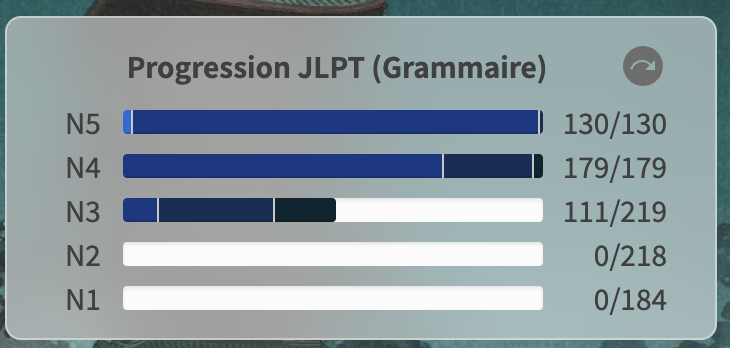
I’ve been adding 3 new grammar points every day since I reached the N3 level. In a little over a month, I’ll have gone through all the N3 grammar points. That was my goal, since I’ve registered for the JLPT N3 in July 2026.

Alongside Bunpro, I do a lot of immersion: reading, anime, podcasts… and I use Anki with an immersion deck where I’ve added about 1,000 cards. Across all my Anki decks, I’ve accumulated just over 2,000 “mature” cards.

To maximize my chances of passing the exam in July, I was wondering if it might be worth gradually adding vocabulary on Bunpro as well.

The thing is, I’m not sure how to make the process “smooth.” I already know quite a bit of vocabulary from N5, N4, and N3—and even above.

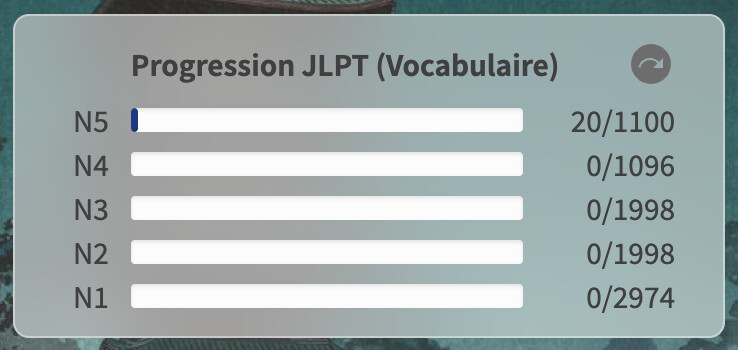
Since I’ve never worked on vocabulary via Bunpro, I have a “backlog” of 4,000 words from N5 to N3. Do I have to go through every single word one by one and mark them as “mastered” if I know them, and only study the others? Are there any shortcuts to make this easier?

Is anyone else in the same boat?

Don’t hesitate to ask if anything in my message wasn’t clear!

Thanks!

1 Like

You can learn vocab in anki instead of bunpro. I used Jalup - now nihongo lessons. [costs as much as bunpro for N5-1]

Ankidrone Essentials is free
Japanese like a breeze and Jo-Mako N5 is free, intermediate and advanced on Patron

Or you can keep mining

Check a list of N5-N3 vocab, and use anki browser to find examples from subs2srs decks.
I download the subs2srs deck of manga and anime I’ve already read/watched. I finished mining chapter 1 of かがみの孤城 Today. And used example sentences from, かがみの孤城, 鋼錬, 犬夜叉, ソマリと森の神様, 進撃の巨人, 坂本ですが, 甘い甘いと稲荷 and ノラガミ

Though I do use Bunpro for vocab reviews for the time being, it’s just not as good as Anki for vocab. I think their intervals are perfectly good for grammar, which requires more practice, but for vocab there are too many intervals in the first two days, and their steps are not large enough later on. I reckon I will probably phase out my vocab reviews on Bunpro once the snowball gets large enough.

I really like that there are a variety of example sentences that showcase different usage though, so it’s a shame.

Marking as mastered the words you already know sounds like a good approach. Unfortunately it might get a bit tedious doing that in BunPro, as I think you’d have to step through every word and for each one, open the sidebar and set to mastered. (There may be a better way in BunPro that I’ve missed, happy to be corrected)

There’s one app I’ve seen that has a pretty good solution to this problem. KameSame is just like any other SRS system for vocabulary (and kanji) but it has a mode called Placement Test that I think would be useful in your circumstances:

Placement test

In this mode, any correctly-answered items will be marked as already-learned (i.e. burned) and any cards you get wrong will be automatically added to your review queue. This is a handy way to work through a list when you already know a significant number of its items.

It’s a pretty neat way of checking what you really already know and adding reviews for what you don’t. It would still take a while to get through all the vocab, but with a smoother interface, and you’re getting the benefit of all that recall practice at the same time.

You can choose to do JP → EN and/or EN → JP.

It’s also free to use. There are a few paid features but I don’t think you’d need them for this.

Edited to add:

I also wanna show BunPro some love here by saying that I do also use it for vocab sometimes, especially in cloze mode, which I find really helpful for seeing words in the context of sentences.

I agree that the actual presentation, with the choice of review styles and all of that, is pretty great. I just think there should be different intervals for vocab. Should be like 1 day, 2/3 days, a week, a month, etc. There’s like four or five more intervals than there need to be.

1 Like

Fortunately, there is a better way. You go ahead and say “learn new words,” and if the word that comes up is one you already know well, you click “mark as mastered.”

That’s much quicker than opening the sidebar for each word—even though I’d rather be able to look at a list, click a box by the ones I know, and then choose “mark selected items as mastered.”


Personally, I’m currently using Bunpro vocabulary as supplementary study. I’ve used Anki and I’m currently using jpdb for vocabulary. I figure that the more places I see a word, the more likely I am to remember it—but if I get overwhelmed with reviews, Bunpro is what I will drop.

2 Likes

Possibly a hot take, but I think through mid to complete N2-ish level, Anki and mining in general is straight up obsoleted by Bunpro. What’s more, Anki is quite painful for non-technical people to use.

One of the decks linked above even recommends installing Arch Linux on the first page of the guide!? I think folks need to remember that a lot of learners are not software developers using a Dvorak keyboard and vim :stuck_out_tongue:

Bunpro takes the guesswork out. Spend less time learning to learn and more time learning.

Eventually, you should mine sentences, but you can do that in Bunpro too. Just add a self-study sentence or, if an item already has them, just add it to your reviews. The cross-domain sentences really help with understanding word usage too!

4 Likes

Thanks to everyone for your replies. I think I’ll stick with Anki for now since everything is already well set up, I can mine very quickly, and the cards look nice. Maybe I’ll try out Bunpro for vocab once they implement FSRS…

1 Like

I’ve basically been at a very similar point recently (How to transition from Anki to Bunpro vocab decks?)
What I found to work best for me is setting the default progress level in the deck options to something high like seasoned 3 for JLPT levels you think you know and then just adding like 20 or so words of that deck per day. This prevents you from setting a review time bomb if you mark an entire deck on one day but will take some time to carry all progress over.
I’ve found the bunpro JLPT levels include more vocab in general (and no overlap between different Anki N2/N3/N4/N5 decks) so when I come across a new word in a JLPT level I just mark the flashcard as wrong in the learn queue which sets the progress level to beginner 0.

Oddly enough I thought no FSRS would be a problem for me but in my experience the lower intervals at low SRS levels on bunpro helps me to memorize vocab better than default Anki settings (never played around with them besides setting the maximum interval).

As someone who the last year started to priotise vocabulary instead of grammar via bunpro,

image

let me tell you this : unlike the grammar points which once you understand them are quite managable, the vocab items get increasingly more difficult by a good mile.

A N5 vocabulary, meant to be the most easy and beginner friendly item starts to use N2 sentences for their final 2 stages. And the final srs content of N4 items will have already N1 (Native level) difficulty.

I am grinding through N3 content and find myself 40 % of the time dealing with close to native difficulty level. You get basically the vocab thats your level, which is being babysitted by smurf- vocabs who will spawnkill you as soon the sentence starts. Thus, the sentences can take quite somewhile if you want to look up and understand everything perfectly, which can be draining on motivation.

I personally think that the level up is far to steep and recommend you to only do lower level vocab on bunprolike N4 if you are N3. You can take a look yourself on one of the items how steep the difficulty goes, but it really gets painstackingly hard.

3 Likes

This is how I approached vocab up until N1. Generally was 1 level behind my grammar on vocab. When I got N2/N1 sentences during N4/N3, I always marked them correct if I knew the vocab and surrounding structure well enough, even if I didn’t get the grammar going on.

Can’t be afraid to have the translation be hybrid like -

He mended his 定め while cursing the instigating 小僧 whose 行方 was as yet unknown.

Actually, during N1 vocab (I’m ~50% of the way through grammar), I’ve manually been adding the grammar points if I see it in the vocab section and feel like I understand what’s going on. Specifically remember doing this for やいなや, want to do it for the 早い one I keep seeing but keep forgetting to.

Yeah… pro of OpenSource all of his stuff is Free
Con, he is very Linux Master Race. One of the Questions on his FAQ is “No I won’t use .MP3 instead of .ogg so iPhones can play it. Don’t you know smartphones are just tracking devices?”
which is the only time his tech opinions comprised his Japanese opinions.

I exported to csv,
converted all of the files
find replace ogg :arrow_forward:mp3 in openCalc
import

As someone who paid for 1 year of bunpro, and studied 1994 days in Anki:

  1. want to use unclear audio, cause the textbook voice does not prepare you for understanding when Shonen yell over explosions. Japanese like a breeze uses audio from anime, including background noise

  2. as a beginner, Bunpro vocab isn’t taught in order, so you can’t read the Japanese example sentences. Most Anki decks teach vocab words in order [both ankiDrone and Jalab]so you read the example sentences

  3. less hints. Bunpro has furigana on hover and highlights the word. Ankidrone and Jalab both do as well, but Jalup - the deck I used- doesn’t. I noticed after spending a year on bunpro, I was less confident in the kanji readings than before because I had furigana on hover. And in bunpro, I wasn’t reading the sentence, only the highlighted word, because it was highlighted.

  4. if you like HTML and CSV anki is great. If you don’t, you can still do reviews in anki, but you can’t mod it. Like WaniKani. I like HTML and CSV - so that’s a pro for me

  5. Anki is free, bunpro isn’t. There are paid decks on Patron, Migaku, and the one I used - Jalup is paid but there are lots of free decks- JoMako has a spreadsheet of other peoples mined decks

  6. Anki is not only for Japanese. I used it to memorize my lines in 歌舞伎, and the Japan県. If you are a student - there’s anki for your other classes. If you study other languages, it works for that too.

  7. offline. I can do anki on the subway, not bunpro.

  8. If you have a job where you use Excel, or plan on mining later, or post on forums like this one HTML and Data cleaning and Storage have lots of applications

1 Like

I also recommend using Bunpro’s vocabulary, either as a substitution for or in addition to Anki - I think it just makes things so much simpler, keeping it on one platform, and it makes life so much easier if you want to add in vocab you don’t know in grammar sample sentences into your own private study decks, or mark them as known.

Both have anki and bunpro have their pros and cons like other people have noted, but personally I’ve been a bunpro girlie from day one - what’s more, as I was going through the vocab decks I’d learn grammar months ahead of when I would’ve learned it through the grammar decks. This made it so much easier when I was going through the N2 and N1 grammar decks, because I felt reasonably comfortable with maybe 1/4 or 1/2 of the points already, after having learned them through the vocab decks first.

Really, it’s whatever works best for you! Bunpro has worked out best for me and I really do recommend taking advantage of all its vocab resources, but if it doesn’t work for you then it doesn’t work for you! Good luck!

Thanks again to everyone for your answers and for sharing your experiences, which are super important to me! Starting today, here is my plan: I’m going to add 20 new vocabulary words, beginning with N5. Any words I already know, I’ll mark as “mastered.” It should take me a little over 3 months to go through all of N5 and N4 at a steady pace. Do you think this is a good idea?

2 Likes

Sounds like a solid idea. Marking words as either mastered or even just at a higher SRS level than default is definitely important; I came to Bunpro after already having studied a couple years, and I made the mistake of adding huge piles of words all at beginner 1, and that certainly came back to bite me

1 Like