to come
Structure
- くる・きます

Hey 
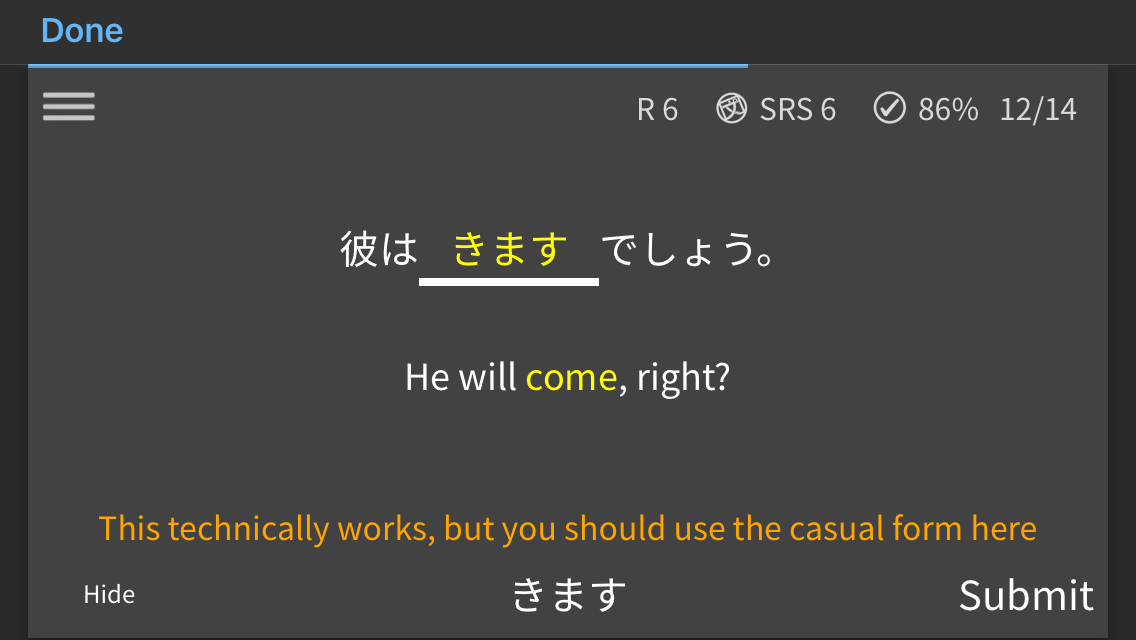
I think this post might help you understand why でしょう follows plain form 
Okay, I see. We let the でしょう make it formal.
Btw, I love your avatar
ありがとうございます😊
I got this wrong for using the particle に.
right:
明日きます。
wrong:
明日にきます。
Is it actually wrong?
Generally words which talk about time from a relative position (today, tomorrow, etc) do not use に. They can be considered as being used adverbially, not as nouns, in such cases. So, 明日に来ます would normally be considered unnatural.
From the perspective of what is being tested in the grammar reviews for this point, you don’t need to worry about adding a particle anyway!
Understood, thank you! You also answered my omitted second question with that (“adverbially, not as nouns”).
I don’t understand why the example sentence カナは駅に来ている? is translated as “is Kana coming to the station?”, when earlier there’s a similar example sentence サヤの家に来ている translated as " I have come to Saya’s house." Can “kitteiru” be used only for the “result of the state of coming” (I have come), or can it be also to say you’re “coming somewhere” in general?