

I read it as “the things I should teach you, with this it’s all of it”. It implies the “with this” is the last of what should be taught. The passed knowledge will be "complete/whole " with これで
2 Likes
It’s hard even in English 🥲
Say I have a 1000 piece puzzle. I give you 999 of them. When I give you this last piece, you will now have the complete puzzle. Your puzzle won’t be 全部 until I give you これ (the piece in my hand), making it the last piece.
I tried 🤷 tldr the sentence and translation both make sense
1 Like
I agree with this. There is no actual word for “last”. It’s just implied it’s the last thing because they are finishing up teaching you.
1 Like
Ok thank you, now it makes more sense
1 Like
The lesson includes conjugation instructions for adjectives and nouns, but zero examples containing those structures. This is especially bothersome because I don’t even understand logically how the concept of “must” can logically be applied to anything other than a verb.
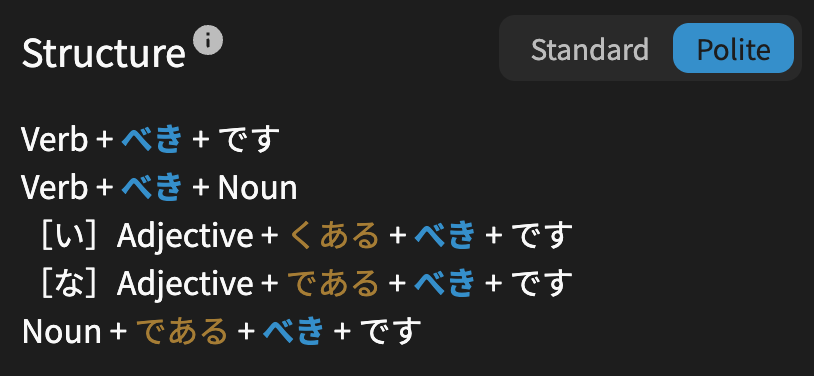
I must study. Makes sense!
I must dog. Does not make sense! I’m guessing there is a way to make sensical conjugations here, but I’d prefer not to guess. Examples are pretty crucial for understanding.
Please consider updating the examples to include those conjugation patterns? I was able to get some decent answers from an LLM about how these things work, but I feel like they should be included here as well.
1 Like
Isn’t ある a verb though? であるべく basically means “should be”. If you think of it that way, I think it makes a lot of sense. For example:
先生は優しい人であるべきと思います。
I think a teacher should be a kind person.
2 Likes
Yes, that is along the lines of the examples the LLM gave me. I’m just pointing out a recurring pattern where the lesson gives e.g. 4 conjugation patterns, and then gives a dozen or more examples that exercise only one of those patterns. I read the intro very meticulously, and then expect to see the things I learned illustrated in the examples, but maybe I’m being unreasonable.
1 Like