Why does this sentence use だけれども after 好き
このカバンが好きだけれども、高いのです。
but this sentence uses けれども (not だけれども) after 好きではない
私はこの本が好きではないけれども、あなたは好きでしょう

Why does this sentence use だけれども after 好き
このカバンが好きだけれども、高いのです。
but this sentence uses けれども (not だけれども) after 好きではない
私はこの本が好きではないけれども、あなたは好きでしょう
Its both just けれども. The だ is often used for na adjectives or nouns. ない is a い-adjective, 好きis a な-adjective.
This usage for だ is universal and you should come across those type of pattern more often in general.
hey isnt that my favorite reptile responding?
because after a な adjective you need だ
because after an い-adjective (ない is grammatically treated as an い adjective), you don’t need だ
see:
Verb + けれども
[い]Adjective + けれども
[な]Adjective + だ + けれども
Noun + だ + けれども
He mostlikely didnt know that 好きis a な-adjective.
tbf I’ve seen a solid number of people in Japan say 好きくない for comedic purposes
E: oh wow it has a jpdb entry
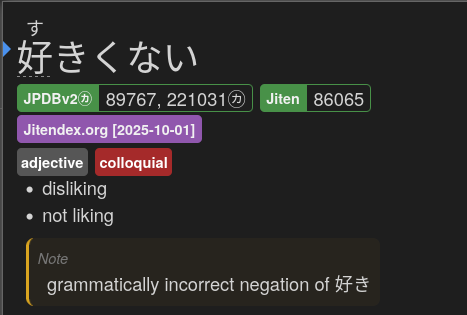
oh no…
I knew 好き was an な-adjective but I didn’t realize 好きではない was an い-adjective ! But it made sense when thelizard mentioned that ない is an い-adjective.