
Is it possible to distinguish Heiban and Odaka from Bunpro’s pitch accent graph? I can’t find any indication of how the particle should sound.
2 Likes
Hi @jvelazquez4802! In our current pitch accent display, we don’t show whether a word is heiban or odaka. For now, you’ll need to listen to the audio in the example sentences. (The audio isn’t perfect yet and has some reading, intonation, or accent errors, though. We’re planning to use better software for the vocabulary sentences and also aim to add human voice recordings.)
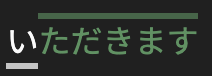
As for いただきます, this is actually a nakadaka accent, and LHHHHL is the correct pattern. We’ve just fixed this error on our site. Sorry about that  There may be still some errors in the pitch accents, and we’re currently reviewing and correcting the pitch accents for all vocabulary entries.
6 Likes
Thank you! Just curious, why not use the dictionary convention of notating the mora on which the pitch falls?
1 Like
We currently use this display system to make things visually clear, but since it doesn’t show whether it’s ‘heiban’ or ‘odaka’ etc., we’re thinking about adding that information 

2 Likes
That’d be great, loving Bunpro so far. Just one more suggestion in this vein, an indicator for example audio that’s been manually vetted would be amazing. Thanks again!
1 Like
All grammar audio has been manually vetted and are recorded by professional voice actors, but while most of the vocab audio is also correct, the software used to make it does still quite often get pitch incorrect on certain words. Unfortunately there are far too many of these for it to be something that we would be able to fix manually, and is true for all AI audio at this present time.
We are constantly looking for better and better TTS tools though, and will continue to upgrade what we use as the technology improves.
In the meantime, I still 100% recommend using the TTS vocab sentences simply as listening practice, and increasing the speed at which you are able to hear words in a sentence and make sense of them. This is something learners continue to struggle with far more than pitch.
1 Like
I got really used to this visualization for odaka:
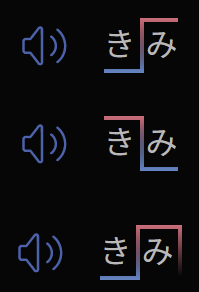
Dropping line after the last mora is clearly visible at a glance.
Yes please please, Heiban/mora indicator would be soo nice, right now the ambiguity on some words that come up based on only showing high/low, especially with combination sounds making several mora in a row appear as low which makes it seem like nakadaka means I just currently use other sites, usually wiktionary when looking at pitch accents to make sure I don’t get it wrong.
I’m definitely far from an expert in pitch accent but i definitely think high/low is very misleading to beginners and makes it feel like one has to memorize H or L for every mora, rather than just 0 or 1 mora having the accent.
1 Like