
How can I differentiate だけど and が?

I’ve really enjoyed Bunpro so far, but I have to say I think the way it teaches (and subsequently quizzes) だけど vs. が as well as ので vs から is quite bad, and frankly extremely frustrating. I cannot find any real difference between だけど and が save for ‘formality’, but the questions I am provided via bunpro do not specify any sort of formality from my understanding.

In this example: 豚肉は嫌い______、鶏肉は食べます

My impression is that the ‘ます’ makes the sentence more formal, so I elected to use だが, however the question was deemed incorrect and the answer was in fact だけど. Through research I have not really come to any more of an understanding of the difference between these two particles, and the bunpro more or less lead me to believe the two phrases are virtually interchangeable barring politeness. Am I missing something?

3 Likes

ですけど is more conversational and more every-day
ですが is more formal and more stiff
だけど is simply every-day casual speech
だが is more literay and often rhetorical

you can absolutely use だけど in plain form and still end your sentence in です・ます
you can also use ですけど

豚肉は嫌いだけど、鶏肉は食べます
豚肉は嫌いですけど、鶏肉は食べます

both are completely valid. Japanese does not require consistent politeness throughout a multi-clause sentence.

for the bunpro grammar reviews it’s completely fine if you have to iterate through them to find the correct one. It’s not a mistake.

4 Likes

Please check out the Topic that covers these grammar points and let us know what you think: Yeah, But... | Bunpro

One of the motivations behind Topics is to help with these sorts of nuance issues and comparisons, although this feature is in early stages still, so feedback is very welcome.

Also welcome to the forums!

5 Likes

Thanks! I’ve read this exact topic, as well as the topics for both だけど and が, but when I am presented with a question regarding either of them it feels like a coin flip rather than an actual knowledge check.

3 Likes

During reviews there are two main forms of hint, both of which will help you here.

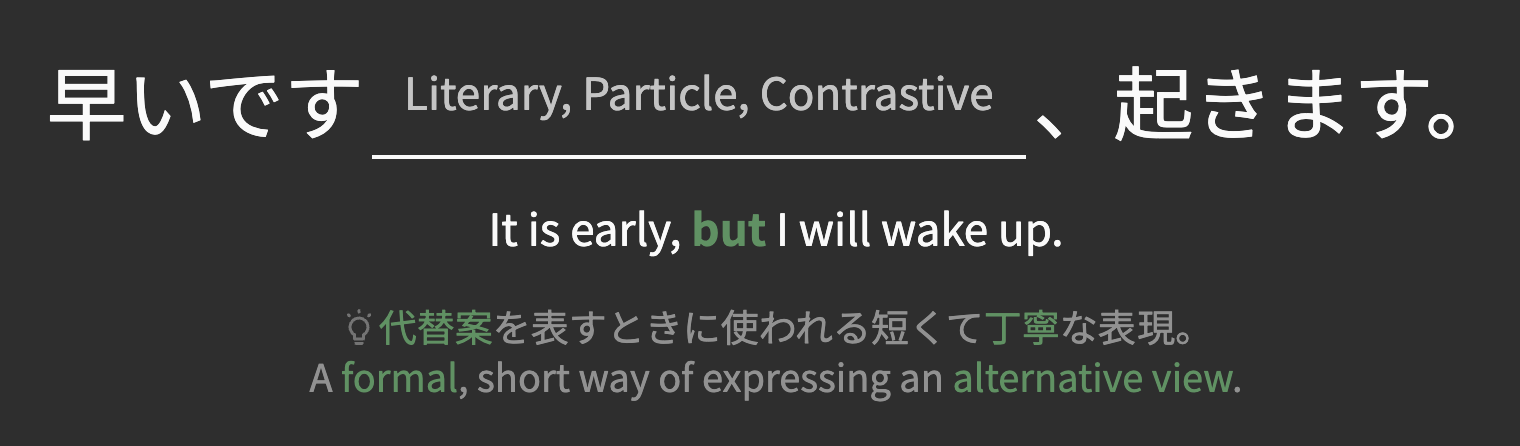
First, there is the “tense hint”, which is the grey text that gives more information about things like conjugation or formality. You can see in the screenshots below that が is described as ‘Literary’ here, whilst けど is not.

Second, there are the “nuance hints”, which are the ones that appear under the sentence/translation. These will give even more specific hints and make it much clearer what grammar point is being sought. You can control if you see these by default in your review settings (cogwheel in top left when doing reviews) or cycle through them with the hint button (bottom left when doing reviews). You can see in the below screenshots that けど is described as casual and が is described as formal.


Between these two hint systems, it should always be possible to guess the exact answer. If you ever come across a case where it isn’t possible then let us know via feedback an we’ll fix it as soon as possible. We have many grammar points which seem similar, especially in translation, so these hint systems are often essential.

6 Likes