
How possible is it to do reviews with no hints?

I think others pointed out in this thread as well, that bunpro seems to use a hybrid approach, context plus strict grammar concepts, I think this latter what you understand under teaching grammar from first principles. Turning off hints in this approach seems counterproductive, because without context, you remain with the primary principles, or not even that.

From what you wrote, chunking seems to be somewhere in the immersion field, however, the approach does not seem to be perfect for the following reason: you learn specific grammar concepts in a specific context, while in real life communication you face an unlimited number of possible contexts. This is why context and immersion in all areas are paramount to me. Without context and added immersion, the result would be stunted.

Comparing early childhood language acquisition with adult learning is misleading in my opinion, because the two work in very different ways. I learned my mother tongue very differently than I learn languages now as an adult and I would likely die of frustration if I had to learn the same way as a baby/ small child.

As adults, we have a framework to build on. We have understanding how certain things work, we can sit down and learn 1000 words… have you ever seen a 4 year old sitting down learning 1000 words in their own mother tongue?
I mentioned in an other thread discussing books that children speak their mother tongue(s) proficiently at their own stage. A 4 year old child can speak their mother tongue perfectly as appropriate for their age, even if they do not speak academically or do not know the usual average number of words in their own language.

While to me chunking and learning elements of speaking/ language usage seems to fit into immersion, I do not agree that it is the most effective learning method. At least not for me, as chunks do not help me when I want to communicate what I want in real life, if the situation does not fit the bracket of what I learned. There is a finite number of chunks facing a possibly unfinite number of real life situations.
To extrapolate from chunks designated for specific situations to cross-use them in a different context, presupposes a high level of language usage/consciousness, which starts after intermediate level, at least for me. I sincerely hope everyone else has all these ready puzzles in their heads waiting to be used and they can pull the right one the right time from the very beginning. From some examples in this forum, apparently it is not just me who usually rather pulls a blank.
For me the most effective way of learning is passive immersion with comprehensible input and relevant level active output. How I use bunpro to aid my learning approach, I detailed in an earlier comment.

For passive immersion of comprehensible input I use podcasts for audio, for my own level and preferably podcasters of my own gender, societal status and background.
For audio fun, I watch “real-life” jdramas, that is, not fantasy, not sci-fi, not historical as language usage differs from modern/average. I am trying to watch specific themed jdramas only if they intersect with my professional background, those are still super hard.

And I read a lot, I love reading. For that, I use lingq due to ease of use.

After the jlpt few weeks ago, I slowed down on bunpro, now I do one new grammar element per day and I immediately try to find it in the immersion I do paralel.

If I would start learning another language, likely next year either French or Korean depending on factors beyond my control, I would use the 20/80 principle to lay a strong grammar and vocabulary foundation in the beginning (plus hangul if Korean), to have the basics down quickly and build on that. For grammar, I would select a solid course book, preferably something that runs from elementary to advanced. Vocabulary anki, reading and listening using the same platforms as now.
I could not use this approach for Japanese as had a lot of random elements of the language already and going back consciously to the basics now is a waste of time and effort considering the possible gains. Since I wanted to do the jlpt, bunpro seemed a good choice to review and solidify grammar points due to the very specific nature of the test.

The part where I can implement the approach which seems effective to me are the kanji, I learn those separately, and while it seemed futile in the beginning, now things start to fall into their place as a I progress. This is specific to the Japanese language.

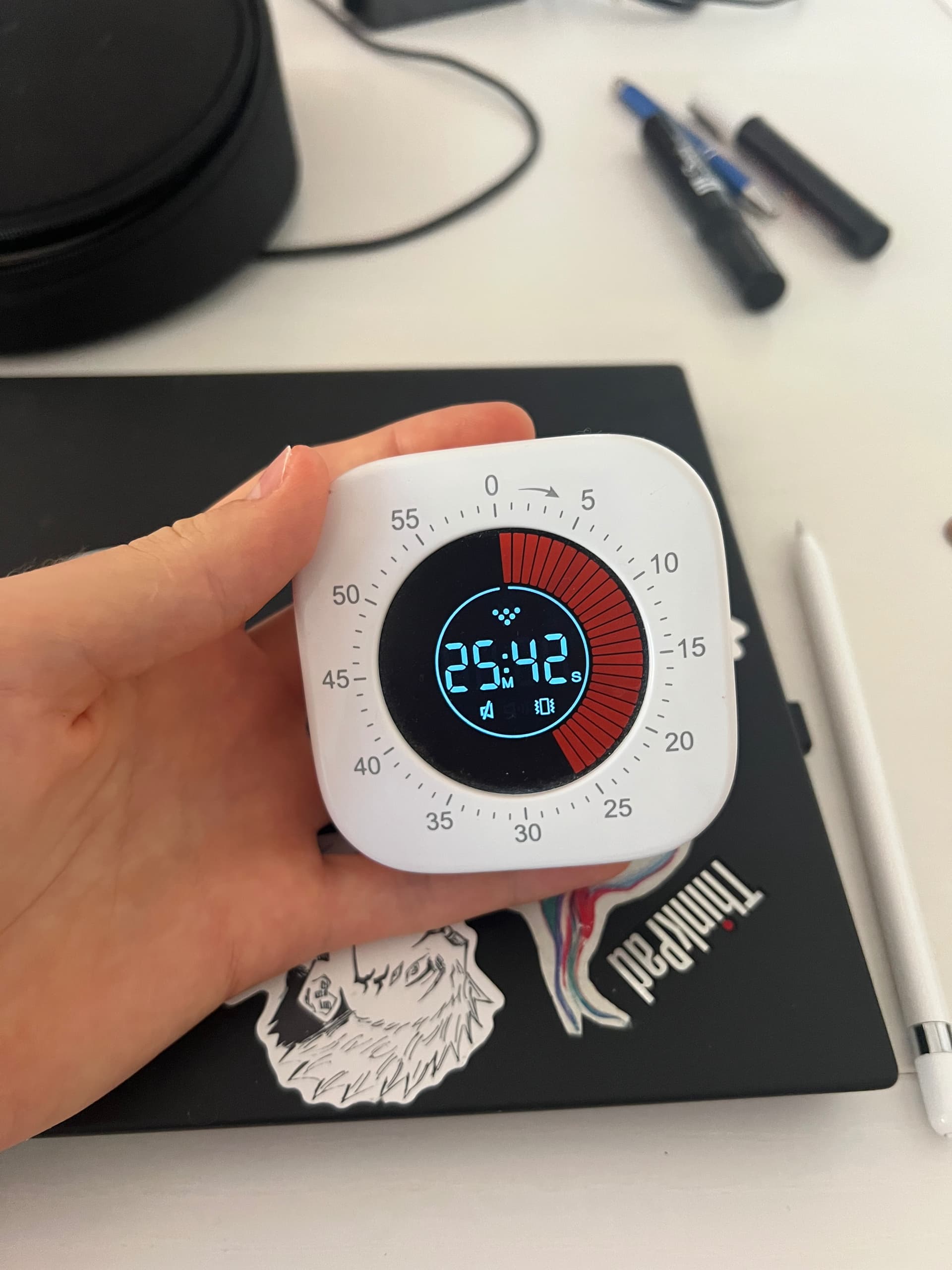
I cannot say for the vocab, because I use Bunpro only for grammar. I don’t have a rigid goal to do a certain amount of new points every day. I have this timer


I set it to fixed amount of time I spend every day on Bunpro.
This gives me some benefits, like if I type in the wrong grammar I can go to its page and compare the two, if I see that I don’t get the point of the current grammar I can reread the page, if I see a sentences or pattern I like I can try to create a sentence and ask some llm if they like it.

Recently I also started trying to copy the voice, because it has brought me a lot of good results in another language, here’s the topic

I think doing so with vocab will also work, especially trying to create new sentences and if there’s a native audio trying to reproduce it.

I personally really like to embrace mindfulness while learning, it’s really hard to study without a rigid framework but I think at the end that is what makes it lively in a long, at least for me.

1 Like

Bunpro is 100% based on 文型. It is pedagogically sound for adult learners and these textbooks were written by academics who are experts in second language acquisition. Resources like A Dictionary of Japanese Grammar are also based on 文型. A hallmark of this style is that explanations are arranged under headwords.

2 Likes

That’s intense. How do you fix leeches personally? Just let them dry out away from you and engage again later on?

Sometimes. Often there’s a problem with the card itself, which I fix. Sometimes I’ll realize I’m shaky on the kanji, so I’ll refresh myself on that

I couldn’t have explained it any better, that’s exactly the situation I find myself in