
How to deal with synonyms when studying for JLPT?

Hi all, see title. I am using Genki as my main source of study for grammar and vocab. I am taking the N5 in July and so I am using the Bunpro practice tests. My vocab score so far has been reasonably good, but I keep falling into the same pitfalls regarding synonyms. Specifically, vocab that Genki doesn’t teach but comes up in the JLPT tests (at least the Bunpro ones). An example is this; I got this wrong as I had no idea what the correct vocab to use was. It’s obviously a meal at night and Genki teaches ばんごはん。Genki also teaches “ひるごはん”。From what I understand, Genki never teaches these words.
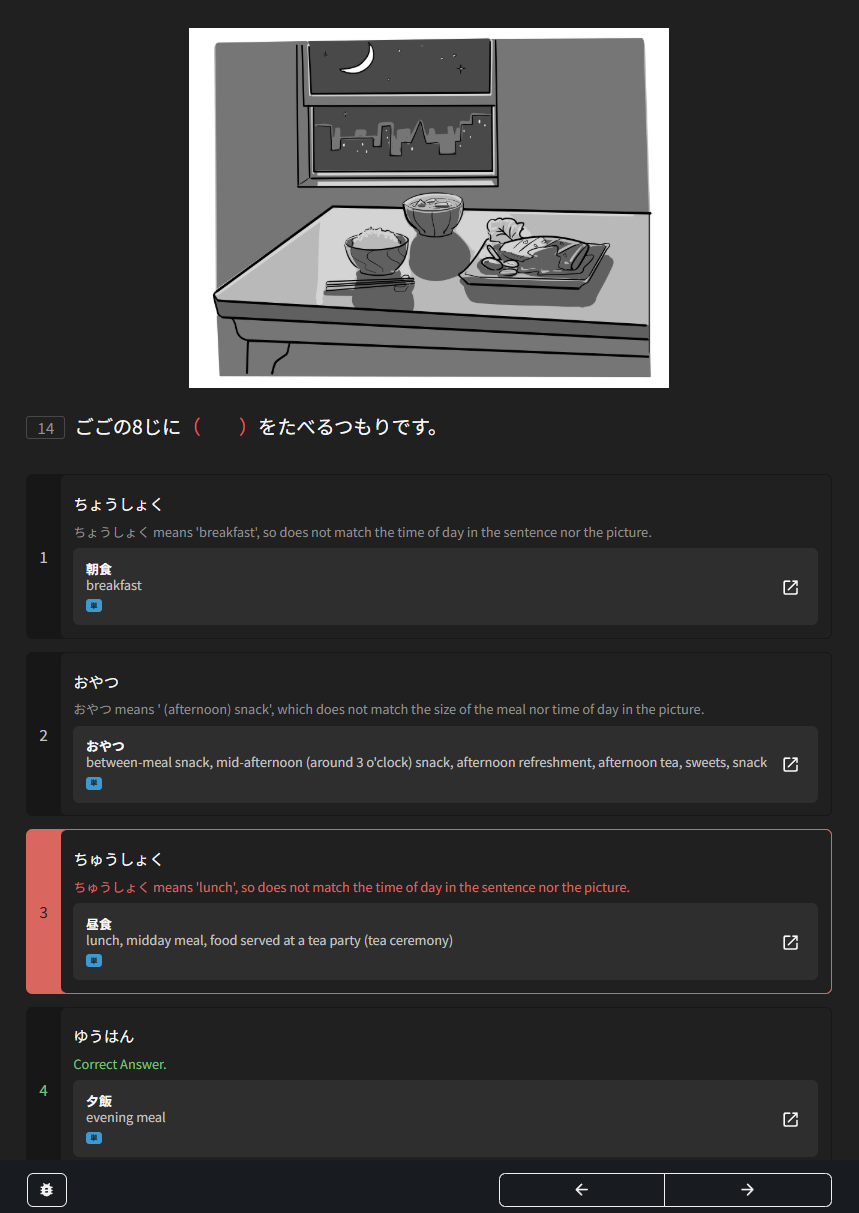
How do I combat this, or do I just accept that I’m not likely to know every word that can appear in the JLPT?

As a person who passed N2 mock test I would press ちゅうしょく here as well

Well, I guess it’s a super rare word. Even in English when a person I was talking to me said “I’m gonna be there for lunch” I had to make sure it’s the middle one by googling it xd

But ye, you might not know all the words, but to pass, you’ll have to do only 50% of the test correctly, so if you get good results on a mock test it shouldn’t bother you if you miss a few questions here and there.

These answers become easier the more vocabulary you learn.

For example:

ごはん is actually just the word はん (飯 - meal, cooked rice) with an honorific ご attached to it.

And the word for “evening” is ゆうがた (夕方) which combines the root for night (ゆう) and the word for direction (かた), meaning essentially “in the direction of night” so not quite night but on the way there.

So if you know these two words, then logically you can work out that ゆうはん (夕飯) means “night meal” and therefore “dinner”.

This becomes especially easier when you start associating these word elements with Kanji.

It doesn’t really answer your question per se, but the more vocab you know in general, the easier it is going to be to work out vocabulary that you don’t know.

So it’s better to study vocabulary extensively and learning the associated Kanji helps with the aforementioned.

6 Likes

Again, I think this is maybe a synonym problem or just words that are very similar in meaning. I would have said "よる” to mean evening or night. I know the word “ばん”, but always associate it with “こんばん”. Looking into it, “夕方” is vocab that is taught in Genki 2 Chapter 18 so it does get there eventually. I guess that for the real exam you either have to know substantially more words than suggested to cover everything likely in the N5 or just get lucky.

Agree 100%. My advice would be to do some vocab practice with the reading mode. Reading helps give a good sense of what feels right or wrong which gives context on what words to use when.

The JLPT will often use words you aren’t familiar with or haven’t learned so your best approach is to be as resilient as possible. You can never know too much vocab for JLPT (providing the vocab you are learning isn’t too casual/technical/specific) so just keep studying vocab where it’s reasonable to do so.

1 Like

As an aside as someone who has lived in England effectively since birth, it took 19 years before I properly distinguished between “lunch” and “dinner.”

Well part of the issue is this: Genki is not a JLPT prep textbook. Its vocab is not exhaustive. The book is concerned with getting people to be able to express things in Japanese. Is there a better textbook to learn Japanese at that level? No. Will you likely pass the test if all you’ve done is Genki? I think so.

But here is the other thing: these words are not uncommon. All of these synonyms for meals are all extremely, extremely common and Bunpro is not out of line for putting them on the N5 practice test.

I also reckon that the reason you didn’t get this question right is not that you didn’t know ちゅうしょく, it’s that you didn’t know 夕べ.

4 Likes

Meal names are a bit tricky to get the hang of at the start, because there are many alternative names that can be swapped in for both “breakfast/lunch/dinner” and “meal”.

And it seems like the Japanese love to mix and match.

But it’s worth learning each synonym, and each component of each word, because they are all fairly common terms and crop up in other common compound words too.

For a bit of extra work at the start, it will make it easier later on :slight_smile:

And the biggest part comes down to whether you are studying to “learn Japanese” or to “pass the JLPT” because they don’t always overlap.

3 Likes

It’s not that rare but hirugohan is definitely something I hear more of.
But just the other day I asked my student what he was looking forward to, and he said chuushoku, lol.

4 Likes

Agreed, it’s quite common.

It’s just a more polite form of the word, so if you live in Japan you’ll see it used a lot by restaurants and hotels that are using polite language. (In those cases, usually they use 朝食、昼食、夕食、so it kind of makes sense to study those words as a set).

1 Like

I’m not sure this is really a matter of synonyms. In this case, yes, you missed a word that was a synonym—but the trouble really is just that there are a lot of words to learn, and it’s unlikely you will learn every single word that you will see on the test. And that’s okay—you don’t need to get 100% to do well.

It can be helpful, though, to work with more than one resource. If you have easy access to a different textbook, or some N5 practice books, or if you work with Bunpro’s practice materials, you’ll learn more words. In fact, you learned some new words from the Bunpro practice test—or at least you became aware of the existence of those words, and can now study them.

One reason I like to work with multiple resources is that as you advance in Genki (for example), you not only learn new words—you also get into harder grammar, which makes the exercises practicing that vocabulary more difficult. But if you look at an additional textbook or resource at this point, you can start at the beginning with easier grammar, but with slightly different vocabulary. It also will reinforce the vocabulary and grammar you’ve studied in Genki and speed up your reading.

3 Likes

I agree with your last paragraph, looking into it 夕べ doesn’t appear until Genki 2 chapter 18 so I’m a year away from that vocab.

It’s been a long time since I did Genki but it took me maybe two months to get through both of them. You can really just do N5 and N4 all in a whack.