
I feel I do not understand this website very well

Edit: Some very nice people have pointed me in a helpful direction. I will be thoroughly looking into the information sources provided.

Its a similar issue I had before. Right now I have oodles of time once again, for the foreseeable future so I am picking up some Japanese again.

Though I haven’t been here for long at all, I now more understand a bit the friction points I’m having. One of them is overall lack of knowledge getting in my way. Bunpro seems great for learning, and also really hard for learning. I know it’s relatively customizable and easy to tailor to exactly to what one needs. But I feel the more “handicap” I add, I won’t absorb the information as well.

For example the yes/no anki mode. I like this mode, but I don’t feel as engaged with it on. Where as with fill in the blank I am much more engaged but struggle with simple things. Like the many ways verbs end. On top of not knowing many of the words presented, I get presented something I don’t know and am expected to come up with the correct ending of the verb. Which yes is probably completely on me. I feel I am missing an obvious highly important piece of information, or many.

While it does appear bunpro describes many of things like the way a verb with る will change to polite and casual forms. I simply have no idea how many of these exist. I don’t know if the rules for the words are even consistent. Like for us in English.

I ate food.
I had eaten food.
I did not eat food.
I may eat food.
I will eat food.
I do not eat food.

Because this is my native language I don’t even need to think about what I want to say before I say it. But here it feels like I’m being presented these situations without having really been explained deep enough what is being asked of me.
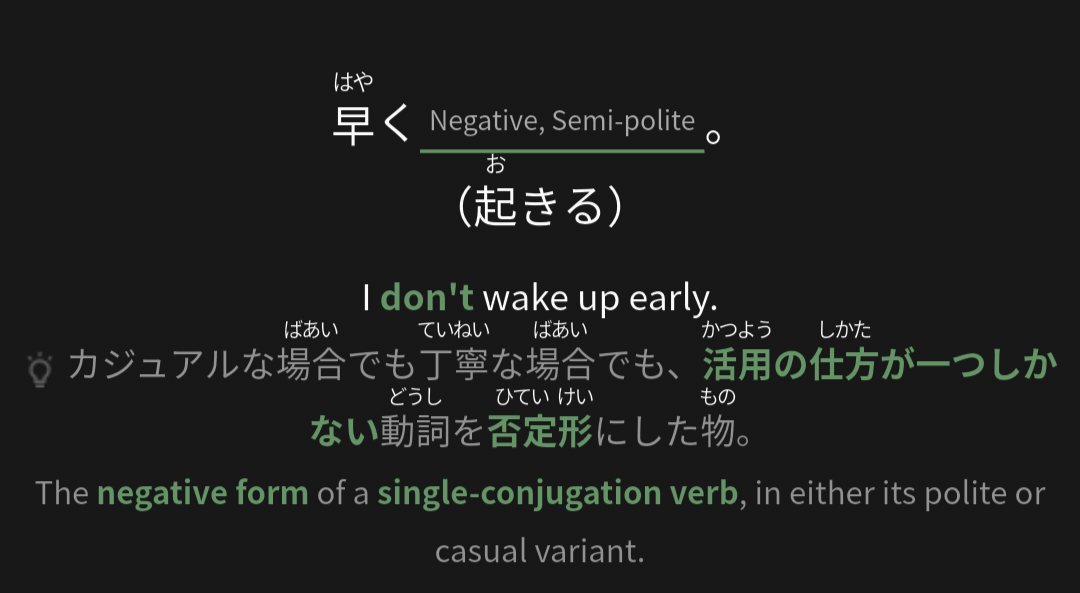
Like I am not entirely sure how I would know what to do in this basic, but necessary to know how to answer scenario. It does explain to me in the ways the words ending can change. I am sure I will encounter a lot more things like this.

Perhaps there are some additional resources I need to look into. Clearly I appear to be lacking some very critical information. So I feel it’s best maybe I ask about this now on the forum as to not dig my own grave of confusion.
1 Like

There are rules to conjugation that you will learn over time. In this case, you have to recognize that 起きる (if proceeded withえ・い, oftenるverb ; if あ・う・お, is うverb) is a る-verb, then follow the negation rule for that (drop る and add ない [the negative])

Heavily recommend you use the Kaijugation function (accessible from both the grammar page and under the “practice tab”). You can practice these grammar points until you have it better memorized.

Edit: ‘kajugation’ → ‘kaijugation’

1 Like

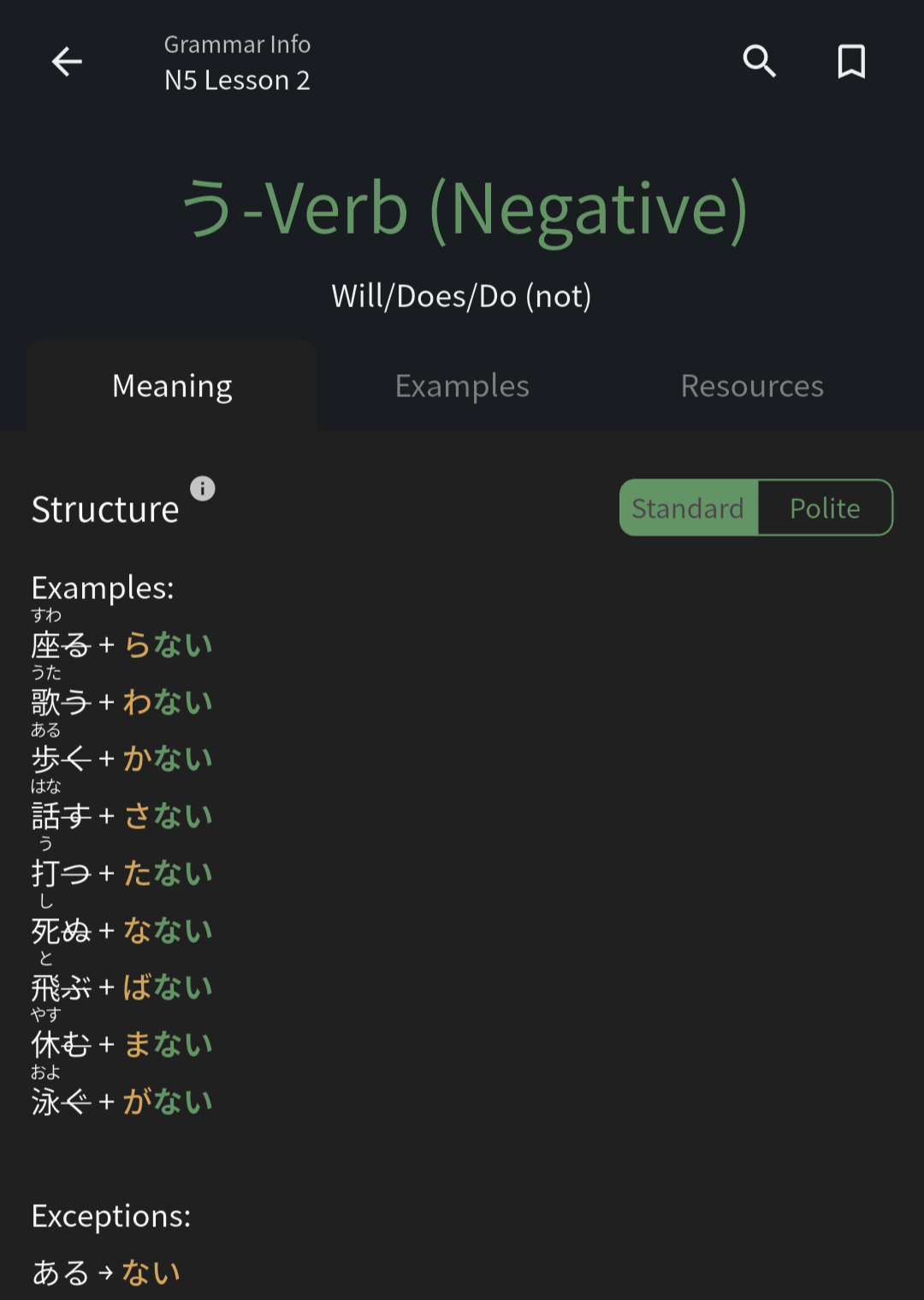
To be specific. You are referring to things like these descriptors that are also available within a lesson being taught right? This one having a particularly large amount of variables.

As for “kajugation”. The game called “kaijugation” you mean or is that something different?

1 Like

Did you use the ‘learn’ option when adding new cards to your reviews? This information should be clearly explained with example sentences on the grammer page before you add it to your reviews. (Also accessible by pressing ‘F’ or the ‘Show info’ block during reviews.)

EDIT: The screenshot in your previous comment is what I mean - and the explanation is below that. It looks to be a lot of different conjugations, but if you read the explanation below you will notice that for U-verbs it’s basically just changing to final sound from U to A.

1 Like

Anki Yes/No is a lie, just like the majority of duolingo stuff. Have you noticed that people there deal with “complex” grammar and language yet struggle to say so much as hello?

Bunpro bugging you about basic things is a feature, not a bug. I beseech you to not give in to the feeling that just saying yes or no is enough, it will teach you bad habits and give you a false sense of competence.

1 Like

Yeah, sorry, I meant Kaijugation.

Seconding this,

Although it looks like a lot of info, there is a base pattern. Kaijugation can help you hammer it in outside the grammar srs.

2 Likes

I use the learn option. It often is explained well though at this level where many things are new, or I understand but only the most basic level, you can see how it may be a befuddling with the sea of information. As often the information pool available for many grammar points is large. So things can get mixed up easily as someone who is reading no better than a first grader.

I understand that in the most basic sense, the type of word used changes the way the words can end in a certain way. To me it felt like there wasn’t a method to the madness because of how many ways it threw at me it changed.

I feel I’ve gained a lot of insight now on the correct paths to look into now from these replies.

@Kinerae
Precisely why I don’t like the yes/no on here. Bunpro, at least this grammar function I’m using does not feel as tailored towards it. I even feel it not being as helpful as forming the word myself. Basic recollection like not as valuable as proper formulation in this scenario, being more complex than simple “did you remember this card?”.

Duolingo is the devil. I’ve used it for a few weeks. To put it bluntly it seems to be an utterly stupid application created to make money.

So I have come here to ask for advice from any kind souls willing to nudge me the right way. Who have told me to check out kaijugation, and I gladly will.

I feel the issue will be solved for now. If there are any other simple pointers people have I would love to hear them.

Using Bunpro to learn basic verb conjugation from zero sounds horrible…I definitely learned that from Genki and YouTube videos before I got into Bunpro.

I just checked out Kaijugation because of this thread, and it actually looks pretty good. I would just ignore the Free Play option until finishing everything in Level Select.