
try something like Rikaikun, it works quite well for my needs.
1 Like
One of the problems with Bunpro is that it does not use consistent anchor words. This means, as you say, you are very often learning ‘Bunpro’ rather than Japanese.
Take this very simple example:
体調はどう?
How are you feeling?
The target word, taichou, is a noun. They try to invoke it using a verb that doesn’t even appear in the lesson for that card.
A more accurate rendering would be:
(Your) physical condition, as for, how (is it)?
Now, the Bunpro approach has it’s merits. It helps understand the feel of the Japanese sentence. But it doesn’t actually help you learn what the Japanese actually means.
Of course, if they did impose consistent anchor words, we’d just complain about their choices. That’s why WaniKani has the right idea - provide a default and allow people to change it. If your chosen anchor always appeared on cards associated with that word, you’d have a much easier time learning it.
But there is no indication that Bunpro will go down that route, (and in fairness, the coding is likely not trivial) so we mostly just grumble about it on the forums. 
2 Likes
I just want to mention that this is one of the main reasons we have nuance hints, which often provide a more literal and consistent interpretation of the target word/grammar.
If we take your example with 体調, as you can see, the hint here should be giving enough literal information to help anchor things.
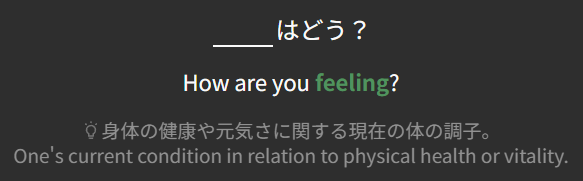
This helps strike a balance between natural and literal interpretation, as each has its own place.
The variety of meanings, including literal ones, should also be on the actual information page for the relevant word/grammar point.
Setting Bunpro aside and just talking from personal experience, I found literal interpretations very useful when I started learning (since you can feel a bit like a cryptographer piecing together a code). Over time though I found they become unnecessary. It is like you hit a point where you understand Japanese as Japanese so any literal mindedness melts away.
Or, rather, the literal mindedness remains but only in Japanese with no relation to English. If I read 「腹が立つ」, I do not think ‘My stomach stands’. I directly think ‘腹が立つ’ (‘I am angry’).
If we take the 「体調はどう?」example, it takes more mental effort for me to turn that into a literal English interpretation now than to just take it ‘as it is’, as meaning ‘How are you feeling?’.
I think the power of literal interpretations is they give you a bit of mnemonic stickiness to recall something but, like all mnemonic devices, they ideally fade away over time.
7 Likes
If you want context for your vocab I can suggest mining your own anime/drama Anki cards using asbplayer or memento. You can get a picture and full audio sentence when you flip the card. For me hearing the sentence every time I do a review helps solidify it. It does take a bit longer than just flipping tons of cards fast, but I like properly listening to the words I am studying.
Sometimes I unintentionally remember the entire sentence before I flip the card (I do front vocab only) because I found the sentence interesting.
1 Like
