I feel like Bunpro is missing WaniKani’s best feature

Disclaimer: I’m not trying to dunk on Bunpro. I really like it for grammar. I’m just trying to figure out whether brute-forcing vocab reviews is a normal beginner phase or a bad workflow.

I’m about a month into Japanese and using both WaniKani and Bunpro.

This might be a beginner take, but Bunpro vocab is starting to feel like brute force.

With WaniKani, even when the mnemonic is dumb, at least there’s some hook. A story, a sound, a weird image, something. I can disagree with the mnemonic, replace it, whatever, but the word has something attached to it.

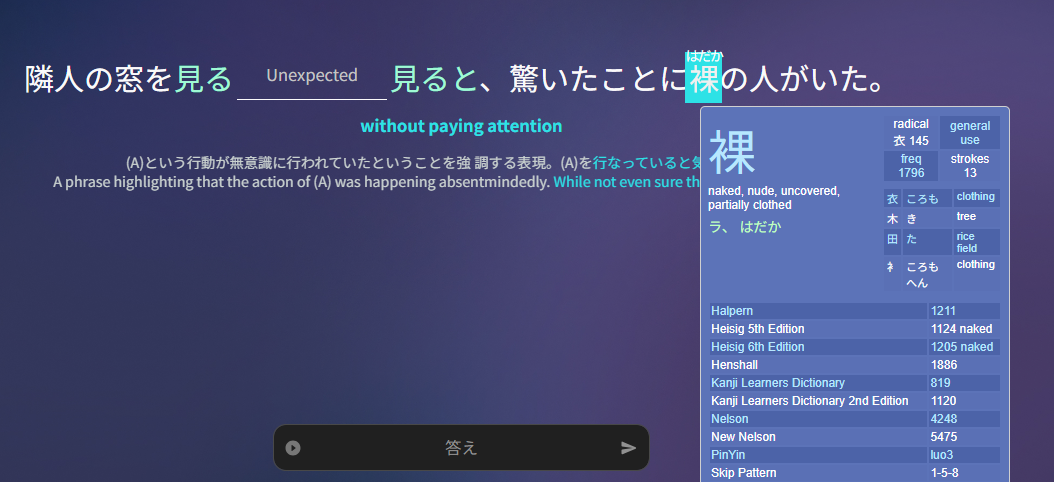
With Bunpro vocab, I like that the word appears in a sentence and the review feels closer to real Japanese. But the fill-in-the-blank format I’m not always sure whether I’m learning the word naturally or just memorizing Bunpro’s expected answer. I just fail it, see the answer, and wait for the SRS to bring it back.

So now I’m wondering if I should just turn Bunpro vocab off and use it mainly for grammar, because the vocab side sometimes feels like repetition without enough of a memory hook.

It feels like WaniKani gives you memory hooks without enough context, and Bunpro gives you context without enough memory hooks.

So do you just keep reviewing Bunpro until the words stick, make your own mnemonics, or entirely move vocab somewhere else?

3 Likes

hey, if you’re learning them in large quantities, make the batch size smaller to something like five word batches. I did this and it works pretty well.

2 Likes

I agree that wanikani vocab sticks better because you learn all the kanji and then the vocab. So knowning the readings and meanings come more nautrally.
However, I do like bunpro because it allows for sentence mining. Even words I think are straightforward can change depending on the context. A basic example for me is 吸う(すう). In wanikani I would only remember it as “breathe in” or “to smoke”, but it can be also be used as “to sip” or “to absorb”. So I really value Bunpro’s variety of sentences for each vocab.

But do whatever works for you, I am still a beginner as well lol.

4 Likes

usually if i still have trouble with that vocab after 4-5 days, ill suspend that card or mark it as mastered so essentially knowingly skipping that card. its not to give up per se, but rather to keep the learning as easy as possible if that make sense. i can always come back to that vocab again later on, or when im better in the future, be able to guess what it means based off the context of a sentence.

1 Like

I view WK and Bunpro as two separate things. WK is great for learning the vocab and recognition of Kanji. Something which Bunpro can help with, but it’s not its intended purpose. For me, Bunpro is primarily grammar. I still use vocab with Bunpro, because the application of vocab in a sentence is put into practical application in Bunpro, something that is sorely lacking in WK (but then again, that’s not the point of WK). Two different tools for learning different portions of the language.

For example, in WK, when you learn 切れる you get the primary definition of “to be cut” and secondary definitions of “To snap, expire, or run out.” but it’s still on you to learn and remember the secondary meanings. You could theoretically go all the way from apprentice to burned on the primary definition alone. (I personally start with what I can get right, and once that is somewhat reliable, then I work on remembering and answering with the secondary definitions until they stick too)

And in Bunpro, you get this:

This is overwhelming to look at, but through the sentence-based examples, you now learn how those definitions fit into a sentence.

So short story, I learn the vocab through WaniKani, and I learn how to apply that vocab through Bunpro. Now, you’ll still get things in different orders, but I found that I got used to that over time. As others have said, smaller batch sizes can help with the initial memorization of new points. I personally just increased my batch size from 5 to 6, but even then, when I’m at the end of a long work day, 5 items can still be a lot to take in.

1 Like

Hey! Thanks for taking the time to share your experience. It helps us build a better learning platform. :muscle:

As someone who used both WaniKani and Bunpro, I definitely get where you’re coming from. Vocab can be one of the most frustrating parts of Japanese, especially early on.

The nice thing about Bunpro is that you aren’t locked into one specific workflow. If Bunpro vocab doesn’t feel helpful for your learning style right now, it’s totally reasonable to turn it off and use Bunpro mainly for grammar. :seedling:

However, one thing to keep in mind is that WaniKani and Bunpro are training slightly different skills. WaniKani is great for building vocab and kanji recognition. But because the words are often learned in isolation, it can be hard to transfer that knowledge directly into reading or output.

I ran into this myself. I had built up a decent amount of vocab through WaniKani, but when I started trying to actually read, speak, or take mock tests, I realized that recognizing individual words wasn’t the same thing as understanding Japanese in context. I found that even though I could recognize individual words, I couldn’t understand or produce any meaningful sentences. It was like having all the lego pieces in a set, having a picture of the final product, but not knowing how it all went together. Sure, I could fit some bits and pieces together, but there was no way the whole thing was being built. :european_castle:

That’s where Bunpro vocab helped me. It felt rough at first, and sometimes it did feel like I was just failing the same words until they stuck. But over time, seeing words repeatedly inside sentences helped connect the vocab to actual Japanese. The sentences also double as light reading practice, which is useful early on.

Wanikani may have changed, but if I recall correctly, they only use mnemonics for kanji. I think mnemonics are very helpful at the beginner stage, but they become less sustainable over time. They are good for learning the building blocks, but eventually it takes more effort to remember the mnemonics than it does vocabulary. (this is coming from someone who wrote his own, rather than use the Wanikani ones.)

One thing you might try before turning vocab off completely is changing the review type. Bunpro lets you switch from Cloze reviews to Reading or Translate reviews, depending on what feels better. Personally, I had the most success with Cloze, especially through the N3 vocab decks, but it’s worth experimenting.

Overall, I don’t think your frustration is weird at all. Language learning is messy, and your best setup will probably involve multiple resources.

All the best~ :bowing_man:

5 Likes

It happened the same to me, at the beginning.

What I did was to study Bunpro Vocab (Bunpro N5) with the Wanikani method, for words written in kanji (900 aprox).

When I started Bunpro, I was at level 10 in WK. If the Bunpro Vocab have kanjis, I learned the kanjis in Wanikani -it didn’t matter if it was of a higher level-. I learned the mnemonics for the composition of the kanji, to be able to identify it, and the mnemonics for the reading of the Vocab -it was usually the kun’yomji-. I didn’t learn the other reading, I’ll do when I reach the level o when I come across ca word with this other reading. From these 900 words, 730 have kanjis from 1-20 levels of Wanikani.

From these 900 words in kanjis, you can study 750 words in WK. I learn the kanji composition of these words in WK, it didn’t matter if they were from a higher level. For the words not in WK, I made my own explanation of the composition, it was easy because I knew the kanji meaning.

It may be because I started learning vocab with Wanikani, but for me, to learn words with kanji, I need to learn first the kanji -recognize it, its meaning and reading- and then the logic of the kanji composition.

There is also about 130 words in katakana. It helps me to know the word and the language -it’s not always English- they came from.

About 80 words in hiragana, mostly adverbs, expressions, grammatical particles. You’ll have to make your own mnemonics or associations with the readings.

This method has helped me a lot, because for me the WK method works, so it also works with Bunpro vocab.

The only problem is that you can’t add to your reviews in WK the kanjis or words learned ahead of your level. As a result, when I reach a new level in WK, I already know about 25% kanjis and 10% words. It helps a bit.

For these kanjis and words not in the WK reviews, I add them in another SRS for an extra review - not only Bunpro-. I use Kamesame - KameSame, but can be Anki or any other one.

Has it been a problem for my Wanikani progress to learn kanjis and words ahead of my level? Not in the least. I am currently in level 29. Of course, I had to learn some radicals out of the WK planification, but on the matter of radicals, I think that the sooner you learn them, the better. I’m talking about the real radicals, not the make-up radical compositions of WK, but if you know the radicals, you’ll understand this WK radicals.

Bunpro Vocab N5 was also a surprise for me, but it has helped me a lot. Because there was the appropriate vocab for a beginner, the basics words one must learn with a new language. It helped me to feel Japanese more real, more approachable.

WK is designed for learning kanjis, and the best way to learn kanjis is through words. So, in WK we learn a lot of words, to reinforce the different readings and meanings of a kanji. For example, from 1200 words in WK levels 1-10, only 500 words are N5, 200 are N3, 150 are N2 y N1.

Bunpro Vocab has sentences -with audio-, sentences with different levels. Vocab N5 has N5 sentences. Sentences help to learn words in context. They are perfect for mining. I used them to reinforce the grammar I was learning. WK can’t give you this, because it is not designed for this purpose.

I hope this could help you.

1 Like

This is a slightly similar experience to me. I used the Wanikani vocab list to build up a lot of vocab, but it’s the reading mode in Bunpro that helped me consolidate it.

1 Like

i wish there was a script or something you could add that would show you the meaning/more info of a kanji by hoovering over it or clicking on it

or if you have a WK sub, you could see the WK info about it

Suggestion: come up with your own mnemonics, and write them in the “notes” section of the Bunpro items.