
Intro
While the title speaks for itself, it doesn’t explain why I’ve taken hours of time to write this in its entirety and then plaster it all over the internet instead of just spending that time studying or doing anything else. The reasons are as such:
- The Sunk Cost Fallacy. There’s a quirk of human brains where sometimes we spend a lot of time/money/effort on something, realize we don’t even want the outcome anymore, but do the thing anyway so that our time/money/effort doesn’t “go to waste.” I’ve spent a lot of time starting this studying journey by writing this article, so that my brain is tricked into not wanting to give up on it–despite the fact that my reasons for continuing have nothing to do with the amount of time I spent writing about studying before I begin.
I’m not sure if that makes sense to anyone reading this, but it makes sense to me, which is all that matters, at the end of the day.
- Perceived Accountability. I just made that term up right now! In a nutshell, I’ve found I’m more likely to reach a goal if I feel like other people know that I’m trying to reach that goal.
Like if I’m just doing this for me, then in times where I feel lazy or discouraged, I can always find a way to justify to myself why taking it easy or even quitting is ok. However, if someone else knows that I’m trying to reach a goal, the fear of them potentially checking back in and me having to explain to them why I’ve given up is a great motivator to keep me on track since I don’t want to disappoint them–even if they, in reality, don’t really care either way.
As such, I’m posting this everywhere I can think that is relevant to the subject matter in an attempt to have it reach as many eyes as possible. (So like, if you’re reading this on the WaniKani Forums and wondering why I’m mansplaining WaniKani, that’s why. Also, if you’re on the WaniKani Forums… ignore the badge next to my name. I completed level 60, honest; I just got curious what it would look like if I pressed the reset button.) Even if the vast majority of people that see this won’t even read to the bottom, and if the vast majority of those that do read it won’t be invested in my progress, and if the vast majority of people who do care won’t actually reach out, I’ll feel like people care, and that’s what’s important!
Accordingly–and I mean this 100% honestly–feel free to reach out at any time via any publicly available method to ask me how it’s going! DM me on Reddit, comment on an instagram post, find me on twitch, I genuinely don’t care; doing that will help get me where I want to go. Doesn’t matter if you’re a complete stranger; feel free to contact me (again, in any way that is publicly available. Don’t stalk me for my phone number or anything like that, of course).
So with all of that being said, if you’re only interested in exactly what the plan is and how I will accomplish it, feel free to scroll down to the “The Actual Plan” heading, but if you want to read the whole story of how I got here, my past studies, and what preparations I did before deciding the plan itself, then read on!
So What the Heck Happened?
My story starts wayyy back in 2021 as a senior in college. It’s the height of the pandemic, and I’m sitting in my dorm room, on a Zoom call with my professor, finishing up my final speaking exam in my JPN 402 class.
“Alright, Carl, that about does it!” My professor said, closing his notebook. “Now let’s talk about your final essay.”
I gave a dutiful “はい” and tried to smile through the pain. I knew what was coming.
“I have to say, as a 4th year student, you really should be writing at a higher level.”
I sheepishly agreed, we talked about it for a bit, and I closed my laptop, letting out a deep sigh of both relief and regret. It’s not that I didn’t try my best; it’s just that my lackluster performance was my best. While I had showed up to every class, done all the homework, and even gone so far as to start a study group when I noticed I was falling behind.
However, that wasn’t enough. I wasn’t great at keeping up with the semi-weekly vocab tests, and I wasn’t getting much extra exposure to Japanese outside the classroom. I didn’t have any native Japanese-speaking friends, I never went to Japan club, and heck, I didn’t even watch anime. And to make matters worse, while all my classmates had done their study abroad their second year of college, I had made the choice to apply for and get accepted to study abroad in Japan… in the summer of 2020.
Needless to say, I wasn’t able to go, and even with my poor performance in my domestic Japanese language class, I still managed to squeak by and pass, leaving the study abroad the only thing between me and my Japanese degree.
But when it was pushed back AGAIN to the spring semester of the next year, I snapped, called my advisor, and she managed to get me graduated given the circumstances of global pandemonium preventing me from studying abroad. With the giant question mark in my life that was graduating finally off my chest, I could at last breathe a giant sigh of relief.
My relief soon returned to dread, however, when I realized that this meant I was now unemployed in the midst of a global pandemic with a degree in Japanese but very little practical Japanese skill. I distinctly remember the knot in my stomach that remained there every day from the time I woke up to the time I went back to sleep–after all, I was an adult, right? I was supposed to be getting an apartment and a job and supporting myself, but instead I was sleeping in my father’s attic, playing video games all day and eating food that I hadn’t earned.
So, I arranged a meeting with a career advisor from my former university, had a wonderfully productive conversation with her about resources I could use to find a job, and then… ignored all of that and applied to the JET Programme.
Gotta JET!
For those of you not aware, the JET Programme is a program designed to strengthen Japan’s ties to the English-speaking world by bringing native English speakers over to Japan, mainly to work as Assistant Language Teachers (ALTs). You apply and interview through the program, and if they like you, they link you up with a contract to a Board of Education in Japan, where you help out other teachers teach English to Japanese kids.
And the coolest part? Basically all you need to apply is a 4 year college degree (doesn’t matter in what), and a native proficiency in English. No Japanese language knowledge nor teaching experience needed, but it definitely will help you out if you get the job.
To cut to the chase, I was accepted to the program (got my live reaction to my acceptance letter on stream!), and assigned to the remote island of Tanegashima. And I have to say, fear and necessity are wonderful motivators for studying–going to the grocery store and having no idea what the signs meant, not being able to read the board in the classroom, having a really hard time talking with my coworkers all lit a fire under my butt to knuckle down and start studying.
And while Every Situation Is Different with JET, my situation gave me a lot of free time after classes each day to use as I saw fit–studying included. So unlike college, I was in a situation where my lack of Japanese knowledge was actively having a detrimental impact on my day-to-day life AND I had a lot of free time where I wasn’t allowed to do things like play video games or watch YouTube videos.
So, in order to get more experience in, I downloaded HelloTalk, a language exchange app that links you with people that both want to learn the language you speak and speak the language you want to learn, and subscribed to WaniKani, a kanji/vocab studying app.
My Adventures with the Crabigator
So what the heck is WaniKani?
If you want to be fancy about it, WaniKani is a web-based kanji and vocabulary study application that utilizes constructivism in a spaced repetition system (SRS) of flashcards.
To explain it more deeply in lay terms, essentially, WaniKani first teaches you parts of kanji (they call them “radicals,” and despite that not strictly being a correct name for them I shall call them that here) by giving them memorable names and mnemonic stories to help stick them in your brain, then, when you learn those, they start teaching you the readings and meanings of kanji that are made up of radicals that you’ve learned, and then when you learn those, they start teaching you both the readings and the meanings of vocabulary that are made up of kanji you’ve learned, using the meanings of their subsequent parts to create fun little mnemonic stories to help you remember them.
In order to make sure you’ve learned it, they use the aforementioned spaced repetition system. Essentially, they show you a radical, kanji, or vocab, and ask either “what does this mean,” or “how do you read this?” Then, you type in the answer. If you get it right, the site will quiz you on it again at a later date/time, and if you get it wrong, it’ll bump it up to quiz you about it again at an earlier date/time.
Here’s an example:
First you learn some kanji parts; they’ll show you something like this「一」and say “this radical means “Ground.” Look, it’s lying flat, just like the ground does.
Also, here’s 「|」. This means “stick.” It just fell out of a tree, and now it’s “stick”ing straight up! I think it’d make a good walking stick, forever being used standing up.
It asks you if you remember their names right after teaching you to confirm, and then it’ll ask you 4 hours later, and if you get it correct, it’ll ask you 8 hours after that, then 12, then a day, etc, etc, until it turns back up months later and is finally “burned,” never to return; you’ve finally remembered it fully! If you mess up, say, the fourth time you’re quizzed on it, however, it’ll drop back down, and it might ask you 8 hours later again, and you’ll have to keep getting it right to push it further down the line until you eventually burn it.
However, once you level up those items to a certain point, it will unlock kanji lessons.
「一」This kanji means “one.” It’s made up of the “ground” radical. Think about it. We don’t say something falls to “a” ground; it falls to “the” ground. Why? It’s because there’s only one ground in the world! Just one. So that’s why this kanji means “one.” It’s reading is 「いち」. Have you ever seen a dog, cat, or horse rolling around on the ground? It’s because they’re so itchy. Next time you have a scratch back there you can’t reach, try rolling around on the ground to get it! Itchy, itchy, itchy!
Also, here’s 「十」. It means “ten.” It’s made up of the 一 “ground” and | “stick” radicals. You stumble across ten sticks sticking up from the ground. What’s this about? Oh my gosh, they’re arranged in the shape of a pentagram! It’s summoning ten little demons right now; they’re coming up from the ground right next to each of the sticks!
But don’t worry, for all of the sudden a Jew (じゅう) rushes to the scene, and holds up her ten fingers. “Begone, demons!” she says, and exorcises them back to the underworld. Man, it was really fortunate this knowledgeable Jew happened to be here! Who knows what would have happened if she hadn’t showed up.
Then, after you learn those ones, you unlock 「十一」, “eleven.” What’s ten plus one? Eleven! The reading is easy; it’s just the two readings you already learned–じゅうand いち make じゅういち.
Overall, this basic system continues, and is divided into 60 levels. Most levels have you learn new radicals and new kanji made of old radicals, and then learn more new kanji that are made of the radicals you just learned. Once you learn enough of the kanji for that level, you proceed to the next one.
And while doing this isn’t easy, it is simple. All I had to do was show up every day, learn the lessons they told me to learn, and do the reviews they told me to do without messing up too much. There’s something very appealing to me about a learning process that has very clear instructions which, if followed, will essentially guarantee that you learn the content.
Now as shown here (or up at the top, depending on the platform you’re reading this on), I figured out relatively quickly that if you made sure to review terms you just learned on the same day 4 hours after you first learned them, you could not only maximize memory retention, but also level up (more or less) as quickly as possible.
I’ll spare the details, but essentially you could learn something to the point of unlocking the things based on them in just 4 days, and while most levels require that to be done twice, some of the later ones can be knocked out in one round.
And while you absolutely DO NOT want to overwhelm yourself to the point of burning out, letting your reviews bury you, and wasting more time trying to re-learn the avalanche of Japanese you’ve buried yourself in, given I had hours of free time each day to dedicate to it, I absolutely could get away with it–I went from level zero to sixty in roughly 500 days.
Now, unfortunately, I wasn’t able to go through and burn every single item–a few weeks after getting to 60, I took a two-week vacation, and intentionally didn’t put vacation mode on. See, vacation mode is a double-edged sword–it pauses all the timers on all of your reviews, which means that they don’t pile up and ambush you when you come back from vacation.
However, that means that every term that you’ve learned but not burned is now pushed back by the amount of time you had vacation mode on for. WaniKani is designed to quiz you on terms just before you forget them, so if you take a day of vacation, every single one of those reviews will show up a day after WaniKani expects you to forget them. I experienced this in the last few months before hitting sixty; in preparation for a three-week-long-vacation (the one I finally met the HelloTalk partner who would later become my girlfriend  ), I didn’t do any new lessons for some time beforehand and then put it on vacation mode for the whole thing. I absolutely felt the effects of this afterward–everything I saw from thereon out felt just a little bit less familiar; instead of waiting a month to see something, I had to wait a month and three weeks. Instead of 4 months, it was 4 months and 3 weeks. So this time, I didn’t put vacation mode on, and resolved to hack away while on vacation and to just catch up afterwards.
Unfortunately, that didn’t happen.
I think it was the fact that my “hit 60” goal was over combined with the fact that I knew that most of the vocab and kanji I was leaving behind was some of the most obscure stuff WaniKani had to offer, but I had little motivation to do it on vacation, even during down time, and when I came back….well, the amount of terms pouring into my reviews combined with the ones waiting from vacation was simply more than I could catch up with. I currently have a total of 6835 terms burned, but 2388 terms waiting, waiting, never getting a chance to enter my brain.
This was like… two and a half years ago, I think. At the start of 2024.
Busting out my Pro Grammar Moves
Having finished WaniKani’s vocab-based studies, I wanted to move onto grammar. I had heard of a another site called Bunpro–it was very similar to WaniKani in the sense that if also used an SRS to help you learn, but instead of having levels that are spaced out and locked until you work your way up to them, you can pick and choose what grammar points you want to learn and when. You pick what JLPT level you want to learn from, and then how many terms a day you want to learn. However, you can continuously study more and more terms if you really want, and put them in your review queue.
Now, in my first brilliant attempt at Bunpro, I decided I wanted to properly go through every grammar point they had, so in one sitting, I read every single N5 grammar point, and put it in my review queue no matter how confident I was that I already knew the answer.
This resulted in me pointlessly reviewing a bunch of grammar I already knew, and with that a lot of headaches in which I was constantly trying to guess which grammar point they wanted from me (かなり?とても?なかなか?). Unsurprisingly, this didn’t last too long, and I fell out of the habit pretty quickly. I felt way too comfortable at my current conversation ability, so my motivation to study fell dramatically. RIP Bunpro.
However! A few weeks back, my girlfriend, now living with me (yay!), reminded me of the fact that my JET contract was going to hit its 5-year max next summer, and that I should probably get a formal certification in Japanese ability so I could start applying for jobs.
This, of course, made a lot of sense, so I started to form an actionable plan.
First and foremost, I revisited Bunpro, completely reset my account, and went through every single grammar point on that site, one by one, and read through them. If I knew 100% what that grammar point meant and how to use it, I marked it as mastered, effectively telling the site that it’d never need to teach it to me or quiz me on it.
If I had any doubt at all about how it was used, I left it there. This left me with essentially none of the N5 grammar, a few N4 grammar points, about a 2/3rds of N3 grammar, and pretty much all of N2 and N1 to learn. I’ve had it set to teach me 5 new grammar points a day, working my way up from the bottom.
There is also the option to learn vocab through Bunpro, and while I went through a lot of the vocab and checked off the ones I already know, I’ve decided to hold off studying them for now–the reason being that there’s about ten times the amount of vocab compared to grammar. For instance, N3 holds 219 grammar points but a whopping 1,998 vocab terms. I need to do some more testing before I figure out what I want to do with them.
There was also a whole debacle where I re-synced my WaniKani account with Bunpro to instantly remove any overlapping vocab words and ended up dumping about 1300 unfinished reviews into my queue, which I had to go through and remove one by one before that day finished so I didn’t mess up my streak, but that’s neither here nor there.
Planning The Plan
All righty! So to repeat what I have heard a bajillion times, learning a language is a marathon and not a sprint. Once more for the people in back: learning a language is a marathon and not a sprint.
As much as I (and by extension, everyone) may want to learn and use a language/get to a certain level right now, the fact is that there is a max speed you can learn languages and that max speed is pretty darn slow. Unlike things like math and science, which were more or less made intentionally with logic and reasoning in mind, languages are the way they are because they happened to become that way over time. As a result, while I’ve found it’s pretty easy to get a deep understanding of math and science through a single good explanation, with language, more often than not I have to just memorize the basics and understand the nuances through experience.
So, the best way to do that is by repeatedly encountering it through time–that’s essentially what the SRS of Bunpro and WaniKani is attempting to do. Practically speaking, it means that the fastest way to do things is to make a set plan that stretches out over the next year(s), and stick to it. The trick is to make it fast enough that it doesn’t take forever, but not so fast that you become overwhelmed and end up buried under your own studies. This is especially tricky considering that your life may not cooperate in the meantime–if you go on vacation or start a new job or have to take care of a sick family member, you could find you’re no longer at the capacity to do your studies at the level you were before, and again… you crash and burn.
Accordingly, I need a plan–ideally, one that, like WaniKani, has a very clear definition of what I need to do to accomplish the goal, so I don’t get all wishy-washy and stop being effective in my studies.
I need what they call a “SMART” goal–basically, it’s an acronym that helps you make plans that will maximize your chances of success. Its meaning is as such:
Specific–the plan needs to remove as much ambiguity as possible in terms of what the goal is and how you’ll achieve it.
Measurable–the plan needs to be defined in clearly defined objective units (eg, not “I want to get fit,” but “I want to lose 20 pounds of fat”
Accountable–the plan and its execution need to be solely defined by things under your control.
Realistic–the plan needs to be something you can feasibly get done.
Time-bound–the plan needs to have a clearly defined end date, and ideally check-in times where you can reevaluate your progress and change the plan if needed.
(I’ve seen other variations where “R” is “Relevant to your broader goals” and “A” is “Achievable,” but that’s neither here nor there.)
That’s why the title of this is so long and specific–I’m trying to be SMART about it!
However, although I’ve set my destination, I still need to know where I’m starting. As such, it’s probably a good idea to take an N2 practice test. Luckily, Bunpro offers a whole suite of 5 practice tests per level that are available for free for anyone, even those without a Bunpro account.
So, while my girlfriend’s at work, I’ve decided to take one of the N2 tests. So if you’ll excuse me…
~test in progress~
…Aaaand done! That was surprisingly doable; I had more than enough time to finish each section. Unlike the real test, they split the listening up question by question, but as they suggested, I only let myself listen to them once to mimic the conditions of the real exam. However, you can’t see the multiple choices for the answers of each question until you click the arrow to move on to it, and then the audio immediately plays.
I’m assuming in the real thing they give you a bit of time in between questions to think about your answer/read the potential answers of the next one, but because I was trying to read the answers while listening to the recording, it was a bit harder. I had like 10-15 minutes extra at the end, so presumably that is time that would be distributed evenly in between questions in order to give me some breathing room
So how did I do?
Well, Bunpro considers it a passing grade if you get at least 70% total, without dipping below 40% on any individual section. I had to divide up Grammar/Vocab and the Reading sections myself, but here’s what I got:
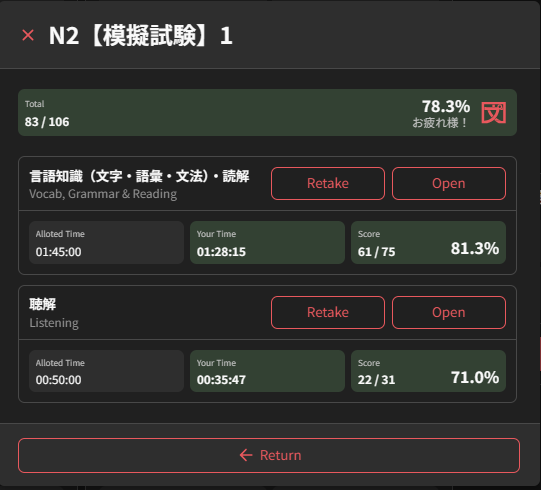
N2 test:
Grammar/Vocab: 37/49 (~77.5%)
Reading: 23/26 (~88.4%)
Listening: 22/31 (~70.9%)
Total: 83/106 (~78%)
In other words, I passed!
Also of note, 7 of the 12 missed questions on Grammar/Vocab were vocab questions, while 26 of the 37 questions I got right were vocab.
Conversely, 5 of the 12 missed questions on Grammar/Vocab were grammar questions, while 11 of the 37 questions I got right were grammar.
In more helpful terms, I got ~78% of vocab questions correct, and ~69% right on grammar. And of course, ~88% on Reading, and 70% on Listening.
So, according to this one test, from strongest to weakest it’s Reading>Vocab>Listening> Grammar.
Kind of surprising, since I feel like I’m really good at everyday conversation, and reading is my weak point.
But then again, I’m really good about asking for clarification and also I’m historically a good test taker–there were a few questions that were very much informed guesses rather than being something I knew with any certainty.
And while this is just a single practice test and not the best indicator of where I’m exactly at, the fact that I passed is a really promising sign. From what I understand, the JLPT can vary wildly in terms of difficulty from year to year, so it’s in my best interests to make sure I overshoot my target to make absolutely darn sure I pass.
But the fact that I’m apparently already at N2 level right now makes me wonder… Should I be aiming for the N1 instead? Let’s take a practice test to find out…
~test in progress~
…Ok, dang, that was a trip. Did it during work in the teachers’ office, and while I was able to listen to white noise to cancel people out during the reading sections, I wasn’t so lucky for the listening portion. Since I couldn’t concentrate, I, timer ticking, asked one of the teachers where I could go that was quiet, so then they led me to the break room, but then I forgot my school laptop which I was using to tether myself to the internet, and then I went and got it, but there was no signal because the school is out in the middle of nowhere and the break room is surrounded by concrete, so I had to balance it on the recycle bin next to the doorway out of my line of sight and hope no one took it, and then I was fine.
I did, however, almost run out of time on the reading section, but the last few questions I rushed on all got answered correctly so I don’t think it impacted my score that much.
The very first question though I misclicked which sucks but ah well.
Again, here’s my results:
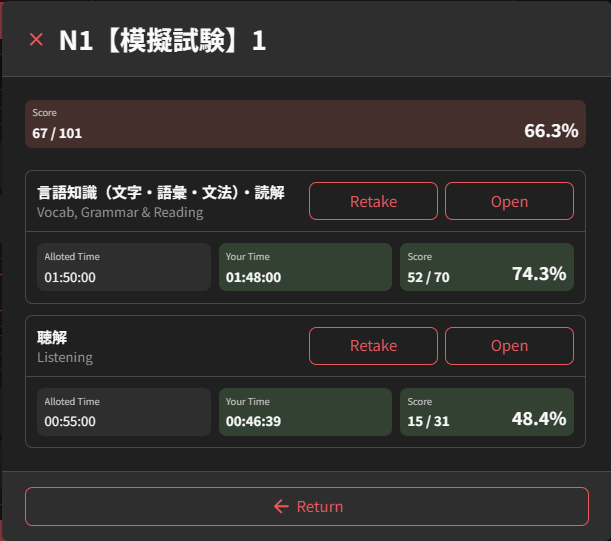
N1 test:
Grammar/Vocab: 26/40 (65%)
Reading: 26/30 (~87%)
Listening: 15/31 (~48%)
Total: 67/101 (~66%)
Unfortunately, just four questions away from a passing grade, but… yeah. Just four questions away from a passing grade! Honestly, I was rather surprised at how much I understood the reading passages; there was only one of them that I had a bit of difficulty understanding what it was talking about. Listening, however… dang, man. I played one of the questions for some of my (Japanese) coworkers and they had a hard time wrapping their brains around it. So like… I’m proud I got just under half.
But that brings me to the interesting discovery, here… should I go for N1 over N2?
I just missed the signup for the summer test unfortunately, so assuming my contract ends July of next year, I only have December to one-and-done the test before I have to figure out my next plans after moving–ie, I need to apply for and get a job. So worst case scenario is that I fail–or specifically, that I try and fail N1 when I would have been passed N2. Best case scenario is passing N1, but a perfectly acceptable scenario would be passing N2, given that, from what I understand, N2 will qualify me for the vast majority of jobs looking to hire foreigners with Japanese proficiency.
So! I think overall it would be best for me to act as if I’m studying for the N1, and sign up for the N2 to really make sure I get it–unless I really feel confident I can do the N1. Luckily since I already passed a Bunpro N2 mock exam, there’s already a real chance I could pass the N2 if I was tossed into it today, so I don’t think this is too crazy of a goal.
Here’s the timetable:
- August 17th is when signups start for the December test. (Signups for the summer test ended in early April. Darn.)
- December 6th is the actual test.
Since spots are first-come-first-served, I’ll sign up on the 17th itself. Obviously, I have to decide if I want to go with N1 or N2 before then. And since December 6th is the test itself, I need to finish studying for it before it happens. That gives me 121 days to decide which one I want to do, and 232 days to study.
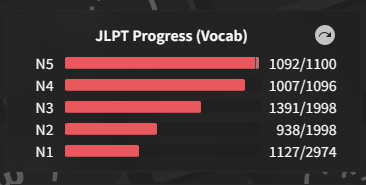
I think a good, clear way to do that is to complete all the vocab and grammar on Bunpro through N1. In order to prepare for this, I’ve gone through every single vocab and grammar on the site, and have checked off every one I already know–that way I’ll be focusing only on ones that I have yet to memorize. Here’s what I’m looking at in terms of things I have to learn:
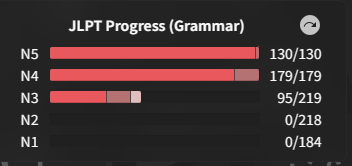
That means for grammar I’ve got 124 points left on N3, 218 left on N2, and 184 left on N1, for a total of 526 points.
For vocab, I have 8 left for N5, 89 for N4, 607 for N3, 1060 for N2, and 1849 for N1, for a whopping 3613 vocab terms! That seems like a lot, but I managed to do the 6722 WaniKani in about 500 days, so that leveled out to around 13.44 new vocab per day. Which is crazy, when you think about it. But if you divide up the vocab with Bunpro by the time I have to do it, it comes out to about 15.57. Surprisingly comparable. Throw the grammar in there and it jumps up to 17.8, but I’m prepared to put in the effort. But to split it up, I need to do just 2.27 ish grammar points a day to learn all of them before the test. Theoretically, as long as I’ve done the lessons for everything before the test and continued to do the reviews until the test, I should have everything in my brain for the test. It might be a good idea to frontload stuff so that if and when I start to feel overwhelmed, I can afford to ease off the gas before the test–especially as I get to harder vocab and grammar.
But with all that figuring out, I can finally actually piece together an actual plan.
The Actual Plan
So here’s the real McCoy:
In order to pass (at least) the JLPT N2 on December 6th, 2026, I will complete the lessons for all the remaining Grammar and Vocabulary on Bunpro that is listed as being on the JLPT.
In the 232 days remaining before the test, I need to get through 3613 vocab terms and 526 grammar points. While this averages to about 15.57 and 2.27 a day, respectively, I think it’s a good idea to frontload them while they’re less complicated (I’m working my way up from N5 to N1), so worst case scenario I can do fewer later, and best case scenario I will be even farther ahead and more prepared for when the test day comes if I keep up the pace. For the time being, I’m setting them at 5 grammar points a day and 20 vocab words a day. From what I understand the higher-level ones get more obscure, so being able to afford doing only one or two a day later on will probably be good.
Also, to measure my progress to see if what I am doing is actually effective, I’ll periodically take the remaining 4 Bunpro N2 and N1 practice tests to see how I’m doing. These are also good dates to look over my plan and determine whether I should speed up, slow down, or change my pace at all. The dates will be May 31st, July 19th, August 16th, and November 1st. All Sundays, when my girlfriend is at work and I’ll have a distraction-free test environment to take them. I’ve already put reminders in my calendar.
When am I going to find time to do all this? I’m an early bird by nature, so I’m going to wake up at 5:30 every day, make breakfast, then get to busting out my lessons and reviews at around 6 am. I’m also trying to run more, so if I’m done by 7 am, I’ll go for a run. If not, I have a dedicated 1 hour and 45 ish minutes to do lessons and then reviews each day, so I can then review the lessons I just learned at work in the afternoon (I always have at least some time for studying at work), and then catch them again the next morning.
Also, to keep my mind on its toes, I will do a Kotoba bot discord test every work day. Basically, in one of the discord servers I’m in, you can ask a bot to give you a kanji quiz, and I frequently ask it to give me ten N1 vocab questions where you type the reading of a word. It’s kinda nice to see new kanji/vocab daily.
Also, as a way to kill two birds with one stone, I am/will be streaming Fire Emblem: The Binding Blade for 3 hours every week from 8-11 AM Japan time (6-9 US Eastern I believe) in its original Japanese, and of course reading through all the dialogue I come across. Feel free to come say hi and check in to make sure I’m sticking to my plan!
I’m also toying with going down to the local library and seeing if I can’t get, like, a high-school level novel to read and get some more real-life reading practice in.
So just to check if I have made this a SMART plan:
Specific - I’m pretty sure this is pretty specific in its explanations of exactly what I’m doing.
Measurable - Bunpro has a very clear way of measuring progress, so it’ll be easy to track. The practice tests also are in place to measure my progress as well.
Accountable - Short of Bunpro’s servers going down, I’m the one in control of doing my reviews. Just me.
Realistic - this is going to be intensive–of that there is no doubt–but given how the workload is presumably comparable to going as fast as you can on WaniKani, I’m pretty sure I can do this. Also, I feel like this is all in general more than what is necessary to pass N2, so even if I have to pump the brakes, I still will be fine.
Time-bound - Not only does this have a set deadline, it also has built-in checkpoints to let me reevaluate what’s going on to maximize success.
Conclusion
That’s about it! Thanks for reading this far, and if you have any questions, comments, concerns, feel free to utilize whatever reply/comments section the platform you’re seeing this on has, or reach out to me directly!
If you’re someone that’s a fan of my 3D printing work on YouTube, etc, I do want to say that studying is going to take priority over any of that, so unfortunately, the amount of models I can make and publish is definitely going to decrease. But hey, at least I’ll be spending my time on bettering myself!
I might post periodic updates if I feel they’d keep me motivated, but I feel like I wouldn’t want to spend the time doing that, to be honest. So I’ll be sure to post again next year when the results are published, but until then, stay safe, do your best, and keep in touch!
I’ll see you on the other side,
~Carl