Japanese Language Trivia Thread

Ever come across a cool word or phrase that you have no reason to memorise but want to share with the world?

Please share it here!

Inspired by what I learned today:
The original name for the Japanese month of October is 神無月, or “no god month.” According to mythology, October is the month in which the mother of all gods died so for 9 days in October all the gods in Japan go to Izumo Shrine and thus the rest of the country is without gods.
BTW I learned this from a podcast episode I listened to this morning, which explains all the traditional month names! I also learned that Satsuki and Mei are both called “May” because Satsuki means May and Mei is a homophone to the English word :smiley:

Looking forward to everyones cool trivia!

18 Likes

This post was flagged by the community and is temporarily hidden.

1 Like

Anyway, todays word is
狐の窓
I learned it in a book I’m currently reading. Apparently it’s an old way of seeing through fox illusions. By making a window with your pinky and index fingers, you can look through it and see if the person you are looking at is really a kitsune transformed into a human through magic.

Edit: apparently I misunderstood a bit how you do it, heres a picture I found online

from https://en.namu.wiki/w/여우창문 though originally seems to be sourced from somewhere else.

Edit edit: I just tried this and it really hurt my wrists LMAO

10 Likes

the phrase 尻に敷かれる(lit. to sit on someone/something, i think?) is used in reference to the woman in a male-female relationship being the dominant one, similar to “whipped” or “sat on” in english. it does not have an inherent sexual connotation and simply just refers to female-led relationships, though the use of 尻 may make you initially think otherwise (at least i did, lmao)
this is used in one of the example sentences for the N3 vocab word 敷く so if anyone was wondering what exactly that meant, here you go LOL

6 Likes

My brain is way too devoid of knowledge to be able to contribute cool stuff like this but these stories are crazy interesting. Love this kind of content.

5 Likes

That first picture is also how Aki summons the fox devil in Chainsaw Man!

I am often amused by how different combinations of kanji form certain words however. Like how 金玉 is slang for testicles.

8 Likes

I actually had a chance to learn a fun one directly from a Japanese friend:

「猫をかぶる」

It apparently means “to feign friendliness”.

The weird concept of someone “wearing a cat as a hat” helped me memorize it, but I don’t have the slighest idea about its origin.

8 Likes

I mentioned these on another thread, but I’d like to do a more detailed write up here!

丑の刻参り ushi no toki mairi / ushi no koku mairi
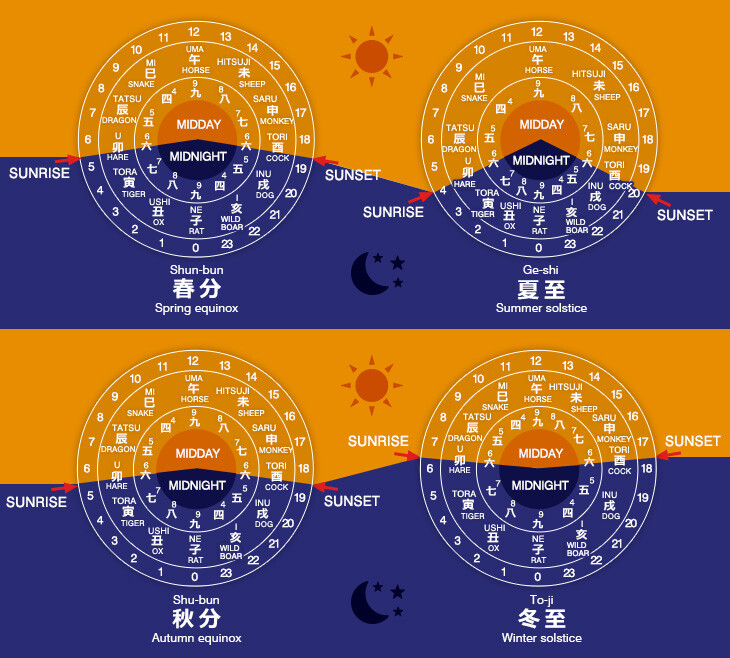
I think this is kind of similar to what we would call “the witching hour” in English, except it’s much more specific. Ushi no toki mairi refers to the hour of the ox (between 1 and 3am) (for reference, the witching hour is apparently 3 to 4 am, which I didnt know! I thought it was just late at night in general lol) and is a method of cursing someone by hammering nails into a sacred tree during the ox hour.
You can read more on Wikipedia: Ushi no toki mairi - Wikipedia

By the way, its a bit confusing to read, but in Edo period the periods of the day were associated with the Zodiac. It seems that the Japanese system was much like the Roman sundial system, where the length of time units were adjusted according to the season.

source: Seasonal Time System | THE SEIKO MUSEUM GINZA

針供養 harikuyou, memorial service for old needles

This is an annual event where women bring their old and broken needles to a shrine or temple to thank them for their hard work.
You can read about it here! 針供養会 - 浅草寺

11 Likes

This post was flagged by the community and is temporarily hidden.

1 Like

Now anime “Dragon Ball” makes much more sense: ドラゴンの金玉

2 Likes

This is from this short, but my favorite is the etymology of the word cat. Originally, cat was 寝子魔 (ねこま) which at the time literally meant sleeping child animal and later got shortened to just ねこ and got another kanji I guess. That channel has lots of stuff like this if that interests anyone!

Unrelated but I really need to fix IME on my desktop PC because it’s a pain to search up every individual kana/kanji :sweat_smile:

4 Likes

When western timekeeping arrived in Japan, it was a thing to create clocks which displayed the time in both western and Japanese systems. Engineering marvels that never caught on.

9 Likes

Love how everyone posts about words/phrases with deep lore and historical background.

I remembered another funny term that is more contemporary: 「大人買い」(おとながい).

It comes from 大人 as in “adult” and 買 for “buy”.

Although some people use the term a bit freely for different types of purchases, it refers to using your funds as an adult to buy products that are usually “intended for kids” (e.g. trading cards, toys, candy).

Here is an article with more details: Otonagai: A Japanese Word for Your Toy and Candy Habit

TL;DR… Example of 大人買い:
A: “Do you really need another Hatsune Miku figurine?”
B: ¯\(ツ)/¯ (transaction approved)

7 Likes

I think this phrase: 鴨がネギをしょって来る (Kamo ga negi wo shotte kuru) is very funny, it’s what the Pokémon Farfetch’d (kamonegi in Japanese) is based on and it’s when I learned that kamo means ‘sucker’ in Japanese (similar to fish in English). What can be more stupid than walking in with the perfect garnish, ready to be cooked :slight_smile:

4 Likes

Just learnt that the other day ! It’s also referenced in that new Kaitani Shinobu manga (author of Liar Game and One Outs), カモのネギには毒がある

2 Likes

Today I learned the word donburako - Jisho.org which is listed as “plop” but is known to Japanese people as “the onomatope for when a peach is floating in water” LMAo

Apparently it’s almost exclusively used in Momotaro and if you tell Japanese people you know it they will be very impressed

6 Likes

Not really trivia about a specific word or phrase, but yesterday I found out something wild while trying to figure out why my phone wouldn’t type the kanji for くず the way I had learnt it.

In 2004 the two towns 新城町(しんじょうちょう) and 當麻町(たいまちょう) merged to become 葛城市. At the time, the kanji was picked for the name, even though it actually differs from the kanji used by other nearby places, which used image
instead. The reason for this was that Windows operating systems at the time used that kanji, and back in 2023 when the name was being decided, officials wanted it to be easier for people to fill out forms on the computer.

However, later that same year (2004) the Window’s code for that kanji was updated to use image, but at that point it was too late and the city had already announced the name. The official name is still the kanji, but the city says they don’t really care which one gets used, and even have a page on the city’s webpage that talks about it: 葛の字の取り扱い/葛城市

5 Likes