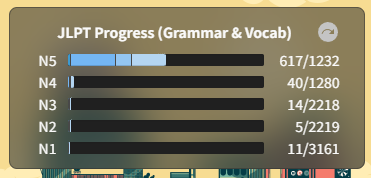
Actually, a few days ago I decided not to take the N5 exam in December and to start studying for N4 instead (but for NEXT year, I don’t like to stress me over a just-nice-to-have exam), since I already feel ready for the N5 exam and have lost all motivation to take it…
In any case, here’s my experience and thoughts on the path to N5:
-
To pass the reading and listening sections, you need vocabulary (including kanji) and grammar knowledge.
-
You can test and solidify your vocabulary/grammar knowledge using the reading exercises.
-
Listening is (for me as a beginner) the hardest part, since you have to get used to the pace, and just because you understand what you hear doesn’t mean you’ll remember the content. Also: It’s no use if you can make out individual words but don’t understand their meanings. In other words, if you have a transcript for the audio, you should at least be able to read/understand it.
So the learning order would be: Vocabulary + Grammar – Reading – Listening.
BUT at the same time, you should start with the hardest things as early as possible, so here’s my suggestion:
July/August: Binge-learn vocabulary and grammar; you don’t need to remember everything yet at this stage. It’s best, if you learn vocab with audio, so your hearing gets used to the sound. If you learn with example sentences, you will also learn how to use the vocab, probably remember the vocab better and you already practice reading. However, it can also slow you down at the beginning, so you have to decide for yourself, if example sentences are really worth the time at this stage.
If you’ve already built up a good vocabulary foundation (since you may be learning Japanese already for a while, befor you now decided to take the N5 exam), you can start practicing listening comprehension through comprehensible input right away.
August/September: Solidify vocabulary and grammar knowledge, start to practice reading, and build listening comprehension through comprehensible input - so you don’t need to know all the vocab yet, but you also don’t want to wait until the last minute to practice, do you?
September/October: Get faster at reading, and practice specific N5 listening exercices for the exam. Don’t stress if you still don’t remember everything from your vocab deck (you don’t need all the 1100 words from bunpro), instead learn the vocab you come across your exercises.
If you aren’t already using an app or a book with JLPT exercises, now would be a good time.
November: Mock exams. Lots of mock exams. To test your knowledge and get used to the JLPT format and the time management.
Especially when it comes to reading and listening, some questions can be tricky, even if you think you’ve understood the content. (With some of the questions in my book, I thought it wasn’t just a language test, but also an intelligence test  )
)
When it comes to vocabulary, kanji, and grammar however, it’s mainly a matter of memorization. Nuances like politeness or similar concepts don’t seem to play a major role until higher JLPT levels.
In my opinion, just don’t underestimate the reading and listening part.
Last words: Feel free to disagree with me 
P.S.: N4 in 5 months might be possible, if you have plenty of time to study and you do study consistently and efficiently. But since I don’t have that much time myself and I’m not a very persistent person (my motivation goes up and down every few weeks), I can’t offer any advice on that.