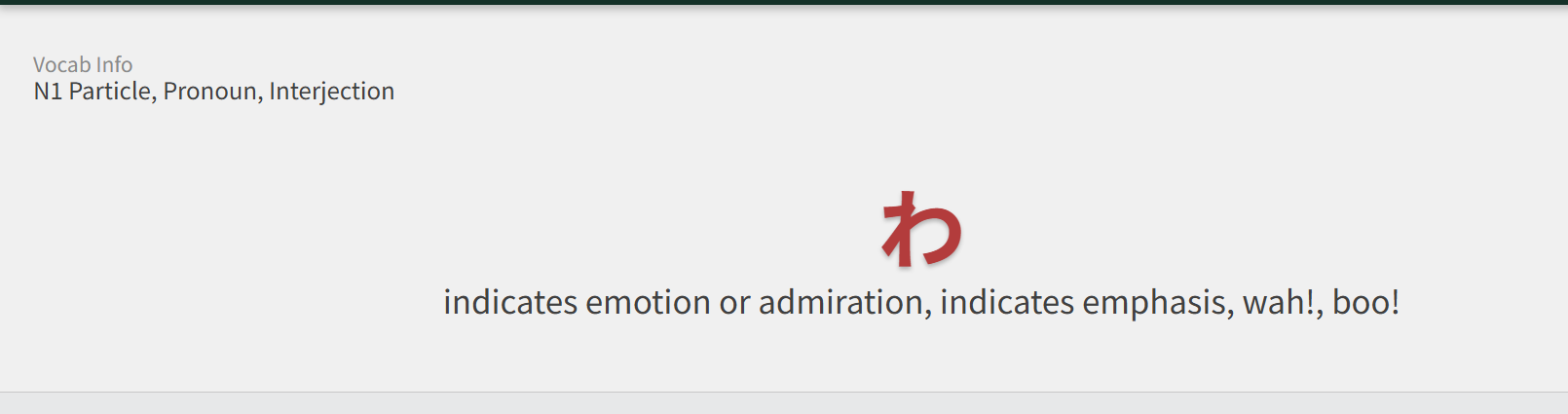
それは is N1, though. That’s not それは as in それはペンです but それは as in… first example sentence on the page.
医者の一家のお家は、それは立派です
Translation
The doctor’s family home is absolutely magnificent.
Translation if what you assumed it was without reading it was
As for the doctor’s family home, as for that, it was magnificent
This actually takes us back to the other discussion which is - how many different それは items should there be? Just それ? それ、それは as in particle one and それは as in the other translation? それは as the particle should not be one at all, but それは the word should be?
It’s not as simple as one might think. Doesn’t mean there isn’t work to do though…
These aren’t the same benchmarks. The N5 deck doesn’t have the most common words, it has the most N5ish words that help you pass the N5 test.
I still 100% agree with what I assume is your sentiment though, which is, there should be a deck for more common words for people who aren’t studying specifically for JLPT or might be more conversation focused. Custom decks help, for sure, but even that isn’t necessarily the most efficient learning method.
Kanji really throws that standard language learning formula for a loop.
For example, Wanikani teaches you N1 kanji like 死 from the beginning because the word is fairly common and is using simple radicals. There are similar examples of “out of order” kanji all the way up through level 20 or so, after which things get a bit more programmatic. WK isn’t perfect either (一斤!?) but there’s something to be said about not teaching the numbers 1-10 all in level 1 because 四 六 and 五 (4-5 strokes) are a bit more challenging than 一 二 三 七 八 and 十 (1-3 strokes).