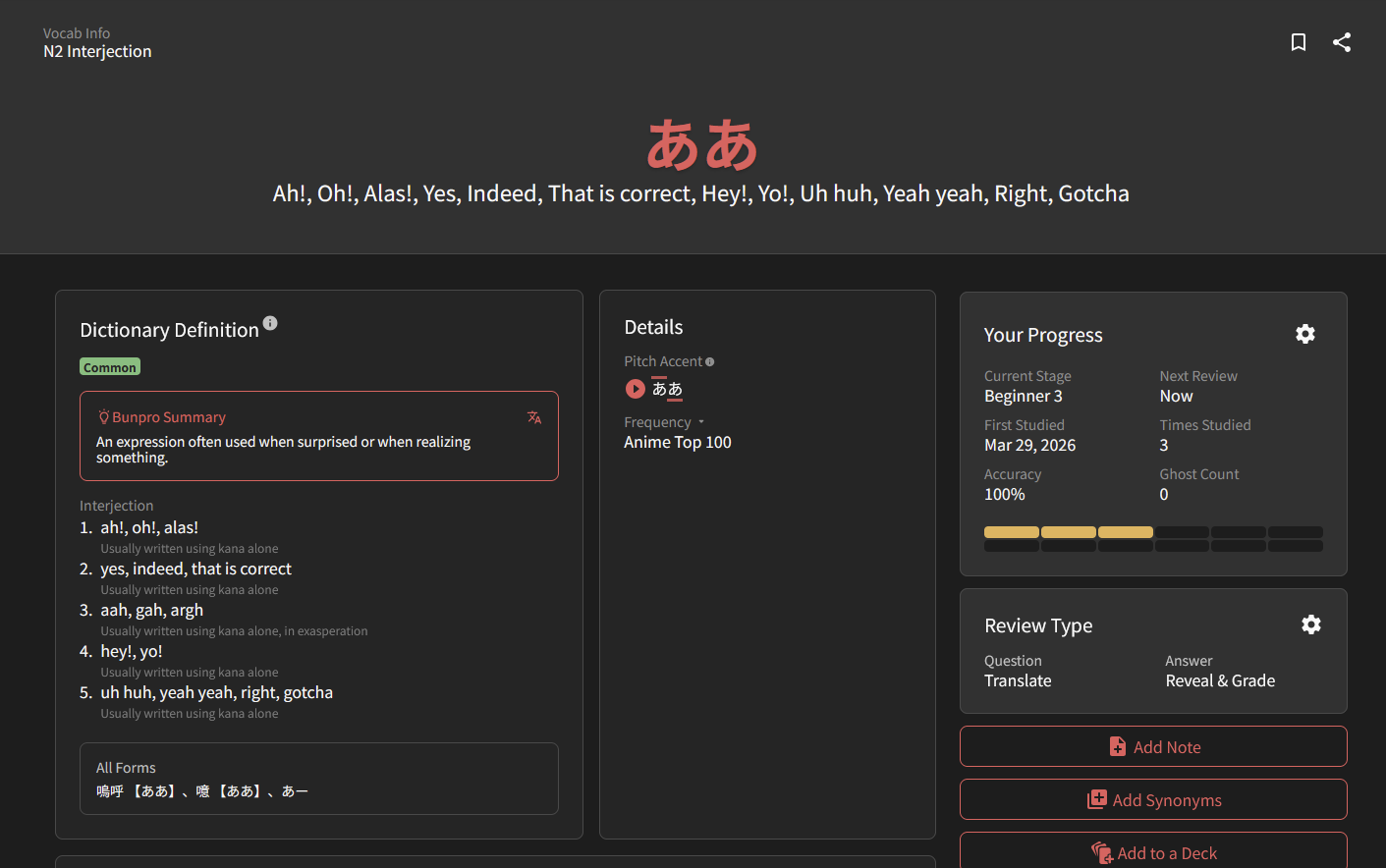
N1 Vocab list is flawed

Every time I to go to learn a new batch of words, I have to click the “Mark as Mastered” button 3-4 times to skip some nonsense words that aren’t actually N1, and shouldn’t be in the list at all.

The worst offender

How are these lists curated and is there any editing of them before they are posted as decks?

17 Likes

Yeah, unfortunately have to wholeheartedly agree. Based on some of the other posts I’ve seen on the forums, it is likely that all levels of vocabulary need a revamp. I find myself in the same situation as you, clicking mark as mastered for vocab such as 死, ずつ、店, and almost every katakana word in the Bunpro N1 Vocab deck.
I would appreciate at least an explanation for how and why the words are placed in each category. “Appearance on the (N1,2,3…)exam” as a standard for inclusion in certain levels does not hold up to any level of scrutiny as that is too small a sample size.
Whether it be anime, books, music, games, or even just being near Japanese speakers, whatever extracurricular method you study or receive input through, you would run into many of these words far before you would even consider taking the N1 exam.

8 Likes

I have found some frustrating things too but could you perhaps be a bit more polite about it? :sweat_smile:

People have worked hard on this site and all after all…

36 Likes

I’d hazard a guess that there was a desire to limit how many words are included in lower-level N5-N2 decks, and so common words that “didn’t fit” ended up pushed up to N1.

Agreed with identified issues.

Grammar words e.g. けど, とは shouldn’t be duplicated in vocab decks at all.

English katakana loanwords e.g ウイルス shouldn’t be in N3-N1 decks at all. English speakers can guess them easily, and for non-English speaking learners there can be a separate katakana loanword supplement deck. All the obvious exceptions like マンション can be covered in N4.

Hundreds of common words like 休日 should be moved from N1 down to N4-N2.

On the other hand, I wouldn’t call it “terrible”.

I’ve checked a couple of my past practice tests, and the vast majority of tested words are included in Bunpro’s vocab decks. There are some missing exceptions e.g. 寂れる, but it seems that the deck does generally prepare for taking an N1.

6 Likes

I actually disagree with this. Seeing a lot of the N4 and N3 grammar again in the vocabulary section has helped cement some of these difficult concepts in my brain.

I don’t disagree that some of the vocabulary seem misplaced for their level, but I’m half way through N3 vocabulary after completing N5 and N4, and I’ve generally found it to be a useful experience.

After completing the N5 and N4 Bunpro vocabulary as well as wanikani to about level 30, the vocabulary section of JLPT N4 was a breeze.

9 Likes

I 100% agree about the grammar items. It doesn’t make sense to do SRS twice for those. Those and the katakana words are the main reason I don’t do the vocab decks.

1 Like

I always find it interesting that people dislike katakana words being in decks so much. The decks aren’t “n5 but minus words you can guess based on your mother tongue” they’re “n5” etc. People should be able to expect a more or less close to full list of words for the exam without any addendum like “sorry this isn’t actually all the words”

Also I dont think words like ウィルス are that easy to guess as a native English speaker tbh. Neither are words like ワクチン. Also ウィルス doesn’t come from English, it comes from Latin, which is probably part of why it’s pronounced as weerus not bairus or something. I’m splitting hairs, but I think loanwords are often false friends.

31 Likes

I tend to agree. I guess it depends on your goals. If you just want to consume content, you can probably get by without worrying too much about certain loan words like the ones you mentioned.

However, in order to actually produce some loan words like ワクチン in conversation, you probably need a decent amount of exposure and output practice. Otherwise, you may say something like バクチン, and not be understood at all.

There’s also the fact that not all Japanese words have a loan-word equivalent (which also slightly overlaps with your point about words that are false friends).

In the end, one of the strongest points of Bunpro is that we do not require you to learn any words to progress. Whether you want to Pass N1, be conversational, or be able to read manga, you can customize Bunpro to work for your goals. If you think something shouldn’t be in the current deck you are studying, you can skip it or mark it as mastered. If you think there is a word that is important for you to study that we mark as N3, even though you’re only studying for N5, you can also add it to your reviews.

16 Likes

In our lord Mark As Mastered we trust, bunmen :pray:

But also you reminded me, Bunpro is available in multiple languages, so it would be unfair to penalise other users and remove katakana words when the site is so customisable to begin with. Bunpro has become such a life saver for me in that regard, and I think it really is what sets it apart from most apps while not becoming a wild west burden like Anki (am pro Anki, but am not pro trying to manage making my own cards and all that comes with that - I am very lazy LMAO).

12 Likes

Having worked myself through N5 and N3 in both anki decks and now on bunpro I’ve been quite happy with how they match up. Of course there are some oddballs and mixups between N2/N3/N4 decks.

On the topic of ‘worst offenders’:


Pretty sure I’ve seen this at N5 in my Anki deck

7 Likes

It would honestly be an easier topic to discuss if BP team set a clear goal for the official decks then.

The decks are called “JLPT vocabulary”. JLPT doesn’t test production. Therefore using a criteria of production for including or not including words sounds contradictory.

If the intention is to provide general vocab decks without a specific learning goal in mind, then maybe calling them “core 1k/2k/4k/6k/9k” would be more descriptive.

Well, in any case, if BP team considers current vocab decks to be perfect, that’s also good to know.

Yeah I also spent a couple hours sorting my known words on Bunpro based on my anki deck and I was quite shocked to find some ez pz words on the N1 list. Nothing much we can do about it beside creating your own custom deck it as I think that bunpro are using an official JLPT list to create their JLPT deck.

The new vocab coverage feature is a good tool to skim through known vocab while studying kown / unknown grammar !

2 Likes

I think there may be a bit of a misunderstanding, so I just want to clarify a couple of points.

You’re absolutely right that the JLPT doesn’t test production. I wasn’t suggesting that output is used as a criterion for including words in the decks, my earlier point was just that loanwords can sometimes require a bit more exposure to use naturally, depending on your goals.

As for the decks themselves, I wasn’t involved in their creation, but loanwords do appear on the JLPT and in common prep materials, so it makes sense that they’re included.

I also want to be clear that I’m not saying the decks are perfect. Part of the issue is there is no clear standard for what would make them perfect. Language learning is inherently messy, and since there’s no official JLPT vocabulary list, there will always be some ambiguity around what should or shouldn’t be included.

At the end of the day, the decks are meant to be a flexible resource rather than a strict checklist for passing the JLPT, so users can adjust them based on what they personally find useful.

23 Likes

I agree with this. If you’re an English speaker, yeah, a lot of them are essentially English, but they’re on the list because that’s where you’re expected to know that borrowed word. The lists are put together based on the test, and people come from around the world to take these exams, so the lists are often made based on appearing in the exam. People coming from other language backgrounds would have to learn these borrowed English words. And like you said, a lot of the English words aren’t logical. Think of something like “stove” that means a space heater in Japanese. Not to mention a lot of these loan words are hard to spell in Japanese.

I actually left the word イエス in my list because while I know it can mean “yes,” I didn’t know it could be “Jesus.” If I see one I know, I just mark as mastered and move on.

6 Likes

Honestly, as a native English speaker, I sometimes find katakana words very hard to read and understand.

First, there’s the assumption that it’s an English loan, but that is definitely not always the case. It’s why my wife always uses non-English loan words, and confuses the heck out of me.

Second, the meaning is often subtlety or completely changed from the English meaning, making the Japanese context very important.

9 Likes

I always just take easy words in a deck as a “freebie” towards my daily learn count so I am completely fine with it personally. :sweat_smile:

23 Likes

I am quite happy with how the website is overall designed and gives so much freedom for personalizing the learning experience. I understand that people have different goals when learning a language. Some may want to just master input, get N1 as a personal achievement and enjoy their favorite media. Others want to become fluent at the language and communicate with natives.

It’s impossible to set in stone a single path that makes everyone happy, but I think that if Bunpro wants to stand as a true contender to other platforms or ways of learning on the long run, it has to appeal to those seeking a broader knowledge of the language. That’s why I think that including katakana words on the default learning path is beneficial. If you don’t care about it, you can skip it, otherwise you can rest assured that you’re sticking with material that will help you through all JLPT levels.

I agree it’s weird finding such simple words on N2/N1 decks. But I also think that although some restructure would be nice, the harm is minimal.

It only makes me worry a bit that out of the near 10,000 words included up to N1, many could be some sort of repetition that gives a false sense of knowing more than what you really get to learn here (this is just an assumption, not sure about it). Just think of all the vocab related to variants of こそあど言葉 that we have in the default decks.

PS. I would love a deck with all the words marked with the Common tag that I guess come straight out of JMdict or similar, as other webs like Jisho share exactly the same tag.

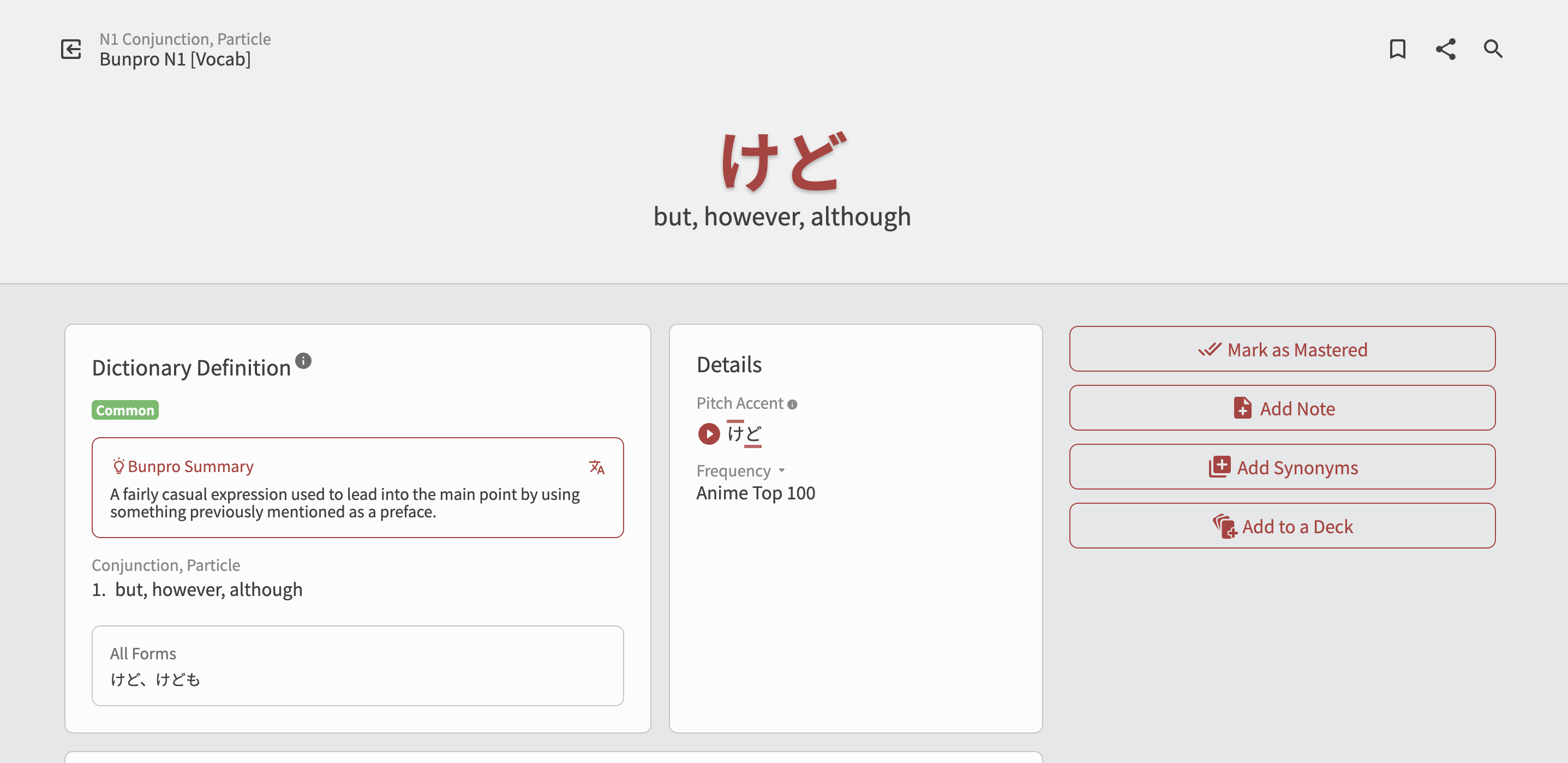
4 Likes

This brings to me another good point- even if ダンス is super easy to guess, having been exposed to it properly first will make your processing speed that much faster when it comes to test time. Even if you can guess it, isn’t it better to save yourself the guessing and processing time by being certain first?

Iunno though, different strokes for different folks and all. But I also agree with @lunchbox1, love a freebie easy word!

4 Likes

In defense of stupid JLPT vocab lists…

JLPT tends to test on certain, more difficult concepts as things move on. So things like the previously mentioned ウイルス (Latin) and ワクチン (German) will end up in more complicated passages than words like ケーキ (English) or パン (Portuguese) or レストラン (French). So yeah… expect harder concepts later, even if they’re Katakana.

Second, the JLPT is run in over 100 countries. Sure, レストラン might be easy for French or English natives, but in Chinese it looks nothing like this.

Difficulty is also based on Japanese test maker’s preconceptions. Today a native told me 璧 looked wrong… could be N1 because despite how common the word 完璧 is, that second kanji keeps it away from earlier tests.

I think two ways the JLPT is organized causes issues for learning Japanese vocab, and Bunpro exacerbates the issue.

  1. N5 is too kana heavy - it delays learning Kanji and the kanji that are learned aren’t introduced in an order that makes sense, ultimately slowing down progress to N4 / N3.

  2. The distance from N2 to N1 is too big. 1000 Kanji added (double N5-N2) which leads to a ridiculous amount of vocab potential that widens a bit with each new test. A lot of these Kanji need to move down to N3/N2, and a few might even need to go to N4 (綺麗、挨拶).

Post is getting long, so to wrap up, I think when Bunrpo adds a Kanji-learning path, it needs to smooth out the vocab path alongside it.

9 Likes

I can understand various explanations for why basic-seeming katakana words end up in the N1 deck, but it just fails the gut check that N2 and N1 are supposed to be the hard stuff, for people who’ve been living in-country for multiple years and kept their studies up. It’s weird to learn an idiom that only comes up in classical literature, and then follow it up with the first word you learned when you got off the plane.

That’s probably on the JLPT test writers more than anything, but I think any reasonable person looking at it would agree that it’s weird.

3 Likes