
[people've lived in Japan] train names mean anything to you?

For those who have lived in Japan, do the train speed names mean much to you? I lived in Kanagawa so I lived with Keiykuu’s (普通/急行/特急/快特) and JR’s (普通/快速/特快/特急), but to be honest my cognitive flow chart is:

  • 普通«Local»
  • 急行«Express»
  • Pick two random kanji from 快特急速, invent a word, ignore it anyway, and just go by color

I mean, even in English the terms are kinda nonsense to me. “Limited Express”. “Rapid Express”. “Rapid Service.” I’m just left with a blank face upon hearing any of those. I’m left thinking, “Are those supposed to mean something to me?” I might be inventing this memory, but I swear I’ve had multiple interactions with people where they told me they took X train (IN ENGLISH), and I was still lost, e.g:
“Yeah, I took the limited express from Shinagawa.”
“What, like, the Keikyuu green train?”

I ask since these words are part of my vocab rotation, but to be honest, I only understand them in the aforementioned tiers, i.e. (normal, express, everything else). I’m always torn between “I should learn the proper definitions of these names” and “ah whatever it’s all advertising fluff nonsense anyway - I know it’s a train speed; good enough”. Unless we’re talking Shinkansen trains, but even then I’m going to think of them by the little names they have, e.g. “nozomi”.

4 Likes

There are different lines, within these lines limited express and express are just trains that skip stops. Local goes to every stop on the line. They are more describing words that affect the speed of arrival than saying anything about the actual route. Hope that makes more sense!

2 Likes

The terms are inconsistent between rail operators. For some you may need to pay extra to board 特急 trains (for example, for JR, you need to buy a 特急券). For some operators this simply denotes how often a train stops (e.g. stopping at every station v.s. stopping at only major stations v.s. going straight from A to B).

You just need to remember the terms for each operator!

3 Likes

disclaimer: not living in japan.

i love watching japanese train videos :sweat_smile: just a view from the cabin, driving from one station to the other. those train vocab start to grow on me ^^
1 Like

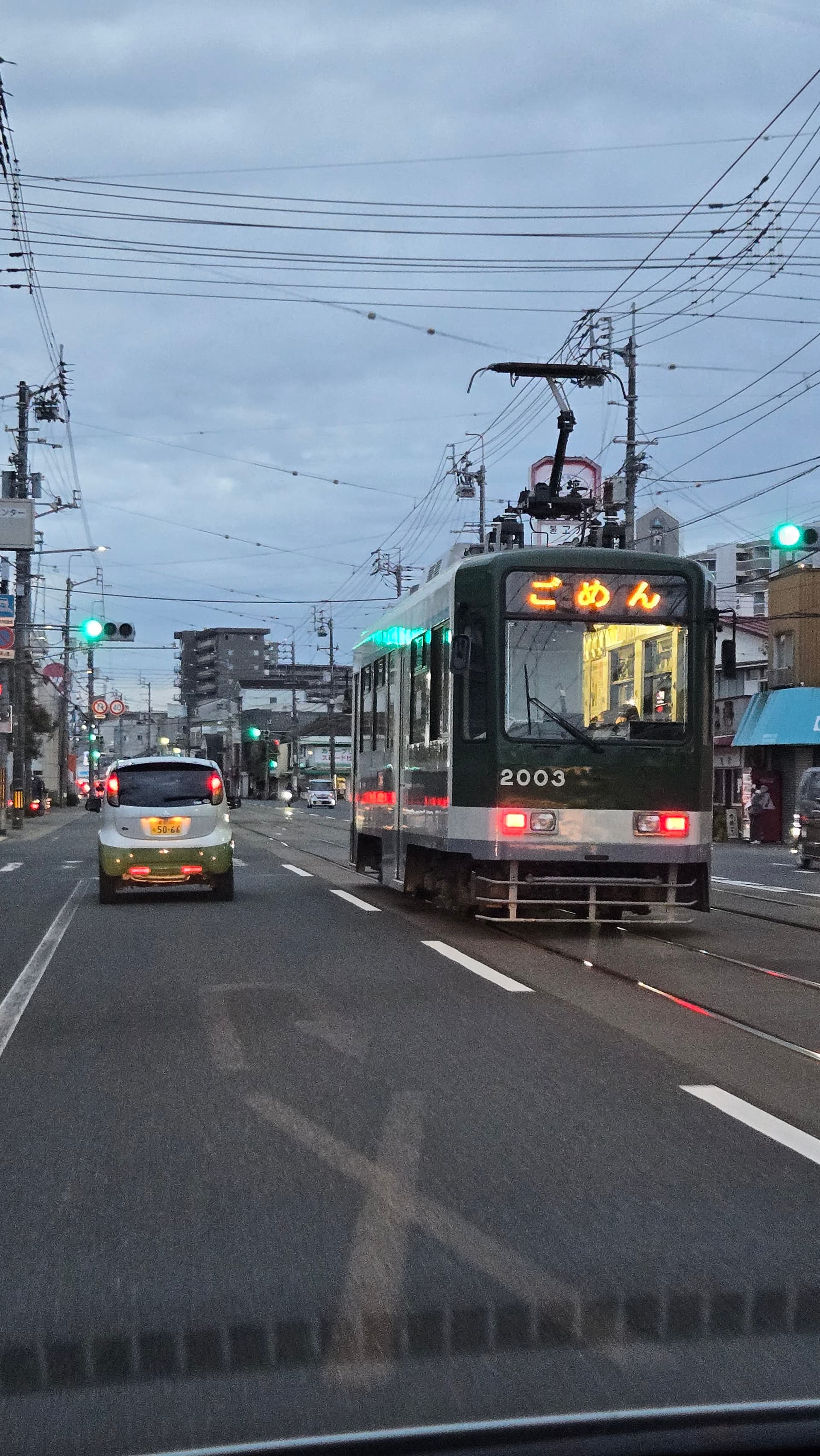
I thought you meant actual train names as this one puzzled me (somewhere near Kochi, Shikoku) recently. I wondered: why would a tram say “Sorry”? :rofl:

7 Likes

I did know the meaning for my local trains. It had to do with which stations got stops. Local was everything, express skipped a few, something like special express might take off a few more, and then a rapid train was going to skip the most stations and do only major stops.

I’m not sure if this is everywhere, but I did pay attention to it because I lived in a fairly rural area and it depended on where I was going and whether a train stopped there. If I was traveling an 1+ hours away on slow trains and had the option of cutting out 30 minutes by taking a super express, I’d do it. If I was just going a few stops it didn’t really matter to me, so it was just about making sure the train went where I was going.

In my day-to-day life, I usually just showed up at the station when I wanted to leave and took the next train that showed up because my local station was tiny and only local trains stopped there. But for those times when I wanted to go farther away, I would go to a bigger station and definitely plan out when I could catch the express trains just to cut down on time.

2 Likes

Took me a while to learn what they all mean, even after having lived here for awhile. You are right, even in English the names don’t really tell you much unless you take trains regularly. Basically this is what they mean -

First of all, all trains on the same track will follow the same line (in Japan). The only difference is which station they stop at.

普通 - All stations
急行 - Most commuter heavy stations
特急 - Only major stations

On a map, it will usually look like this

→ 普 急 特

名 ・ ・ ・
名 ・
名 ・
名 ・ ・
名 ・
名 ・ ・ ・
名 ・
名 ・
名 ・ ・
名 ・
名 ・ ・ ・

名 is the station name. 急 indicates the express will stop there, 特 indicates the rapid express will stop there. So if you wanna stop at a minor station, but accidentally get on a rapid express, you’re boned :upside_down_face:.

So basically, the names have nothing to do with the speed of the train, just the time. Less stops = faster time.

7 Likes

I haven’t lived in Japan for an extensive amount of time, but I have spent enough time for this type of thing to become troublesome.

What I will agree with is that the English names don’t really makes sense to me. I don’t live in place that has a good rail system, so when I saw Rapid and Local, I’m like okay, I know what rapid means, but what the heck does it mean by local. Then I look at the Japanese.

各駅停車

And I’m like ohhh, it means to stop at every station. That’s literally what the Kanji says. I will agree that the verbage could be more consistent. I would use “Frequent stop” instead of Local.

2 Likes

As ph3rin mentioned, the terms are inconsistently used between the operators. So I just pay attention to the specific train I am looking at riding for whatever trip I am taking.

Because of the train line I take most frequently, though, I associate 特快 with ‘commuter rapid’ though. Even though that’s not what it means…but 青梅特快 is often called ‘Ome Commuter Rapid’ on google maps directions. I have definitely learned my lesson about paying attention to whether it’s the 急行 or the 特快…

1 Like

I live in the middle of redacted nowhere and don’t even have a train station within 10km of my home. Whenever I do take a train in my prefecture, it’s usually going to the final destination anyways so the names just mean how quickly I’ll arrive.

However, when I take trips to more train heavy areas they do end up mattering. For example, I’m staying in Kanagawa now since the hotels are cheaper than Tokyo, but still taking a train into Tokyo and back most days. Knowing which train actually stops at my station has become imperative. Especially since I’m mostly taking the last train. I gotta make sure I get the right one or I’m in for a long night. It also helps to know if I need to plan a transfer.

1 Like

Visiting Japan, the names didn’t matter at all–I just boarded whichever train Google Maps told me to–EXCEPT it was a royal pain figuring out whether Special or Limited or Rapid Expresses needed extra fares (and which fares) on which railways, since グーグルくん would, happily and without warning, order me onto reservation-only carriages or trains that needed additional tickets I hadn’t purchased.

Eventually, I figured that out and either bought the extra fare or waited for the next train.

2 Likes

Google maps planner was giving me accurate fares, but I don’t think it explicitly called out that a supplement is needed. So it was on me to compare the prices it shows for different options to spot what requires a supplement and what doesn’t.

3 Likes

The train line I’m on, the 特急 goes the farthest [from A city to D City with 田舎 between ]and costs extra, 快速 runs from A to B and C to D. and 普通 goes From A to B, B to C and C to D. B to C you pay in coins to the counductor like a bus [the rest of the line has ticket machines and IC card readers]

2 Likes

Catching a train in Japan sounds quite difficult! But then again, is it simple here in the UK :face_with_monocle:

2 Likes

What about payment? Is there the danger I buy a ticket for train company A to find out to get to my destination I should have bought a ticket from train company B?

2 Likes

brilliant, thanks for the help. I am finally traveling to Japan (checks calendar) next year so thinking about that, but I think I’ll start another thread for that rather ‘derailing’ this one.

1 Like

Oh yeah absolutely.

If you land in Tokyo Narita, there are different operators all departing from the same platform. You have to decide if you are taking an IC card train, or a more expensive Skyliner. Long queues to various machines and counters, and general airport stress don’t help. And if you want a refundable physical IC card as opposed to an iphone IC card, those are sometimes out of stock in Narita.

Some JR segments, some non-JR local train operators, and all highway buses don’t accept IC cards, so you have to buy the right ticket from the right machine (or counter). For instance, if you go see Hirosaki castle sakura festival, Hirosaki-Kuroishi line is such local operator. Highway buses are run by many different companies.

On some stations different operators all accept IC cards, so you just have to check out - check in at the correct gates. For example Nagoya Meitetsu, or ferries, or any stations with shinkansen stops.

Ticket counters don’t operate 24/7. A crowd of people on Kawaguchiko station all trying to get back to Tokyo with all busses sold out was a sight to see.

You give yourself an advantage if you figure out how to buy your non-IC tickets online and board with a QR code or whatever they use. Sometimes websites want a JP phone number that you likely don’t have as a tourist (data-only SIM), sometimes you can fill in any number and it’s never actually used for any verification.

But I haven’t had any unsolvable issues.
Just plan your itinerary (plus backup option) in advance. Get IC cards for everyone in your group. Carry backup cash. Buy shinkansen or highway bus tickets 1 day in advance. Give yourself extra time on unfamiliar stations. Ask station attendants for help if anything goes wrong with check-ins.

3 Likes

Just to add on this already great advice:
In some bigger stations where more lines run, theres multiple areas each behind their own IC gate with different fare prices. So pay close attention to the signs, or else you can get locked out since you cant leave from the same gate you entered.
Thats about as close to buying a wrong ticket you can get. There’s usually station staff present who will let you out if you tell them you picked the wrong line though.
Also on iPhones you can charge your digital suica through apple wallet which is super convenient while for the physical ones you need cash.

2 Likes