
Would learning the most frequent radicals greatly benefit me in learning Kanji? I saw on a random wikipedia article that just 52 radicals occur in 3/4 of the 常用漢字. Learning 52 radicals probably wouldn’t be that hard, but I wanted to know if it is really worth it.
1 Like
Help in what sense? It would probably be beneficial in terms of writing them faster/more legibly, but not very helpful in terms of meaning/pronunciation.
1 Like
I can’t read at all really, but learning the radicals just helps to not think the kanji are a bunch of random drawings. I have tried to learn Chinese and feel the same way, that learning the radicals doesn’t help much.
Using WaniKani to memorize the different readings of each kanji (and the patterns of when each reading is used) would be more helpful.
The advice to “learn vocabulary not kanji” makes sense to me.
1 Like
Learning radicals (and kanji study in general) is valuable for reading Japanese and understanding kanji structure. There are many kanji that look very similar so being able to identify different radicals can help distinguish them.
For example: 金 is the kanji for “gold” and “money” while 全 is the kanji for ”whole" or “complete”. The only significant difference between the two is the addition of two strokes at the bottom of the “gold” kanji. There are many kanji that look very similar so being able to identify different radicals can help distinguish them.
That being said, it is not necessary to learn Japanese. Kanji can have several different readings so when reading a sentence, its going to be context that helps you know which version is being used. This also makes it much easier when (and if) you do learn the kanji. The experience isn’t “ok, i’ve never seen this before and have no context for this, but it is apparently pronounced のう、の or あらたせ (this is made up for example’s sake)” to "Oh, I’ve ran into this word before, that’s what it looks like!
So, in summary, radicals are very useful to learn kanji, which helps you know what a reading for a kanji could be (which is valuable), but it is also equally valid to just learn vocabulary, be exposed to countless contexts in which that vocabulary is being used, and learn that way, Either way, you’re going to need tons and tons and tons of exposure
sorry, i didnt elaborate that much. i meant that learning the radicals could help me memorize and identify the kanji better.
I think it depends on your learning style, how you memorize things better.
For me, it would not help, because it does not make sense to my brain to learn smaller “abstract” chunks just to learn bigger “abstract” chunks, because my brain does not make the connection between the two.
So I stick to learning the kanji themselves in context. Context is the goat for me. I learn x kanji together with a few frequent words containing x kanji. I separately learn kanji words with example sentences.
Try different approaches and stick with the one you feel the easiest. Radicals are just as good of a starting point like any other.
thanks for you feedback, ill experiment with different learning styles and see which one works the best for me 
1 Like
Tools like Wanikani use radicals to “get you to learn them faster”. It does make sense, but only if you’re going to put in a significant amount of effort over a shortish period (1-2 years). If you don’t know anything about kanji yet, starting out with that method is probably beneficial. But I imagine it will pay off only when these (sort of) corner cases of multiple very similar kanji start to appear, which is maybe 25% of the way in.
Having completed the Wanikani journey (2.5 years in), I don’t remember anything about the radicals. I am currently just trying to brute force remembering the difference between similar kanjis with some moderate success. Right now none of the learning tools can really beat consuming actual japanese media.
2 Likes
Usually the similar appearing kanji have different enough meanings that which kanji is being used is obvious by context. Now, writing in kanji is a different story, but fortunately I can rely on my computer most of the time for that. 
1 Like
When I first started learning kanji, I tried to memorize the radicals, but I gave up pretty quickly. I picked up some radicals right away, but others were hard to remember, or I kept mixing them up with other radicals. BUT I find some radicals really useful, like the ones for person, water, hand, and to go… (e.g. for telling apart 待 and 持 or for remembering 休 = 人 + 木 = a person rests under a tree).
Still, for me repetition works best.
So, yes, in my opinion, it would be beneficial for you to “try” to learn the radicals, meaning to spend only a little time for learning them (don’t know, probably at most a week), because they could help you at some point, but you’ll have to figure out for yourself whether memorizing all of them will actually help you. Since there isn’t one learning method that works perfectly for everyone.
1 Like
There some very helpful components, and some less helpful ones.
You should definitely familiarize yourself with these ones:
- left-hand meaning radicals (see List of kanji radicals by frequency - Wikipedia e.g. 氵=水=water, 忄=⺗=心=heart)
- right-hand phonetic components (see Kanji Phonetics - TheMoeWay although I haven’t used their deck specifically and cannot vouch for it)
The rest of WK / Heisig “radicals” that don’t have either etymological or phonetic rooting, and are made purely for English-language mnemonic convenience, can be skipped until much later.
2 Likes
I don’t think the meanings of radicals matter as much as the readings do. 青、清、静、精 all have the onyomi of せい. There’s many examples like this. Picking up on these patterns helps. I think here is also some semantic connection between these kanji of having some sense of cleanness/purity, but I don’t think learning that helps that much.
I learned kanji with an app called Kanji Garden which puts the kanji with similar readings next to each other. It was my favourite kanji learning app for a while since it helped me understand onyomi and kunyomi better.
I’m not sure how I’d learn kanji today, but don’t repeat my mistake of just learning kanji, but also the words which use them. Wanikani seems like a good tool.
1 Like
Learning the radicals can greatly help speed you up over the long run in terms of learning more kanji, but learning the radicals alone won’t actually teach you any Japanese by themselves, because you still won’t know the meanings or the readings of the kanji that those radicals can create when assembled. Think of it like a speed boost or accelerator; just keep in mind that the payoff for learning radicals is a bit delayed and doesn’t teach you Japanese by itself.
Learning radicals simply gives you anchors for building kanji. Once you know more and more kanji, learning more kanji is easier because you will eventually know enough radicals that you are building new kanji from familiar radicals, which is psychologically a win as you aren’t starting from scratch every time, and those radicals can be used to create stories for the new kanji, except because the radicals start to repeat, making those stories gets easier.
I do believe that WaniKani is a great resource for the average person starting out who doesn’t really know how to study kanji and just wants a single, one-stop-shop for learning kanji. Even with no background knowledge, all you have to do is follow along the lessons and do your reviews. What WK does well is teach you some radicals, but then immediately teach you some kanji made from radicals and then some vocab made from those kanji, and then gives you example sentences for the vocab, so that you can immediately start to apply your knowledge. However, I know there are other ways to learn kanji, so I’ll leave it up to you to experiment and then decide. 
One other factor that’s important is immersion. If you’re constantly immersed, learning kanji is easier because you just see a lot of kanji already naturally, so it becomes like second nature. However, immersion only starts being useful once you know at least some kanji and radicals - that way, even if you don’t know all the kanji, you can at least call out what radicals they’re made out of, and that will be extra radical practice!
3 Likes
Stating the nowadays obvious: ask AI.
I just asked my go-to AI and it gave me a detailed response with pros and cons for each method, how they fit different learning styles etc. Maybe worth a try, if not else, you may find some methods you have not heard of yet.
1 Like
I still use a paper dictionary. Radicals, and number of strokes, is how it is all catalogued.
When I am old and poor, and can’t afford internet and maybe even not afford electricity, I’ll still have my dictionary.
5 Likes
the meanings help you remember them tho (and their readings)
2 Likes
I use AI for some things too but I think its better not to outsource all questions to AI when this is quite an easy topic to investigate by one’s self (and more fruitful if done that way)
7 Likes
@appogiatura gave a really good answer above.
The radicals, “official” ones and otherwise, are a nice way to crack into what at the beginning looks like a mess of lines in complex kanji. I mentioned using a paper dictionary above. To use one, you don’t even need to know the names, you just scan starting at the top and left side of the kanji for familiar shapes:
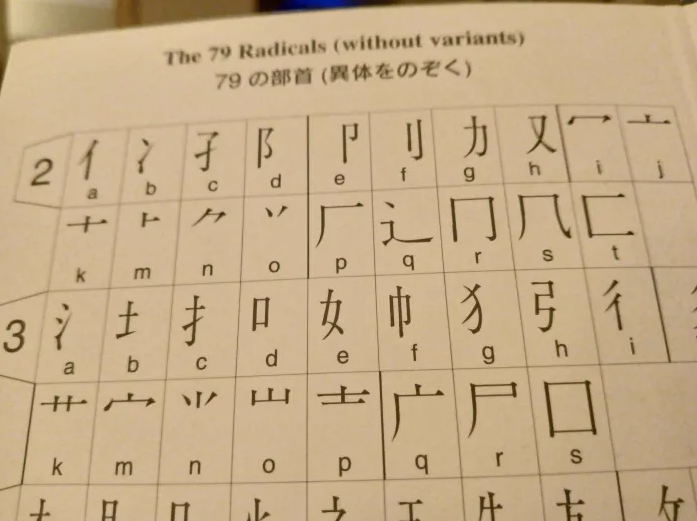
For me, personally, having a pretty good mental catalog of these common forms within complex kanji is what makes it possible for me to distinguish one kanji from another. One of the beauties of using a paper dictionary is that you always start a search looking for common forms. You don’t really need to “learn” the radicals to use the dictionary, they are always right there on one page in the front and back.
The Wanikani list of radicals is much more extensive, and each have names to be used as building blocks. I personally found this useful, but only up to a certain point.
Presumably, though, everyone’s mind works a little differently.
3 Likes
In general I would agree, however, in this context, I think it is actually good to ask AI.
While I did not spell it out in my response, I think it is quite clear from the context that my prompt was about different learning methods (gave me pros and cons for each method or whatnot). One of them was actually learning radicals.
For this AI is good, summarizing options with explanations, so you have them in one place to review and decide for yourself. As for the decision, that is personal. It recommended me learning the radicals in first place, which I know is totally useless for me, does not fit my learning style nor my language goals.
2 Likes
Language learning is honestly such a low-stakes activity that AI is fine to use in conjunction with primary sources. (Probably don’t just use AI to learn a language.)
1 Like