Not really an easy answer to your question.
First, not sure if your goal is to study linguistics or to study Japanese. I think from N5 to N4 levels, it’s better to straight up learn set phrases, common ways to speak and avoid translation and just have simple conversations.
If you’re more advanced, it can be good to discover on your own how to go from a thought in one language to another. For example, to say you “need” something in English tends to require the word essential, 必要 in Japanese.
So instead of saying… You need bread to make this soup! You would say… When making this soup, bread is essential (homework - write this in Japanese!).
Japanese is so fundamentally different that sentences like “I am in my underwear” are very difficult to translate.
- Is it a statement of fact like “I’m wearing underwear so don’t come in!”
- Are you “basically in your underwear” I.e. half-naked, thus would be embarrassed to go out in the outfit you’re wearing?
- Did a crow fly by and steal your clothes of your back!?
Each would require a different way to say “in your underwear” in Japanese.
This is because Japanese is a high context language, so translations in either direction have to be made with that in mind. If there’s tons of implication, a Romance or Germanic language translation might need things that aren’t there spelled out (or removed if going in reverse).
So… now on to my assumption! Are you having trouble in back and forth conversations? If so, write down things you struggle to say, then figure out how to say them in Japanese. The best way to do this is to ask a native or fluent speaker to point you in the right direction, but the search feature in bunpro usually can get you there.
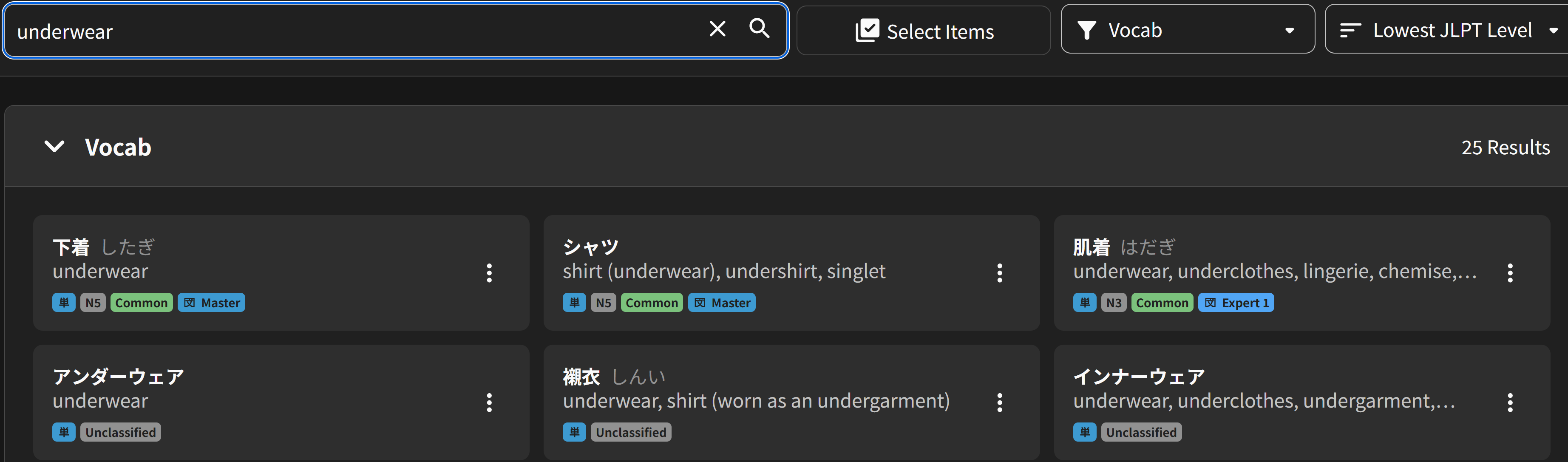
Here are some words I found for “underwear”
Going with the common one, 下着!
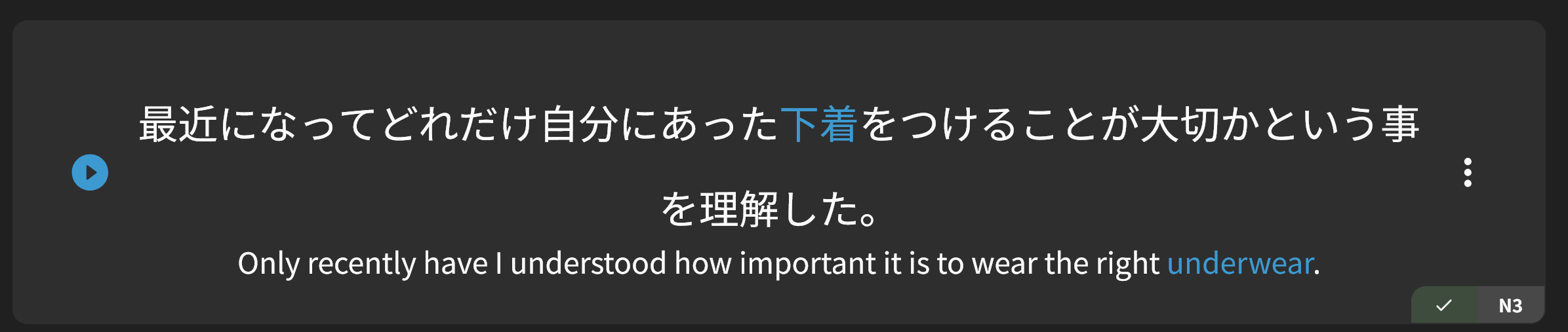
This seems to have a sample sentence about wearing underwear. That tells me that this word is used in that way. What about 肌着?
Yeah… seems like this one works too. Using these examples, could even go broader and see if phrases show up by searching on google - example: 肌着を着る or しっかり着る like in the above sentence. (Careful… this is underwear you wanted to talk about for some reason…)
What is the difference between these two words? You can either google - “difference between 肌着、下着” and hope for an English answer, or brave mono-lingo land and type “肌着、下着 違い”
Again… this is about underwear so … be(under)ware! 
That’s where I’ll drop off for now. Hope this helps you and others!