
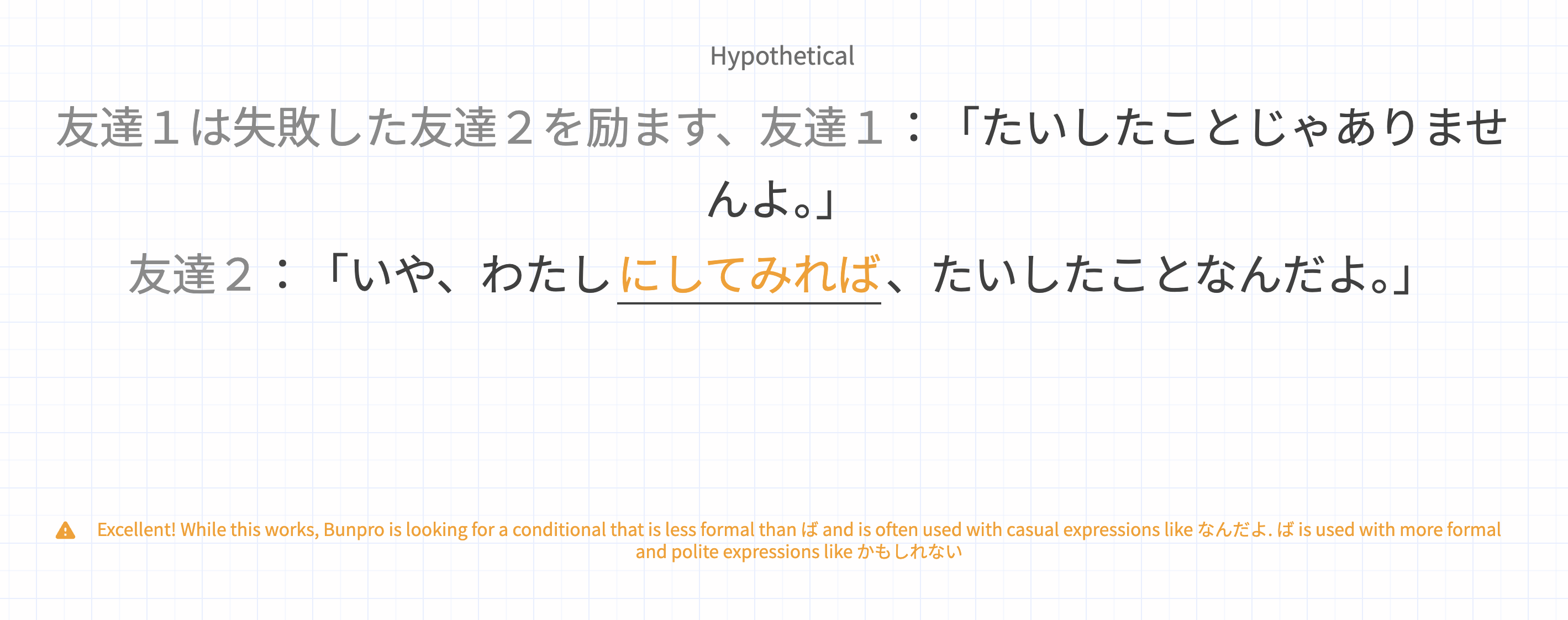
I may be missing something, but the grammar point doesn’t explain when to use みたら over みれば, however the exercise seems to imply the latter is more formal in some way. Is that the case?
1 Like
More or less yes. Very generally, ~ば is more formal than ~たら across most usages. The rest of the sentence is pretty informal, so when choosing what form of a grammar structure to use you may as well go with the one that matches that informal tone best.
That said, language is not an exact science and Bunpro’s accepted answers seem to be decided manually. There are occasional bugs and more-than-occasional inconsistencies, which is to be expected since exhaustively accounting for the incredible flexibility of language the context of usage (like formality) for each grammar point is pretty intractable. The inconsistencies in the amount of usage and alternate forms information can be frustrating sometimes, but especially if you’re working with N1 grammar you’re probably well aware that actually learning and using a language at a high level is more about developing intuition for the language similar to how native speakers acquire it, rather than referencing a giant rulebook you’ve memorized.
1 Like
Thanks. Makes sense. And yes I’m aware there’s not always rules, although I’d personally love it if there were.