は vs が (For the 100th time)

The answer the native gave is because there is no context. Obviously they’re not wrong but it is an incomplete answer. Regarding what a child would write, it’d be 何々が好き. If the topic is alrready 何々 then simply saying 好き is enough.

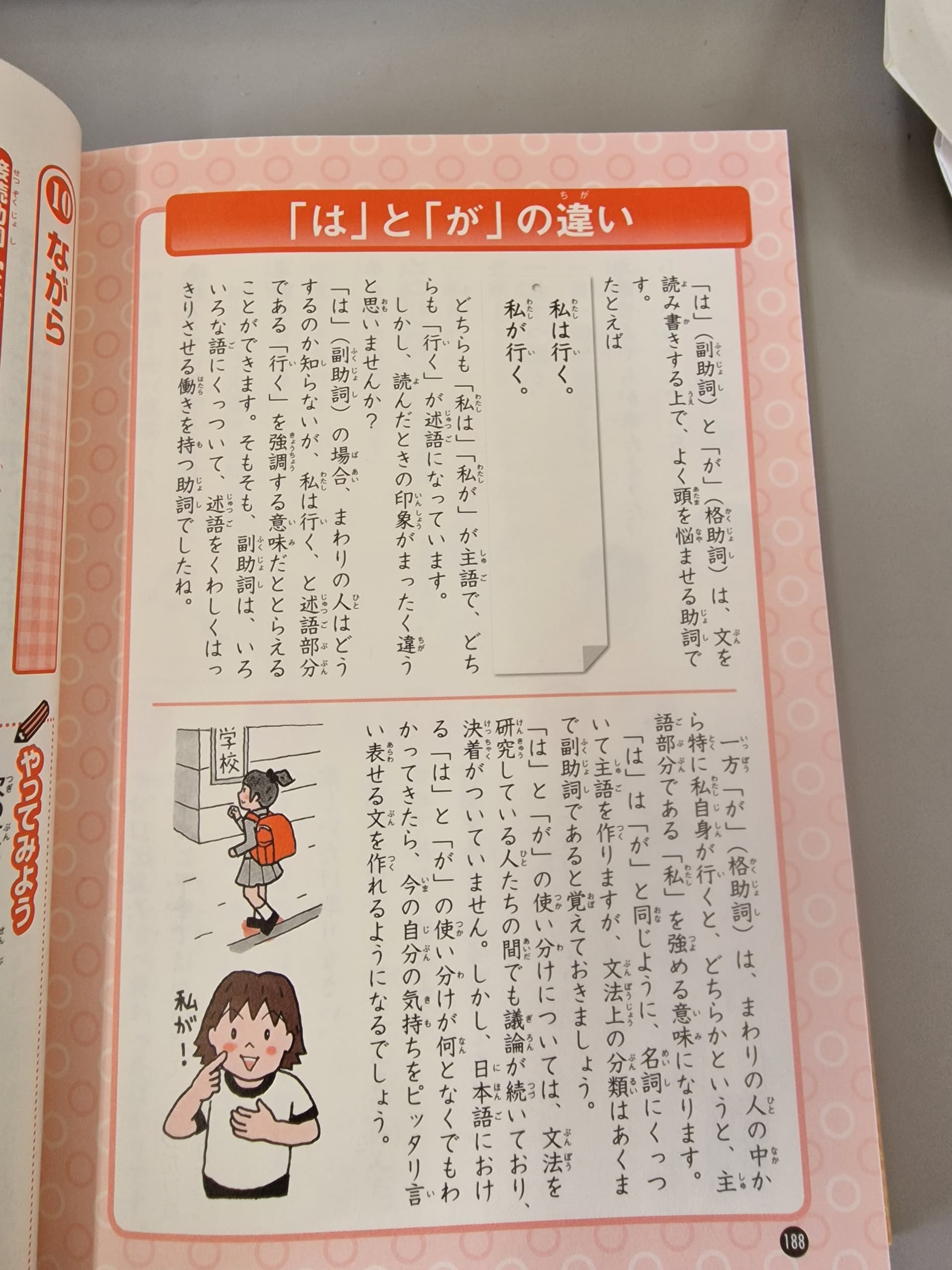
As you asked about Japanese children, here is an explanation for native kids. You’ll see it is just as vague as anything else you’ll find (but enough to understand things generally):

This answer neglects certain nuances but obviously overall is a good one. You’ll also notice it basically says “You already know the difference”. In general natives cannot explain the usage well but can easily tell you if it is iffy. I’ve spoken at length about the actual grammatical function of both with kokugo teachers. The topic is controversial even amongst native linguists. Anyway, the point I was originally making was it’s fine to get the gist first and work out the details later.

6 Likes

The subject of the sentence is 馬, actually. The topic is marked by は. Or, it’s a double subject sentence. It depends on your analysis. (OP, perhaps you can see why there is not a simple answer to your question now)

3 Likes

Maybe it is also connecting it back to the zero-ga. A situation where in the examples I provided in the article of the oranges, it’s being prompted already, subject is already clear, or the direction of it being to the person (what is liked by the person) so when you then answer it can be either は or が

But when you have no precursor, it’s that zero-ga that is missing. Which is why the Japanese person interpreted 馬は好きです as needing something in between marked by が like a carrot. But in the Orange sentence, were already asked if we like fruit so that zero-ga is clearly us オレンジは(0 が)すきです and now since both particles are able to be used, we now have a distinction of nuance. This is pretty much what you mentioned in your post about having no context.

Much like how she provides the 私はウナギです example in her lessons, obviously in this you aren’t claiming to be an うなぎ instead you are saying your order will be that of うなぎ and the が invisible marked subject is obvious, it doesn’t need to be stated.

Also I appreciate you taking the time to help me, It really helps.

3 Likes

From what I gather from that, is it’s discussing how both 私は行く and 私が行く are on a very literal basis stating the same claim. However when you read them there is a clear difference, obviously this statement is intended to a Japanese child who would get the difference but not know why necessarily, and I suppose I am not at such a low level that I cant get that too, I do sort of. So it seems 私は行く is not just about what I am doing but innately that I am doing it, regardless of whatever others are doing (Well I mean, I’m going, I don’t know about anyone else, but me, I am." But 私が行く is more just a statement of what will occur, I will in fact be going. It emphasizes the fact that I am going as opposed to others around me.

What I find interesting is that it stated, 私は行く that you can interpret this as emphasizing the 行く when I would have though it emphasizes you, compared to others. But instead it emphasizes your action of going, compared to the action/inaction of others?

I would have thought its
私は行く - I am going (compared to others who aren’t)
私が行く - I am the one who is going (no one else is)

But it seems more like は is saying, my action is what is different, its not about me, its about the action of いく being different from other actions around me. and が is about it being ME who is doing the action, I suppose this lends credence to the は emphasizes what’s after, が what came before.

I’ll also be honest I don’t entirely understand even now how は is an adverbial particle, as my understanding of an adverb is it is supposed to describe how the verb is taking place or provide further detail to it, but I don’t think that makes much sense here as plenty of sentences lack a verb in general, but I guess you can say だ is である and stuff like that? And even so I fail to really see how the は is affecting the verb even if there is one in a way similar to はっきり or something. The case marking particles make a lot of sense, adverbial particle は makes little sense to me.

The resource you provided is super helpful, and I will definitely be saving it, thank you a ton for helping me out.

3 Likes

Yeah, that understanding is exactly what I’d say is going in that explanation. I think you’ve got a reasonable understanding of the essential idea already.

The case for using は in that kind of sentence would generally be for contrast. E.g., 銀座本店は美味しいけど(この店は美味しいかどうかわからない) would be one such use. As you can see the context is important. A plain statement of fact would use が or no particle or drop the subject entirely in most cases.

So with the horse thing, either it is as you say 馬は(何々が)好き or it is (I don’t know about everything else but)馬は好き. Again, there could be many contextual things affecting this.

3 Likes

(placeholder text - I’ll give a detailed answer to this part later but am too busy probably for the rest of today to answer! Sorry for only replying to half for the moment)

2 Likes

This is just my general recommendation for grasping the fundamental nature of both particles: Watch the first three videos in this playlist: https://www.youtube.com/playlist?list=PLg9uYxuZf8x_A-vcqqyOFZu06WlhnypWj The presentation format is super weird, I know, but this woman has an incredibly deep grasp of Japanese grammar and teaches it in a way that, at least to me, feels way more “true/fundamental” than any random grammar articles I’ve found online. The entire playlist is amazingly useful, and it starts by explaining が, because it’s the central feature of Japanese grammar, and then immediately after it explains は, and how they relate to each other.

Spoiler alert: が is present in every sentence, although in some sentences it’s implied rather than explicitly stated.

1 Like

Yeah, answers to questions take が because は is for bringing up new topics. If you answer a question you’re still on the topic of the question, so using は would make it sound like you were ignoring the question and starting to talk about something else.

1 Like

CursedKitsune will probably give you a way better answer than mine, so I’ll reply to this bit only.

Basically, as you say in the above quoted paragraph, は mainly focuses on what comes after it, while が focuses on what comes before it. However, where I think you’re getting confused is when は is used for contrast. For example, if you say:

馬が好きです。

This by itself is just a general statement. However, if you switch が with は in that sentence, now you’re creating a contrast between simply liking horses (with the use of が) and liking ONLY horses (with the use of は). That’s because typically you use が before the adjective 好き, but now you’re creating contrast by replacing が with は.

This is why you never want to say 今日は美しい!to a Japanese woman, because it implies that only TODAY she looks beautiful (but not on other days).

Honestly it’ll be easier for you to simply memorize when you typically use が and then remember that switching it with は creates this contrast that posses this extra meaning/context. At least until you get a better feel for it.

Anyway, this is a very complex topic and I’m no linguist, so I can only give you my suggestion. Sometimes it’s better to understand things intuitively, as you do with your native language, than to try to pick every single detail apart. Trust me, you’ll eventually get a better feel for it as you keep learning. I’m with CursedKitune in that it’s better to let it wash over you for now (sort of speak).

Take care!

5 Likes

Ha! Check this out. I forgot about this video, but it’s simple and to the point:

Also, for the lols:

4 Likes

No, this is extremely helpful, I don’t have any expectations of perfection, I appreciate anyone trying to earnestly explain it to me.

You also touched on what I believe to be possibly the biggest hurde tripping me up, which is the contrasting function of は. I do not understand if its contrasting what came before it, or what came after it.

Within your explanation, you back up what I had previously thought with the example of calling a woman beautiful, that makes sense, same with a 今年はよろしく, however I then see examples within the videos like this. https://youtu.be/o-hK4-qv9Yk?t=371

Now I may be misunderstanding her, but she seems to not make it clear which way the contrast goes when saying “But it also implies the comment on the new topic is different from the comment on the old topic and even if there wasn’t an old topic, it still implies that it’s different from the comment on other possible topics” and goes on to say “So 私は本を買った is essentially saying what I did was bought a book, you may have bought something else, others may have bought nothing at all, but what I did was buy a book, were stressing the fact that I bought a book as opposed to other possible topics who didn’t buy a book”

Do you sort of see what I’m saying? The core idea of this contrast I am completely confused on where said contrast is about what は is marking or about the comment about it.

Is 私は本を買った emphasizing that I bought a book, as opposed to other people who did, emphasizing ME, not the other possible people who did, or is it expressing contrast of the comment, saying that I could have done other things, but the one I did was a buy a book, is the contrast me, or is it the book buying?

4 Likes

You’ve misunderstood what she meant. She’s saying the same thing we’re all saying, that は emphasizes what comes after and that が emphasizes what comes before.

With the 私は本を買った example, all she’s saying is that the important piece of information is that I bought a book. Other people might’ve done otherwise, but what I did was buy a book.

Think about it this way. Someone asks you, “What did you do today?” And you reply, “I bought a book” The emphasis is on what you did, but also は is marking you as the topic of the conversation.

Now, if someone asks, “Who bought a book?” Saying 私が本を買った is putting emphasis on “I”. I am the one who bought a book. Not Sarah, not Tom, I.

Does that make sense? If not, here’s another video with many examples on the differences between these two particles. Perhaps seeing it being used, as opposed to being taught how they are used, will help. BTW, I love this channel, so I highly recommend it (especially if you also like video games, lol):

HTH!

2 Likes

Yeah I think on this specific topic I need it explained like I’m 5 lol. It is discussed that は is contrastive, so which is it contrasting to other possibilities, the possibility of it’s topic, or the possibility of it’s comment. Considering no one has answered this tells me I am really missing something obvious lol, but I genuinely don’t get that one piece of information. I am assuming that it’s always contrasting what it’s marking as in 私はx It’s I that is being contrasted with other possible topics. But that gets weird when it keeps getting said that the emphasis is on the comment, not the topic.

I guess instead of writing all this, it’s easier to just ask it as this.

私は本を買った Is the contrast applying to 私 or to the 本を買った?

1 Like

I just watched the GameGengo video and it literally answers this question. He goes into pretty much all of the functions of these two particles. Watch it, and let us know if it helped or if you’re still confused.

1 Like

“Xは” is often translated as “as for X”, so “私は本を買った” could be translated as “as for me, I bought a book”. This translation makes it clear that the emphasis is on buying the book, like, “Others may have done something different, but as for me, I bought a book”. This is also mentioned in the playlist I linked above.

2 Likes

Sorry to keep spamming you haha.

But within the video you linked at this time https://youtu.be/qtK1ScAMZUk?t=245

To me, this sort of gets into the problem for me, in this the が seems to be now the one being used for contrast. “THIS GAME is mine” as opposed to other games that aren’t? Isn’t this expressing the contrast that is supposed to be done with は?

1 Like

I have watched that entire playlist already just to be clear. More so than not understanding the grammar, I more don’t understand why my questions are seemingly bizarre. It seems whenever I ask about contrast, people bring up emphasis, but if I bring up emphasis, contrast gets brought up. I feel as though my question is rather simple though…I just want to know if the contrast of the は particle is contrasting what comes before it or after it…

1 Like

OK, I see. This is why I mentioned earlier that it’s better if you first memorize when to use が, because from there you’ll understand when が is being substituted by は for contrast. Right now, you have no clue when the contrast is happening, and that’s probably the root of your confusion. The GameGengo video goes through the typical usages of these two particles.

Sorry if I sound patronizing, but that’s not my intention. Hopefully you don’t read my comments that way. And I don’t mind answering your questions :blush:. I think it might just take more exposure with these particles in order to get the feel. It’s really hard at first. We’ve all been there (heck, I’m still not 100% sure on them either, if I’m being honest lol).

3 Likes

After re-watching, I think that it is just は is marking contrast always of what comes before it, and that I am allowing myself to get confused by the more complicated explanations that I’m not ready for. He gives good examples and they all seem to lend themselves directly to making the XはY being that the x is what’s being contrasted. It is just confusing me that the focus is all about Y when X is what’s being contrasted every time, but I suppose that’s just a difference in my perspective from others. I would think the contrasted thing is important, but it doesn’t seem to be the case, the comment is what is thought of as important in the language and to everyone else lol.

3 Likes

I would have to find where, but I am like 99% sure in Cure-dolly’s videos she says that は always even if implicitly is marking contrast, so I have always been viewing it as marking contrast.

I think it’s also that I have probably spent a lot more time than people are expecting with these topics, I have probably listened to literally 10k+ hours of Japanese and watched 2-3k hours of directly educational content plus whatever amount I spend actually studying/srs and stuff. But certain topics like this one I find that a lot of the information is contradictory, at least in my mind, so I must be looking at it wrong, which is why I like asking other learners as maybe they could explain a trick or just say it in a new way that will make me realize how stupid my previous confusion was lol.

1 Like