Thanks for reading me!  Hope you had fun learning some Japanese today
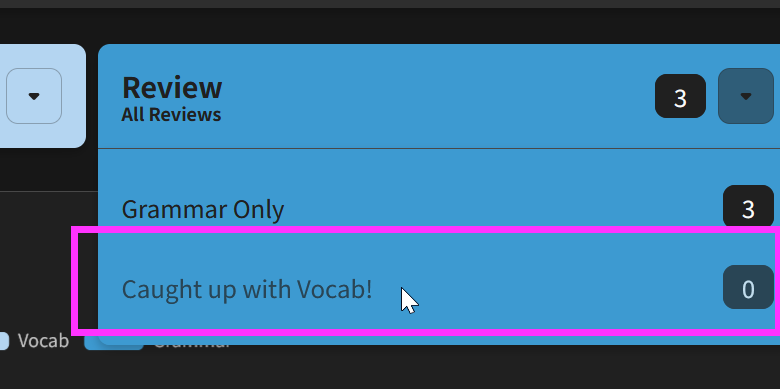
TLDR: I’m considering unlinking Bunpro and Wanikani, or at least configure Bunpro to stop reviewing the vocab I learned on Wanikani (if that’s possible). And I’m wondering what you guys think about this (hence the poll).
Here’s the looong rationale:
On Wanikani I get a lot of reviews and I’m usually racing through it because they’re just “word:translation” or “kanji:reading” pairs. The stated goal of WK is to get fluent reading kanji so in that way I like going fast as it’s kind of the end goal. I take note of my mistakes of course and I go slower on specific kanji/vocab if I feel there is something that requires special attention.
In this case quantity isn’t a problem: I may have hundreds of reviews on a specific day but I’ll get through it rather quickly and at the end of the review session I feel like I’ve done my job: refreshed memories in my brain, wrote down my errors so I can understand them and correct them later.
On Bunpro however, I would like to go at a slower pace and take more time to read: read the sentences in the review, re-read the grammar points to make sure I fully understand how to use them. Read the alternative answers. Basically quality over quantity, where I don’t mind doing less and going slow as long as it sticks.
For this reason, I have set up Bunpro to ignore vocab lessons and just serve me a few grammar points every day.
But lately I’ve noticed that since I linked WK and BP, Bunpro makes me review a lot of WK vocab. It mostly comes through in waves but I’d say a good portion of my BP review queue is just “WK vocab”.
I initially thought this was nice, because I get more repetition thus better memorization. And also the words are served in the context of a sentence, helping me to better understand the meaning, or to make sure a verb is godan or ichidan etc.
But this has many downsides: first it creates a significant quantity of reviews (woke up to 256 reviews on BP yesterday) which can either discourage me or make me spend less time learning new things. But most importantly, it’s making my mind think fast rather than slow and I end up reading just the highlighted word without bothering with the sentence. So quite a few perceived downsides:
- It makes me skip the sentence so less global understanding of japanese.
- Because I skip reading the sentence I make more grammar errors which ends up being frustrating.
- I ultimately spend less time reading the grammar points, as I want to clear my review queue first because I’m afraid of the numbers getting bigger
 and I’m often out of time or energy after dealing with the review queue.
I’ve tried to force my brain to go slower but it’s not working. So I’m considering dropping WK vocab from Bunpro so I can have less reviews, and taking it nice and slow going more deeply into each review sentence.
I’m probably forgetting something but this post is already long enough. I’m curious to know if you’ve had similar issues and how you went about solving them. And in general, how does your brain approach Bunpro reviews altogether?
See you next year I guess! 


- I should keep reviewing WK vocab in BP
- I should use BP only for grammar points, at a slower pace
0 voters
 I don’t know how you learn beside WK and BP, but I would separate both and instead concentrate even more on mistakes and diffcult vocab/grammar OR just use the time for reading instead. Not reading sentences but texts of course. Because that’s also a kind of review with other benefits.
 ), also because BP has sentences, my Anki deck does not. But I just have more reviews now that I don’t really need (yes insecurity, I DON’T NEED THEM!) AND mostly ignore the sentences… maybe I’m not ready for them (too much unkown vocabs), maybe my brain just want to have vocabs OR texts and not single sentences, who knows
 )
)