Hard to, Tough to, Painful to, Difficult to
Structure:
Verb[stem]+ づらい

How do I type this in the keyboard for the review answers? I keep getting ず instead when I type “zu” and the answer is marked as wrong.
Tried “zzu” or “tzu” as well. No luck.
Edit: Looked it up on Google right after asking this. Apparently it’s “du”. Weird.
Welcome to the forums!
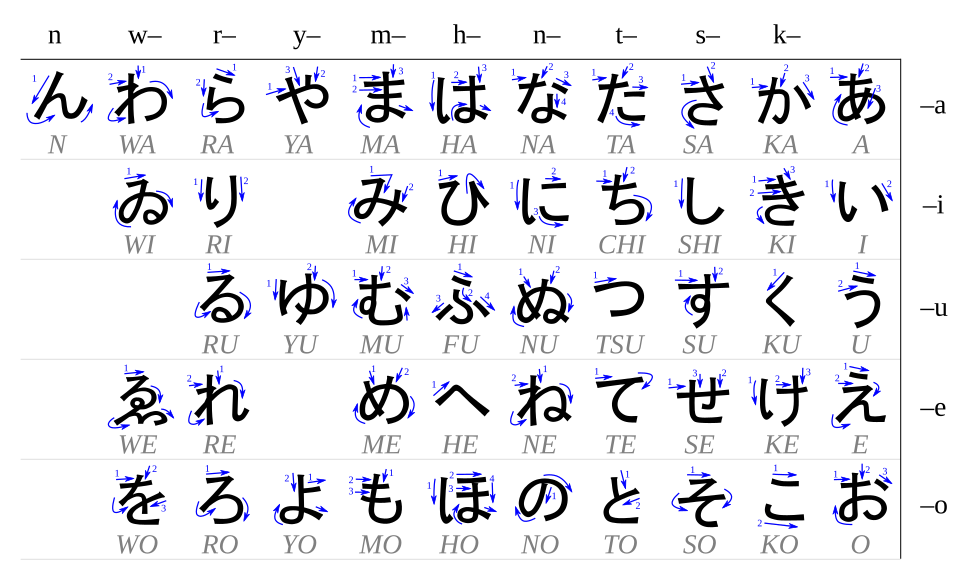
If it helps, consider that つ is in the column for “t” sounds in the kana table:
So when typing, you can use ta=た, ti=ち, tu=つ, te=て, to=と. We can then change the “t” to a “d” for the corresponding voiced sounds: da=だ, di=ぢ , du=づ , de=で , do=ど.
Question about にくい vs づらい
I am so confused on when to use one vs the other
タピオカが大きすぎて吸いづらい
I put にくい first and it said “Let’s try a grammar point that focuses more on the subjective, emotional or psychological difficulty of the action”
It is because of the “subjective” meaning? Like maybe the tapioca is hard for you to suck through a straw, but for other people it may not be? I was under the impression that づらい is for emotionally/physically taxing/difficult things. But here this is just nonsensical to me. Unless it means like when you’re trying to suck something with big chunks blended in and you can’t suck it through a straw because the chunks are blocking it. But wouldn’t that still be にくい due to the fact that it’s literally difficult?
Maybe it’s just me, but both づらい and にくい shows up as “Subjective” when i review them.
From what i’ve came to understand, they’re supposed to be, but the exemples don’t show it.
にくい expresses you can’t do an action because of a factor such as a skill level required.
“Japanese is hard for me [because my level is low]”
づらい expresses you can’t do an action because of it being physically or emotionally difficult.
“Standing up is hard for me [because I’ve hurt myself]”
Both have a nuance : you are the one not being able to do the action, others can.
If you take my exemples : Japanese is easier if you already are japanese, and standing up is easier if you never had any motor issues.
You need to reach N3 to actually learn the “impossible” (for everyone) point.
Here, がたい is not just your own experience, it’s for everyone.
“Making a video game is hard [because it requires many skills, with experience in each, years of actively working on it, funds for assets but also marketing to reach more audience]”