Experiments log

Hey! I always wanted to reply to your posts, but time + social anxiety always got in the way… Anyway, I’ve been enjoying your posts, and really impressed by how much thought you’ve been putting into your studies <3

I can’t speak for others, but I do struggle from time to time with keeping up with my habits. Honestly, I found it easier to stick to them if I was less strict and harsh with myself - like, for my flashcards, for example, I don’t set a hard expectation to do them everyday, and I don’t beat myself up if I miss a day (or two, or three), or if I do ‘too little’.

I know, optimally speaking, I should be doing all of them everyday, but if I’m feeling blah, or busy, or whatever, I give myself some grace to slack off. Having less guilt/stress over it makes me more likely to continue doing it, and more likely to pick it up if I’ve stopped for some time.

I used to be a lot more rigid about my habits (japanese, art, piano etc), but it always led to me burning out and stopping for years, so I’ve gotten more loosey-goosey about it now. It seems to have worked so far, so maybe it might work for you too?

Oof, yeah, making new cards was a major pain for me when I was using anki. I found it easier to create a bunch of them at a time, maybe once a month or so - something about getting in the rhythm of making them make the process go much smoother. I’m not super clear about how you add new cards, but it sounds like maybe you could practice reading separately from the act of finding new kanji? It can be a little draining to do too many things at the same time, at least it is for me.

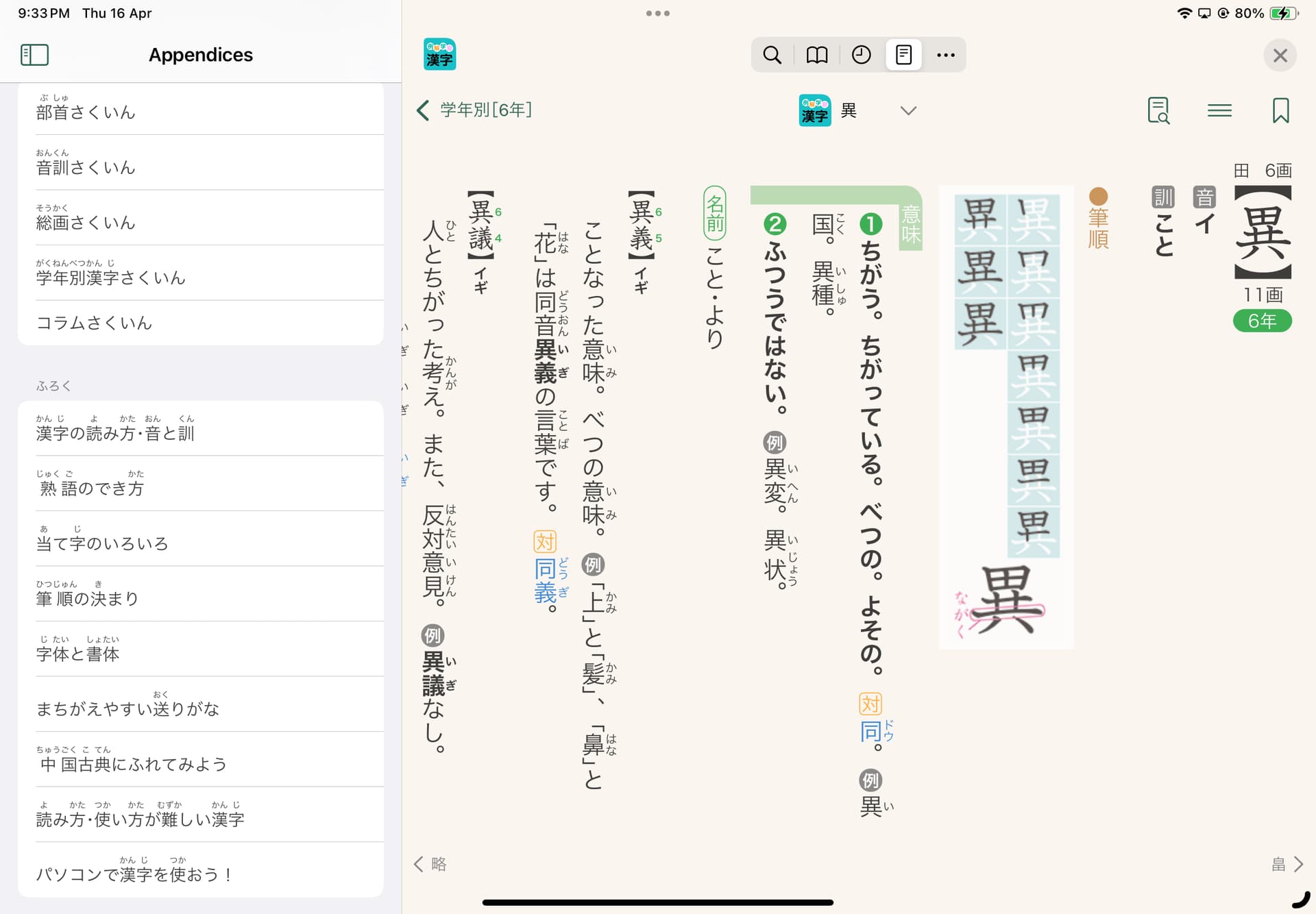
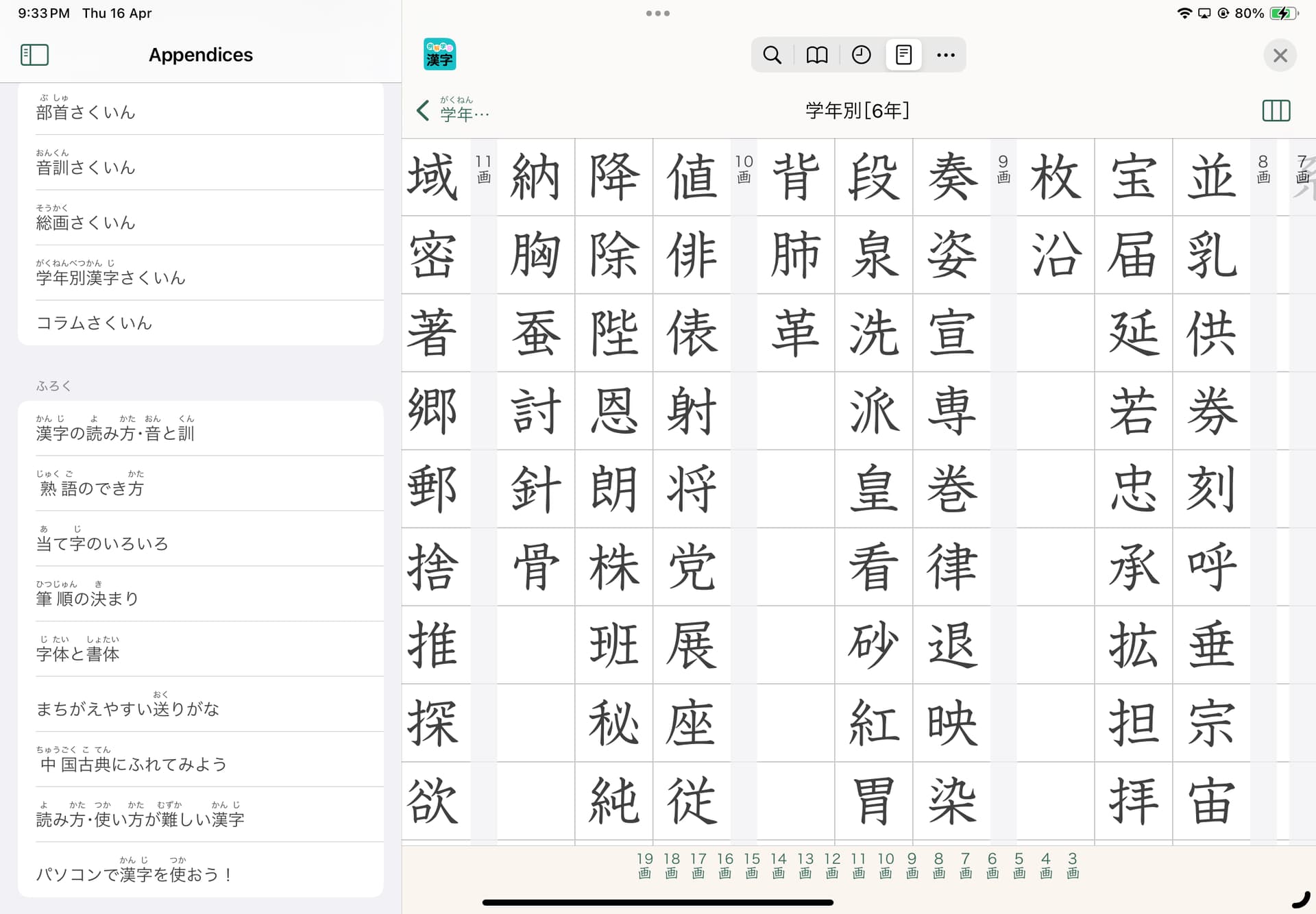
Or maybe using kanji dictionaries as a resource might streamline your process a little. Something like this (例解学習漢字辞典 - for elementary children, but I like the colours/images hah) might cut down on the searching?:


Thanks for reading, and I hope you have a good day too! :slight_smile:

3 Likes

Thanks for the kind words and for putting in time and effort to write a reply!
I’m really glad you found my log interesting!

I think that is what my usual learning style feels like, and my “go to style” as well. There was a time when I couldn’t do anything without a clear structure and goal that I definitely had to complete everything I’ve planed, and if you look at my first log here, I’d been trying to do it for 8 months (and a few months after that) before I’ve started getting to the understanding that I both learn and enjoy much better when I’m free in what I do every day.

This challenge with a habit is more about having one thing that I try to do every day, and trying to see if it’s really a thing that can be as effective as just feeling what I really need to do at the moment. As well as it’s just the thing that is not within my ability, so I want to try to be able to make it a part of what I can do.

Now I’m using yomitan and while going through a book/article, trying to find kanji that would suit me, within a sentence that I would fully understand and recall its origin. Usually, I would create something like 8-10 cards in 1-1.5 hours, and I would have everything work for 3 more days.

But now, thinking about it after you suggested it, I think I could try choosing kanji I like from a dictionary or a list. It will definitely make the process easier for this particular activity, which is good. The one thing that bothers me is that I really need some good sentences, as I’m doing cloze type cards, it shold be kind of obviouse what word it needs (or I have to be able to recall the context, which I do not get in a dictionary).

Also, I really like the app you’ve sent!
The explanations seem to be very clear and understandable, now I basically know what 同音意義 is :laughing:
Is it a dict just for kanji, or does it have some words as well as sentences? Design is really nice as well! Could you tell me more about it?

Another way I could think of right now, is to print all the kanji on one paper, and highlight kanji that I want to learn first, that I know, kanji that I kind of know, kanji that I haven’t seen etc. Seems like a cool time spent to me :laughing:

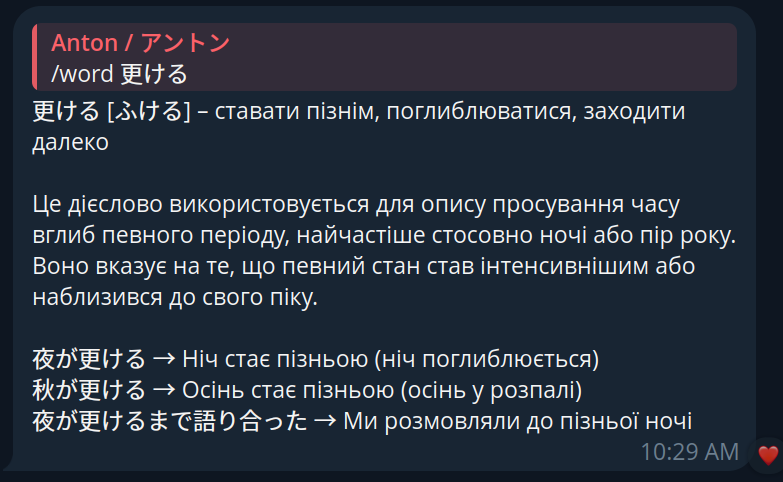
Also, if I’m doing it more artificially, I think I could use some help from AI. Basically, it’s now really good, (I use gemini mini 3 model). We have a bot in telegram which makes very easy explanations in the Ukrainian language.

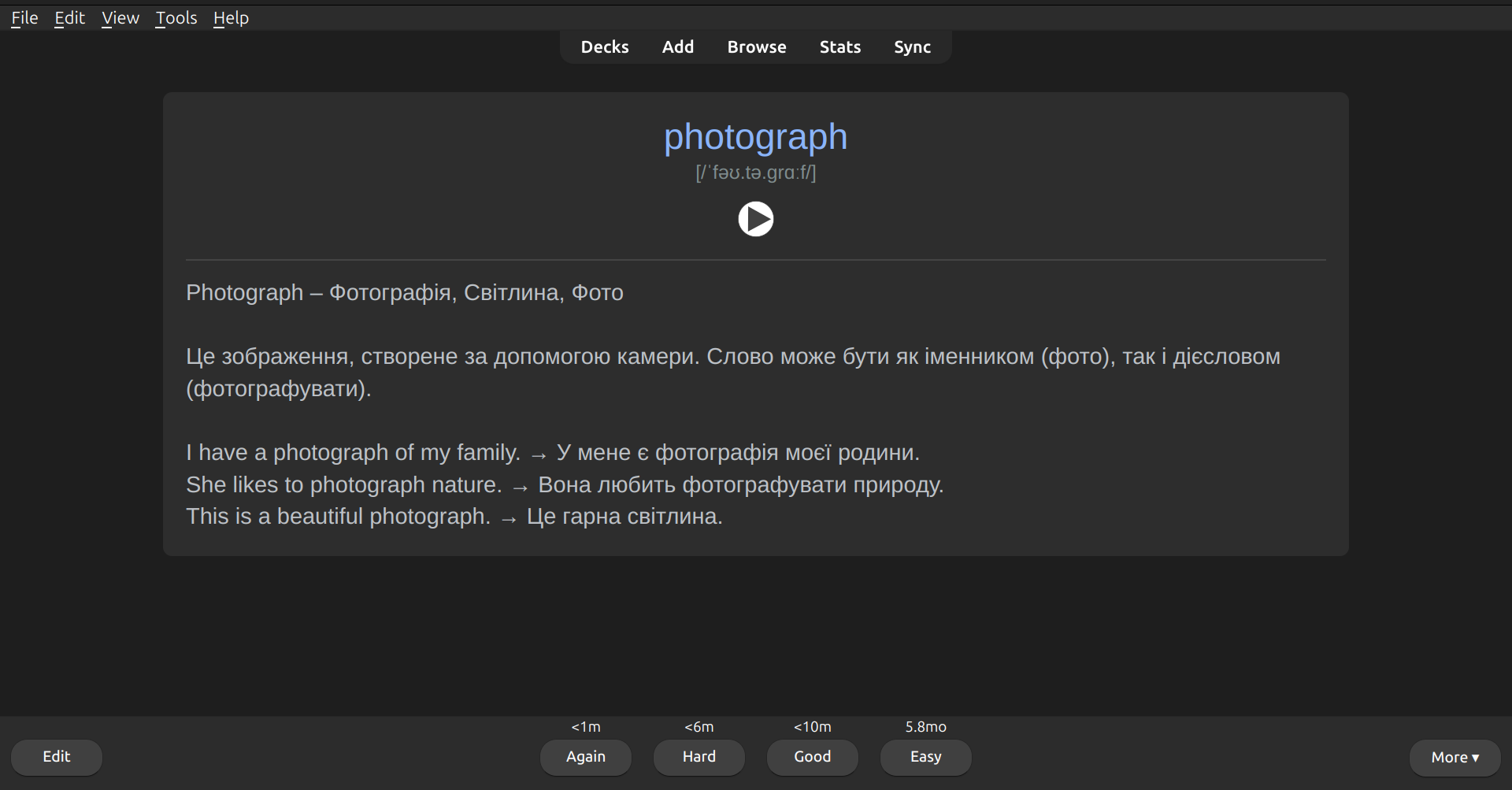
So I even made a deck with that for my English mentee:

It has like 5k word cards from an Oxford list with sound from the Cambridge dictionary (cost me 3.50$ to make)

But, I don’t just want to create cards with that, my idea of recent day was to give some context to kanji. And what I mean by that, as Gemini, about really important information, the main one is "In what contexts/fields/media do they use that kanji/word) because it’s basically the question when I ask a person when I want to understand a word! Not the etymology, or translation, or sentences, I’m looking for the bigger meaning for me, I’m looking for a meaning of why would I need to learn it.

So ye, I might just connect gemini so it gets me that info after I create some cards.

Again, thanks for the reply and have a good day as well!

3 Likes

6 weeks

This week was by far the best in terms of everything.
The average retention of 79.4% for this week, which puts the general retention up to 71.8%.
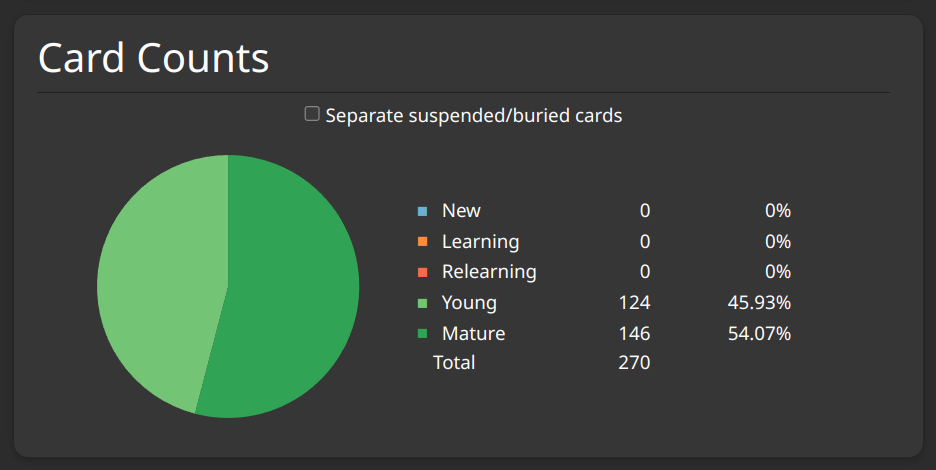
The total number of cards is 129.

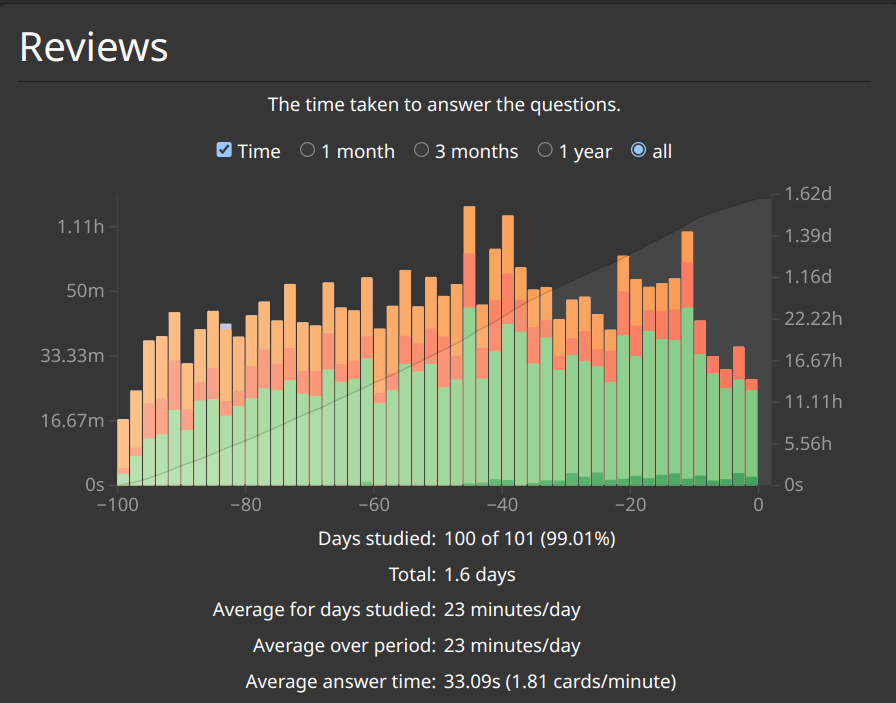
Time of study

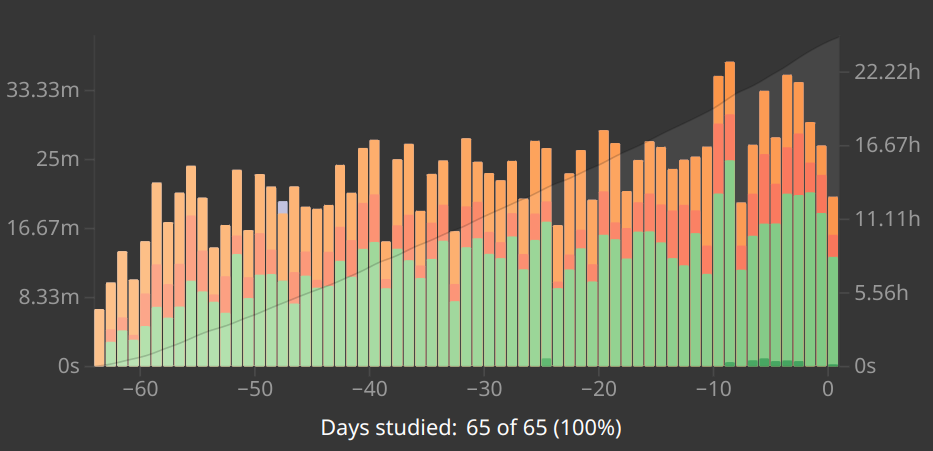
This week, as I’ve stated in the previous post, I’ve been trying to do my reviews straight after lunch, and so far I like the results!
image

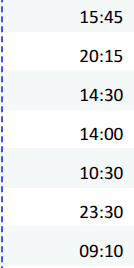
Doing reviews during the day is much more pleasant than at 1 or 2 am, and having a fixed time for that event makes it really easy to do. Also, one day (when I have the thing done at 10:10), I managed to get 90% retention! Now I’m thinking if I should start waking up early, just to get better results at learning :laughing:

Image Occlusion vs Cloze Text

I had a theory that texts from a medium where the word is written on the surface would help me remember it much better, but I cannot see me it directly, maybe due to some of my cards are just manga panels where I didn’t understand subject too well, or maybe it’s just not the thing. I’ll be trying to figure that out.

Google Spreadsheets for kanji

Thanks to @theremeene I started rethinking my approach towards creating new cards, and decided to do the thing I write below.

So Google spreadsheets are super cool.
I’ve been working with them for the past two weeks to make two projects, one is just to auto-select videos for my friend to watch in Japanese and track the progress, and another one is a little bigger, a system for tracking chess students’ progress for my chess sensei. Spreadsheets are really cool because you can use it as a db, write cool queries, and even implement scripts (vibecoded by Gemini)

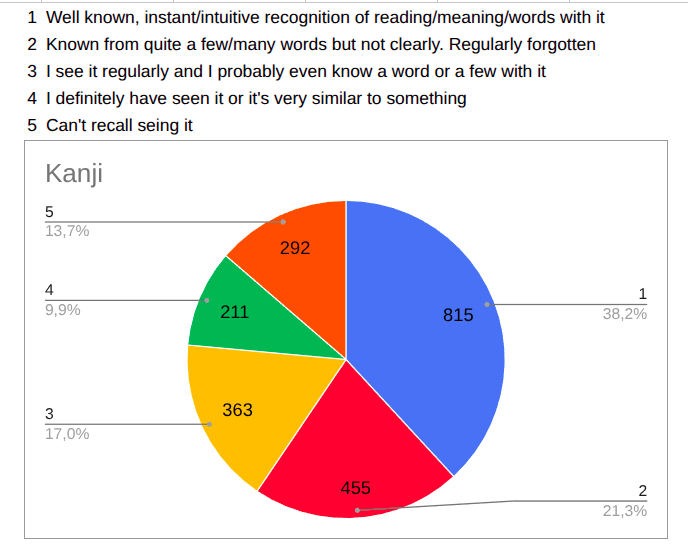
As for kanji I decided to add all the jouyou kanji into it, and go through putting 1, 2, 3, 4, or 5 after each kanji
1 - instant recognition
2 - recognition, but not very clearly, not all the meaning, there are it’s a simmilar kanji, etc.
3 - I have seen it a lot of times, and I probably know at least one word with it, but I strugle to recall it
4 - I think I’ve seen this one a few times, or I know how to read it because it has a sound component and I don’t really know if I’ve seen it but I can read it and it feels familiar.
5 - I have no idea what it is, have never seen it before (probably)

Went through 1200 kanji as for today (while being on the train from Rome to Florence and back)

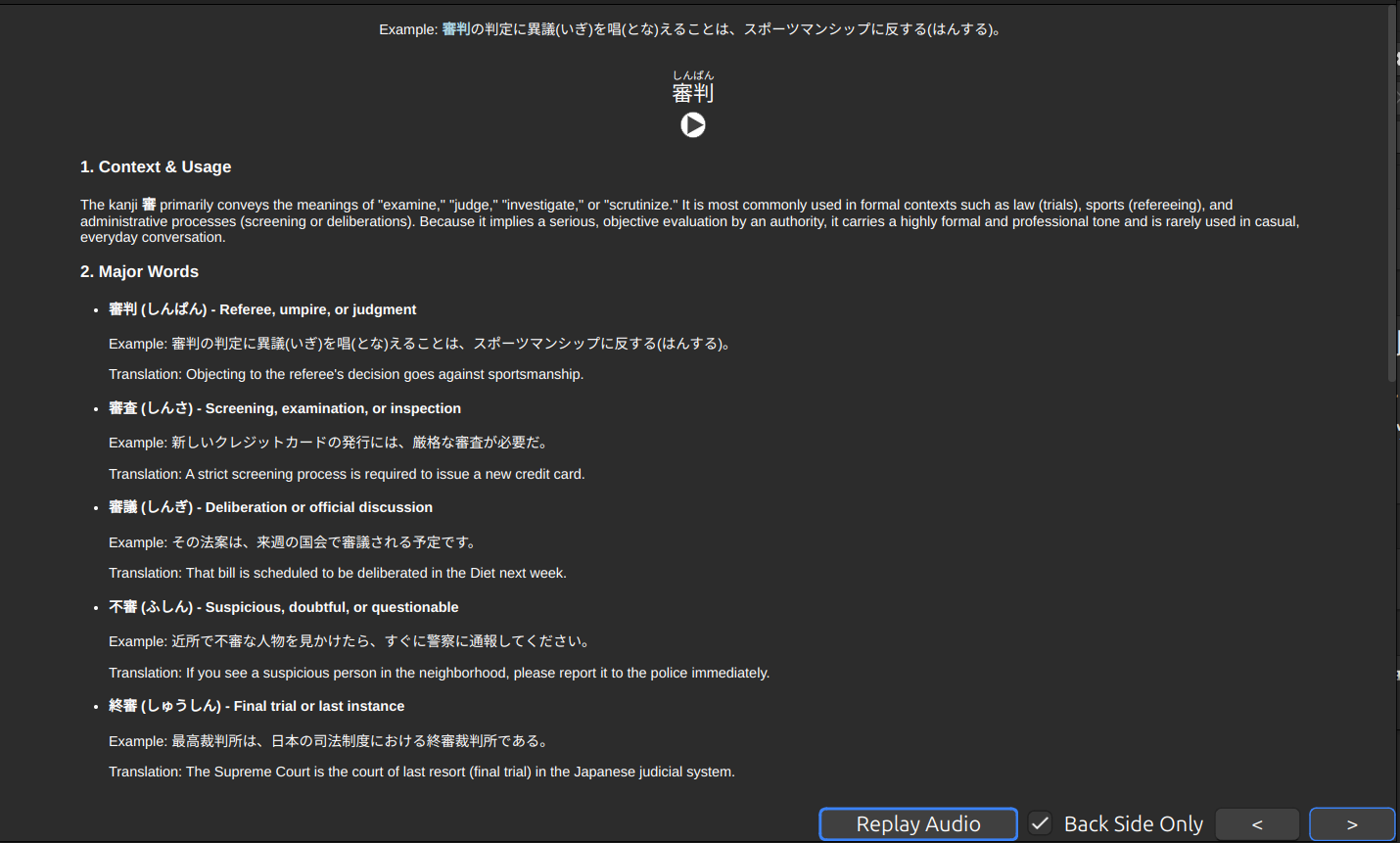
The plan is to generate AI explanation for each card, like:

But a little more compact and with more words, somewhat better in general.

And then create 1 really good Cloze sentence for each card with numbers 3, 4, 5, so I can continue doing the current deck.
But for cards that fall under category 2, ill just automatically create cards with meaning, onyomi, kunyomi, on the front side, and it will be just writing recall deck to finally get those kanji into know category (recalling writing really has worked like magic, and no other type of cards so far). So ye, I’ll do the update when I’m finished with this one (hopefully before the next saturday)

3 Likes

Hi! It’s an app called ‘Dictionaries’ by Monokakido, someone posted about it on the forums here. The nice thing is that there are a bunch of dictionaries (some are pretty pricey though) that you buy on the app, so it’s not just kanji - there’s dictionaries for grammar, collocations, EN-JP, FR-JP etc. I’m using it on iOS, not sure if it is available on other platforms.

There’s some reviews for japanese dictionaries on Tofugu and Wanikani, some of which you can buy on the Monokakido Dictionaries app. Honestly I’m super tempted to get a paper 類語 (thesaurus), just to flip through when I’m bored - it’s harder to browse digital versions.

And yay! I hope your new card creation method proves fruitful! Excited to hear how it turns out :relaxed:

2 Likes

Week 7

This week I’ve tried a bunch of new stuff, which I want to share now.

First of all, I went through all the 2136 joyo kanji in my spreadsheet, arranging kanji by level. At the end, my kanji knowledge level looks something like this:

The second step was to write an App Script (script inside the Google Shpreadsheets) that will be sending API requests to Gemini in order to get information about kanji I want, so I’ve also completed it. I can choose a group of kanji for which I want to create an explanation, and it will go through a fixed number of kanji adding it for them.


I’m still not sure if it’s a good idea to create cards from the template sentences, as I feel it can cause me to remember the context of the word worse than with real sentences, but on the other side, now I can add words without too much trouble searching for them, as well as add more popular and familiar kanji first.

Right now, I’m going through level 3, starting from more common kanji.

Level 2 deck

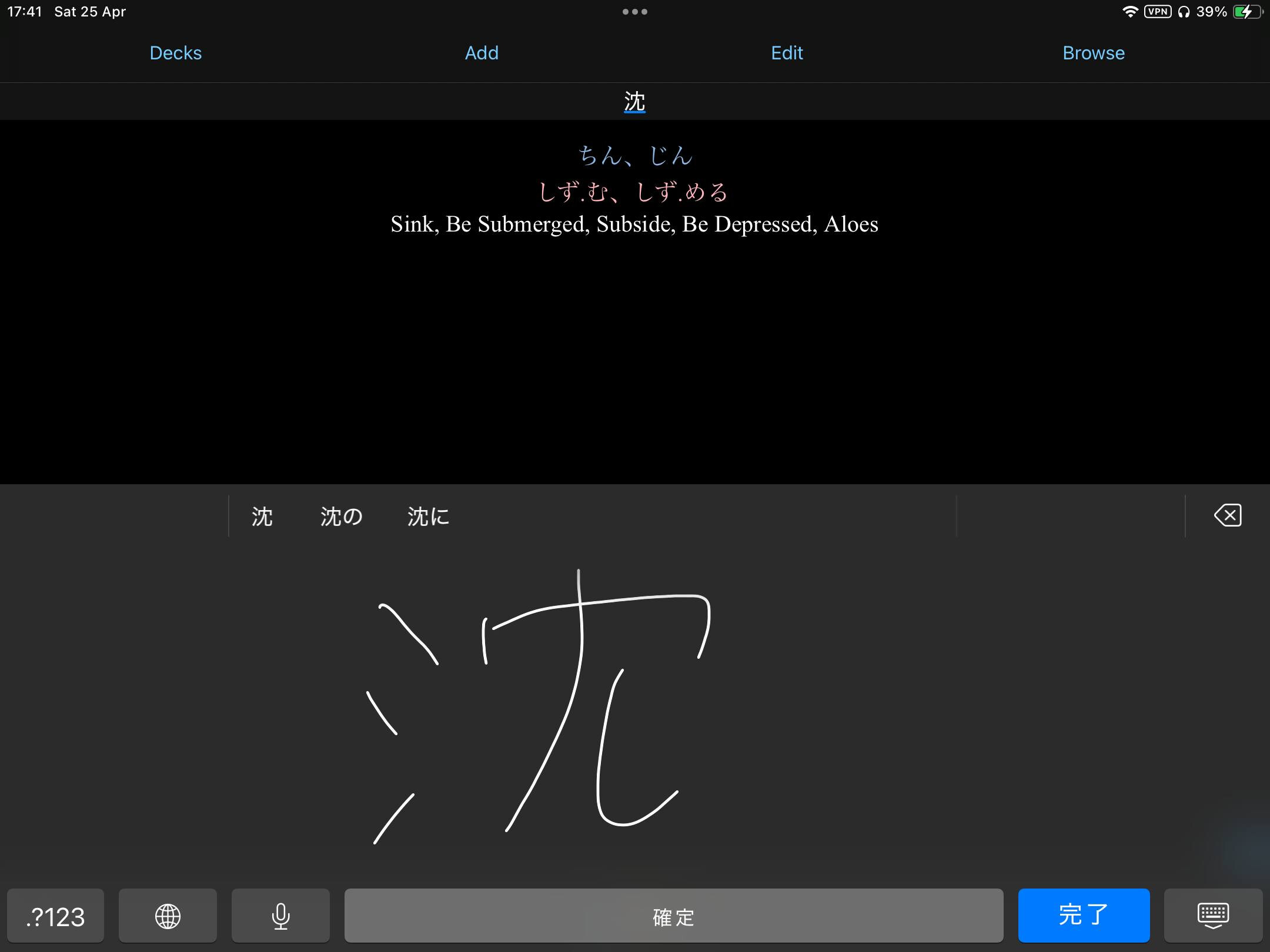
There are 450 level 2 kanji, those are kanji that I kind of know well enough, but just not yet. In order to transfer them to level 1, I created a deck with the following template:

Here I just have to write the kanji based on it’s meaning and it’s readings.
I added 120 kanji so far (trying to do 30/day), and I do it after I’ve done with my everyday kanji deck.

Bunpro

I started learning grammar with Bunpro again. I deleted all the N3 from the reviews and went through all the N4/N5 grammar in a few days.


Now I have 63 ghosts (most of them are already level 3 and 4) so when I slay them all it’ll probably be only 15-20 reviews/day.

The idea is to do bunpro when I wakeup, before cooking lunch.
Doing all reviews, and if I have time add one very unfamiliar grammar point (or a point that was on the radar for a long time but I couldn’t understand it, like 動詞テ型 + やまない which was following me for quite a long time after I’ve noticed it in this (vocaloid) song without taking apart it’s lirics. Listening to it now I can hear that it’s 思い出してやまない (cannot stop remembering) and like 引かせてあまない?着させてあまない? I’m not sure it’s right there are no subs)

Migii

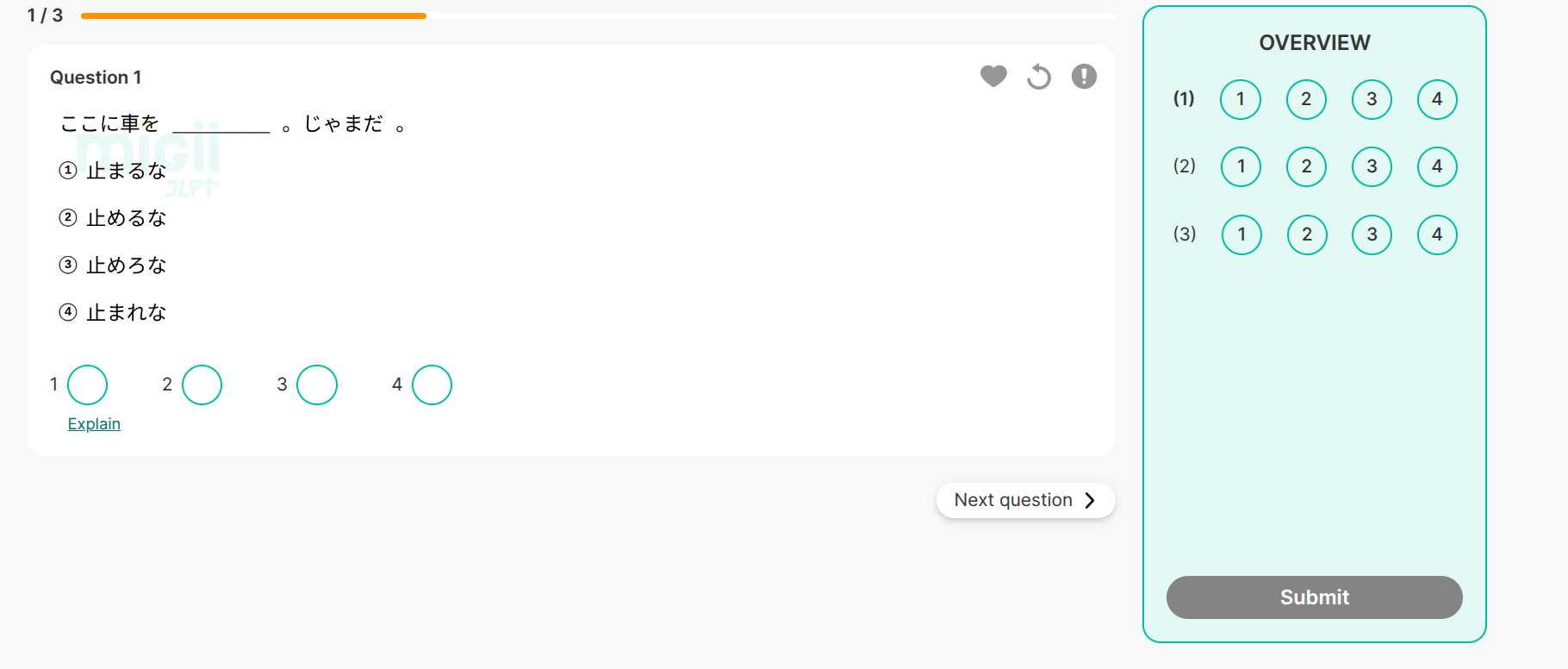
In another thread, a few people recommended it, and after taking a look, trying a free version, I’ve come to the conclusion that it’s a really good resource for me.
They give a lot of jlpt tasks, I can do them in bunches (like 5 or 10) and then when I do mistake immediately try to get what is wrong, what are the meaning, what I’m missing.
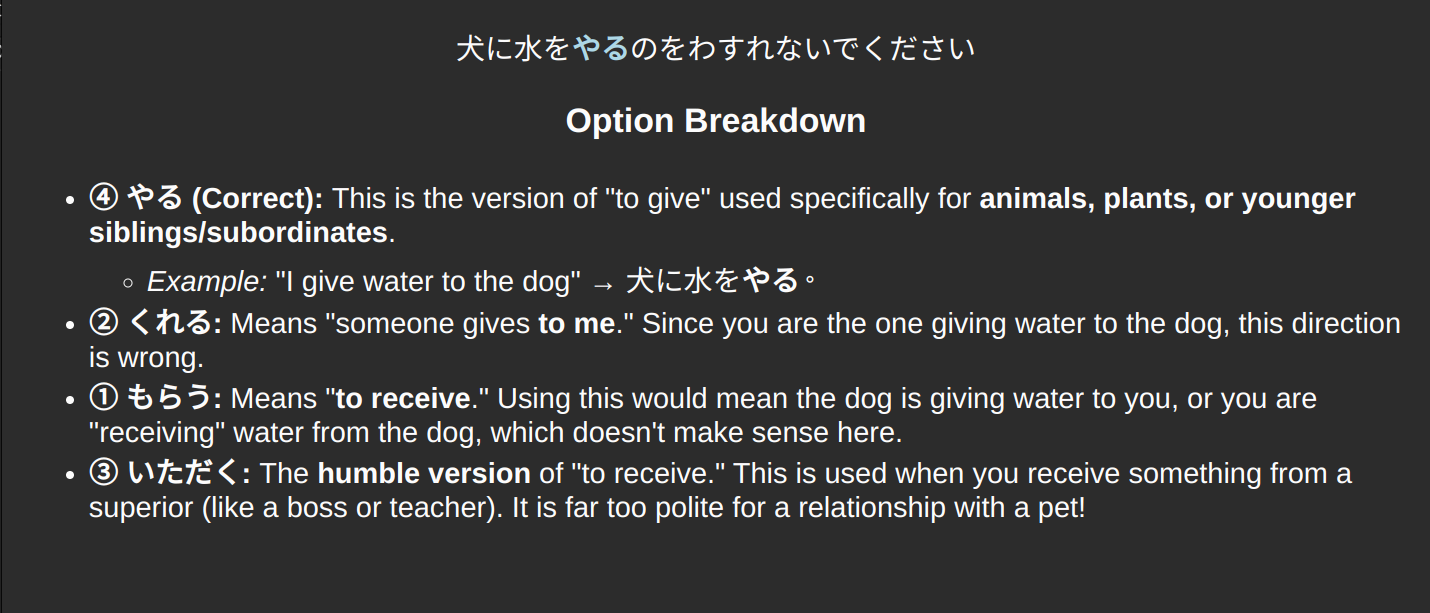
For example I’ve immediately made a mistake of 田中に会いました, the first thing to come to my mind was と but there was no と so I just clicked を and was humbled. Now I also have a deck for these mistakes:

Here I add mistakes in Cloze format and on the back I have a Gemini explanation of why I was wrong. I think I’ll be doing N4, N3, N2, N1 in this order, because I have to catch all the basic mistakes first, and also get a grip of the whole thing in order to be able to go through a lot of questions that I understand how, and not fail just because of my attention. Basically, I need to train my brain to avoid those unnecessary mistakes, so I can go even 100 questions without a fail when all the rules/things are known.

I still don’t know how to go with this one, I don’t know if I’m gonna mine any words (probably not until I have my level 2 deck completed), or how to work with listening/reading where I cannot make any anki cards with rules as it’s just attention and knowledge of the language (probably just do the stuff, idk) I probably should just do that with now anki in general.

For now, I’ll leave it as an additional quest I can do if I feel like that, at least before I buy the subscription.

Conclusion

So this week was quite an active one for my Japanese, I’ve created a lot of plans and now I just have to see how it goes.
Thanks for reading!

6 Likes

This week was kind of harsh. In two days I was doing my reviews after 1 am, and that definitely makes me do it less, but when I do it as early as 14pm it still feels good.


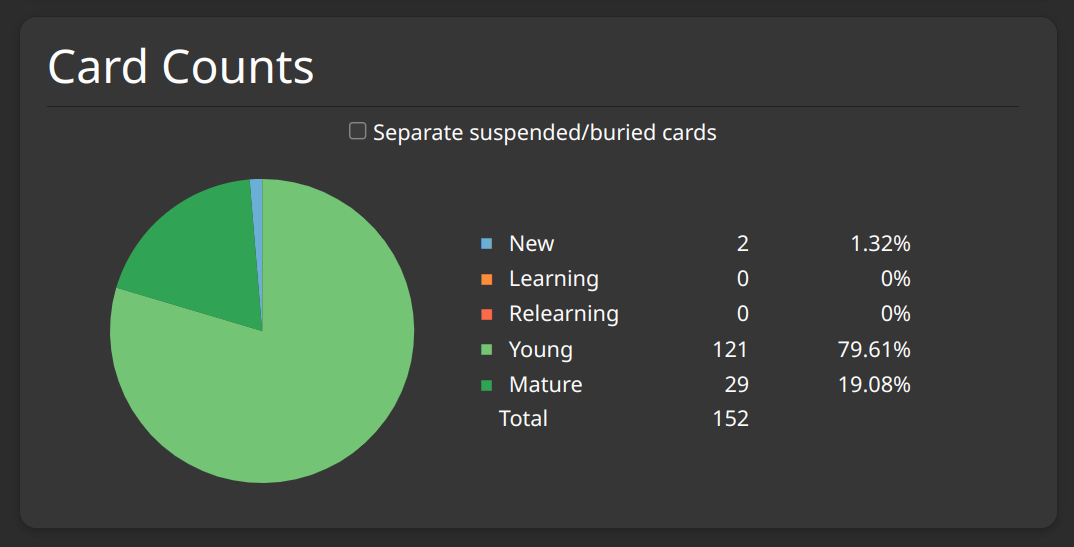
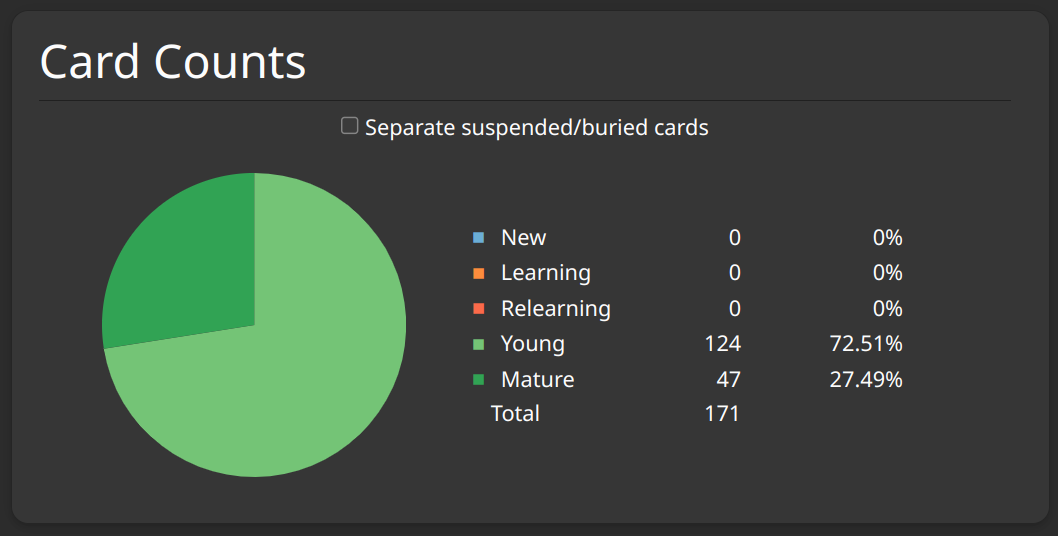
I have 171 cards so far!

Another thing that I started is level 2 kanji deck. After doing it for 5 days I stopped because it was not fun, I couldn’t concentrate fully on it, and decided that I’ll just do something where I can do my best.

It’s an interesting trap, in which I fall regularly, creating some kind of study strategy where I cannot exit easily, and it’s almost always has to do with Anki. I need to start coming up with strategies from which I can exit as fast as I get bored, to start the execution of a new one where I see progress.

I’m still doing Bunpro as it’s super easy for now.

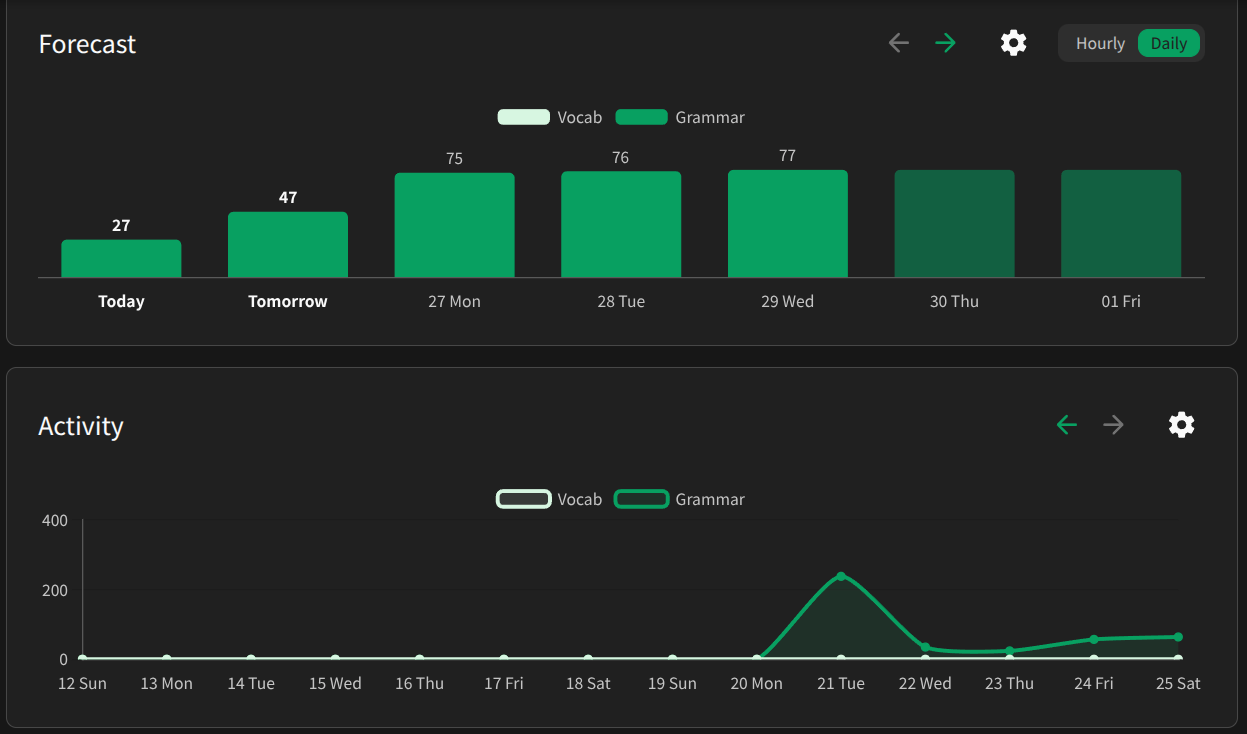
For a few days it’s been only 10-12 reviews/day, and as you can see, I have only 45 reviews in total for this week.

4 Likes

This week was very hard.
Most days, I just don’t have the usual time after lunch because every day is very different, so I tend to postpone doing reviews till 23pm and later. Also, my brain is getting tired of reading all those sentences I’ve seen so many times.

For now, I’ll switch from adding new words with new kanji to adding known words with kanji I don’t recognise in other words. I’ll continue them from my Google Sheet table. Also, for the time being, I’ll change the type of new words I add to Audio + hiragana on the front to see how it goes. Hopefully, I’ll be able to take review time from 25-30 minutes that I do now to 15 minutes. But anyhow, doing reviews earlier was the most effective method. Like today, I’ve done reviews early for the first time after a period of doing them late, and managed to finish all the reviews in 20 minutes.

Anyhow, I don’t think I’ll give this deck so easily.

From my general progress, I’m watching Dorohedoro in Japanese, and I almost never have to look up anything (looked up 3 words in the entire 8 episodes) or even think about the language. For me, it’s kind of a showcase of the progress, as the show seems to be quite complex.

Also, I often read comments under different videos on YouTube, and there are still so many comments with unknow vocab and also phrases that seem to have just a few words, and I cannot find what they mean.

4 Likes

This week wasn’t difficult to complete.
I’ve managed to do reviews every day before late, which I again can see as a main point of being able to continue doing this kind of repetitive stuff.

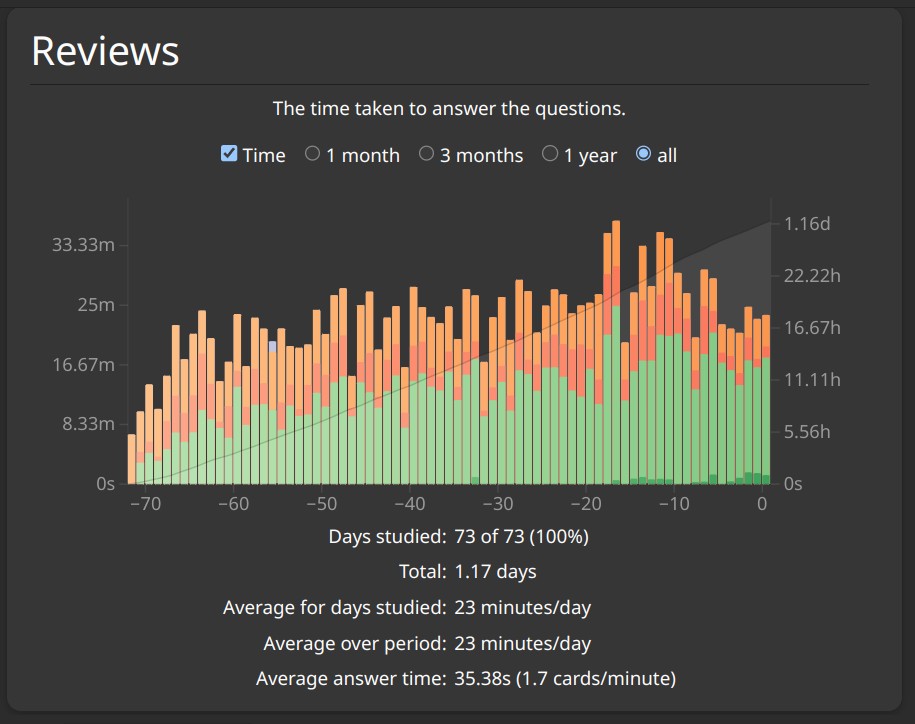
With the introduction of an Audio to Kanji card format, it becomes much faster to do reviews now it takes not 35-40 seconds per card but only 27-31. Retention is going up as well, because it’s much easier to recall the reading of words I know.

Also, as it can be noted retention is climbing up again, after getting a bit down for the past few weeks.

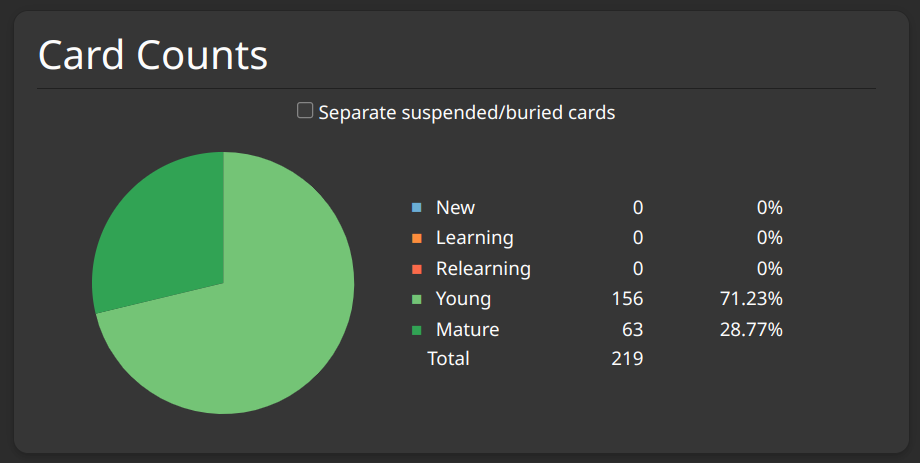
Till this point, I’ve managed to accumulate 219 words with 1 or more not familiar enough kanji:

I also started a thread about learning Japanese history.

But as I also wrote there (after posting it), I’m not sure it’s a good idea to occupy two threads at the same time, so I might just continue posting my texts here, but I’m not sure about it yet.

I’m really happy I can use Japanese now where it makes sense to use, and where it really serves a good purpose.

3 Likes

Rutine

To my surprise, this week wasn’t as hard as I thought it would be!
I was able to do reviews at the right time, and even started going to my local park, which is 5 minutes away from my house. Now when I think about it, it might also be my most favourite park!

By the way, I started going to that park because of this video:

There are definitely a few crows there, but only today I’ve managed to get as close as 5 meters to one of them. I’ve tried giving it some food, leaving it and stepping back, but the crow didn’t take it. As a snack, I used bread cut into pieces. The next time I go to the supermarket, I’ll buy some cat or dog food, as it seems to be a good snack for crows. From what I’ve learned from a perrot that I had, patience is a key here (and Gemini said that as well).

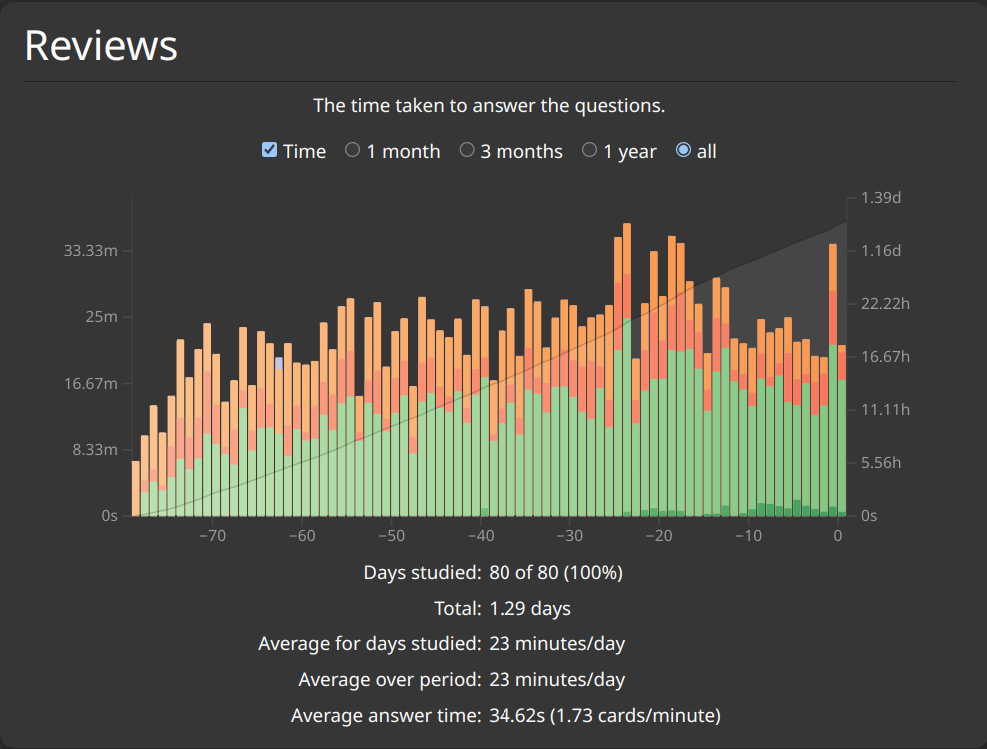
Getting back to my regular kanji learning routine, it’s been 80 days so far!

The big spike is me doing the reviews at night.

Recent activity, plans, and thoughts

History

I don’t know what’s going on with my history essay writing thing. There are a few points I didn’t like after trying the plan I created.
The first thing is, I literally spend the most time writing, and not learning, but maybe it’s a good thing, because this way I’m building a very long-term memory.
Another thing that I hate is getting corrected by Gemini, if I do that, I start to feel like nothing has changed from the time I was at around N4 level. It just says “this point is a little bit 不自然” but it doesn’t know how that 不自然 feels, and if that is something that native would render as an error or not. Of course, there are obvious grammar mistakes, and when it catches them I feel good, but when it starts saying “Japanese people don’t say it like this” it really bothers me, because I can’t know to what degree they don’t say that thing!

I know there’s an app where you can write texts, and people would correct them. I can’t recall its name at the moment, but I’ll find it, and maybe I’ll try working with it.

Speaking

I’ve tried using Hello Talk for the third time, mainly through the Voiceroom feature. This time I had some petitions and was able to find a few people (6 as of now) that are actually interesting, and somewhat share my absurd sense of humour! I still manage to make the atmosphere awkward by laughing when I don’t know how to say something, I probably should stop that and just be silent while thinking… I wonder how that app will handle it, I mean silence.

What I understood is that to use this app the user must be quite good at a language, or another option that I understood people use is to create a JP/EN or like IT/JP voiceroom, so when it becomes hard to speak, have an option of switching to a language with better proficiency, but even then.

Another observation is that people who say they primarily use Hello Talk to study sound extremely fluent in their 相槌, by which I mean not only “Um, um, hai” but how they ask questions and use little words for situations like when someone has left, or someone has a bad connection, and generally their language sounds extremely good.

One part that bothers me though, is how everyone says 上手ですね, and the reply is of course いや、まだまだです

Anyways, for now it’s going well as it has never before, so I’m going to continue using it.

Growth

As it’s been 80 days since I started this thread, I thought I’d also share some points where I’ve felt progress throughout this period.

The first thing is that so far, after 4 days of intense use of Hello Talk I’ve never been in a situation where I couldn’t understand the language. Except that one time where two people from Cambridge started talking about sub-university level math and physics. Not only listening, when I’m fresh enough, I feel like I speak really, really well, when we are talking on a somewhat familiar subject. When it’s not a familiar subject, I still manage to transmit my thoughts, but I feel like it’s not as easy for natives to catch what I’m talking about at many times.

Again about Hello Talk. I feel like little by little, but my absurd humour starts working in Japanese as well. If earlier it was just silence or a kind of “what?” sound in return, now it’s more like 40% success (I also do it less, maybe)

I feel like I’ve finally reached a level where I genuinely can understand the meaning of most comments under the youtube videos I watch. There are unknown words, but usually it’s not more than 1 or 2 per comment, so I can get the meaning without translating them. Or even if I translate, I’m getting the meaning, which wasn’t the case, for example 2 months ago.

I felt a huge jump in comprehension when watching content. I almost didn’t have to translate anything to watch Rezero or Dorohedoro and a few others, and usually, if I concentrate, I can also take any video, any channel of the ゆる言語学ラジオ family and understand it.

Even though I don’t know quite a lot of words, I feel like my basics have become very strong, and with that, my Japanese intuition got much better, so my brain just feels in the missing components. But in the past week, there were two times where in an important moment they said like 10 unknown words in 5 seconds, which was of course too much to understand something.

Another achievement, is that I really don’t have to concentrate now in order to catch Japanese, if the video is lower than my level. Before I could get lost easily or miss something, now it seems that my brain is just filling that in for me if, of course I had it before, but I’ve just noticed that this month it has gotten much stronger.

Another achievement of mine, is that I’ve tried joining a Minecraft Server, and I’ve passed all the rules reading sections and tests without using yomitan. At the end, I didn’t like the server’s structure and idea too much, so I decided to leave it for now, and not connect with Japanese people there.

The last one is again, the thing I noticed a few days ago, but I now I can read everyday Japanese without struggling. And what I mean by that is that I don’t struggle when I talk with Gemini and it responds fully in Japanese, or if someone sends me a message, I don’t have to get my brain together to read it. As long as all, or most words are known, reading it feels natural!

So ye, these are the points of growth I’ve noticed, mostly this month.

Other studies

Italian

Besides Japanese, I also study Italian. I have one or two lessons every week with my teacher:

I do my deck with corrections, but not regularly, maybe 1 or 2 times a week, it’s kind of boring, so I do it when I fill motivated.

The progress is quite good, as for now sometimes I can have a fluent small talk with a cashier without making mistakes visible to me. Also, today will be the fourth time that I visit a language exchange site, here in Rome. There are tables where people speak italian, but they are mainly foringers, so I just go to the English table and end up speaking English with Italians there, untill they become tired and switch to Italian.

The hardest part about Italian now, is that in the evening, when I have to talk in a fast manner, I mess up genders and number of nouns and adjectives as my brain is kind of already cooked at 10 pm (we can see it from my anki stats). Anyhow, I have a good progress here as well, and btw, when I’m finsihed with this post I’m heading straight to that language exchange meetup.

It says that it’s held from 19:30 until 22:30, but I usually stay up untill 23:30.

English!

After speaking English with Italians, I again understood that my spoken English is quite good, because I don’t really have to think about grammar, it usually comes out naturally, as well as the words just flow out of me. So when I think about improving English it’s about learning an accent, for me it’s RP. In the span of last two years, I’ve been doing some practice. Mainly mistakes with sounds, like sounds like /s/ and /z/ /th/, /ə/, and and others as well.
Now I’m using a deck I created for my student, with RP pronunciation of the most used English words.

The idea is that I have the written word on the front and audio on the back, and I have to say it in the RP way automatically, and if not, I work with that word, and fail it. The big achievement is that I somewhat got how to say all the 44 sounds of RP, and now it’s just relearning which one the word actually use. Though I’m not fully sure about/ʌ/ /æ/ /ɑː/ and other A sounds as well, I kind of got them, but not fully. There are also other important rules, like how to aspirate /t/s and /d/s, or how to end each word (not silencing the sounds), and probably much more which I’ll discover as I fix more probinant mistakes.

Also, I use a “English brick by brick, British pronunciation” podcast to practice when sounds are compared, and do some tongue twisters.

As a person whom I would shadow, I’ve chosen a Spiffing Brit, as people say he has a really polished and exaggerated RP, which is what I’m aiming for, plus I like his content and was subscribed to him even before thinking about shadowing him, so it makes it not only a good RP practice but also a quite fun one!

To test my progress I use BoldVoice Accent Oracle wich guesses accents quite well. I can see progress as from telling me that I’m 95% my native language, if I try now it can say that it has 10, 21, 30% British in it, which wasn’t the case till just a few days ago, and now I can get it quite often.

Thanks for reading through!

Wow, I’ve written quite a lot today!
I’m not sure how many people are going to read this all, but to those who did - my greatest thanks!

5 Likes

I just went to the local meet I was talking about and wow, today was the first day with a Japanese table!

I didn’t know it was there, so I set with Italians, speaking English, but after some time I decided to try an Italian table, and discovered that there was a table with Japanese materials laying on it!

I was so shocked that someone actually did form one :laughing: I was so soo 驚いた when I discovered it, I was like “まじで!めっちゃ驚いた!すごい!どうやってこのテーブル成立したの?“

I also discovered two things.

The fist is that I don’t know 丁寧語, I didn’t really try to speak it, but I tried a little. Than I just said that I can’t really speak it and we continued it タメ口

The second thing, is that I can describe the first episode of Frieren, and what it is about, without major problems :laughing: Probably me watching it 16 times has to do something with that 草 I think I can talk a lot about it, maybe I should write an article :laughing:

My Japanese never felt as good as it did this time, not only the Frieren part, in general!

When I found that table there were 5 people, one of them is a Japanese person, but 3 of them left immediately, because I came rather to the end of it. What I was said is that 1 of them understands Japanese quite well, 2 of them are at around 0, the ones who stayed were Japanese teacher (it’s not a teacher, for the most languages it’s just a person who helps people, so they know what to do if they cannot find a way to start speaking) and another guy who is a chad that speaks 8 languages, with major in Chinese, and Japanese as a second language, I really liked talking to him afterwards in Italian and English. He said there’s another meet on Fridays and Saturdays in a cafe named “Gio e Gio”. And ye, when I heard it for the first time I didn’t hear the “e” part (“e” means “and”), my brain went strait to “JoJo???” 草

Ye, that’s a quick update on some wonderful start that happened to me!

In the bus, there also was a guy reading a cool looking manga and I asked him about it, and we talked a little! I wish we talked more but I had to drop earlier

These meets give me the real power that allows me speaking up with people :laughing:

4 Likes

Today it’s a short post, I hope.

For some reason it’s been dificult in a past few days to manage my kanji deck, from the stats perspective it seems in tact, but I just don’t seem to find any interest in it.

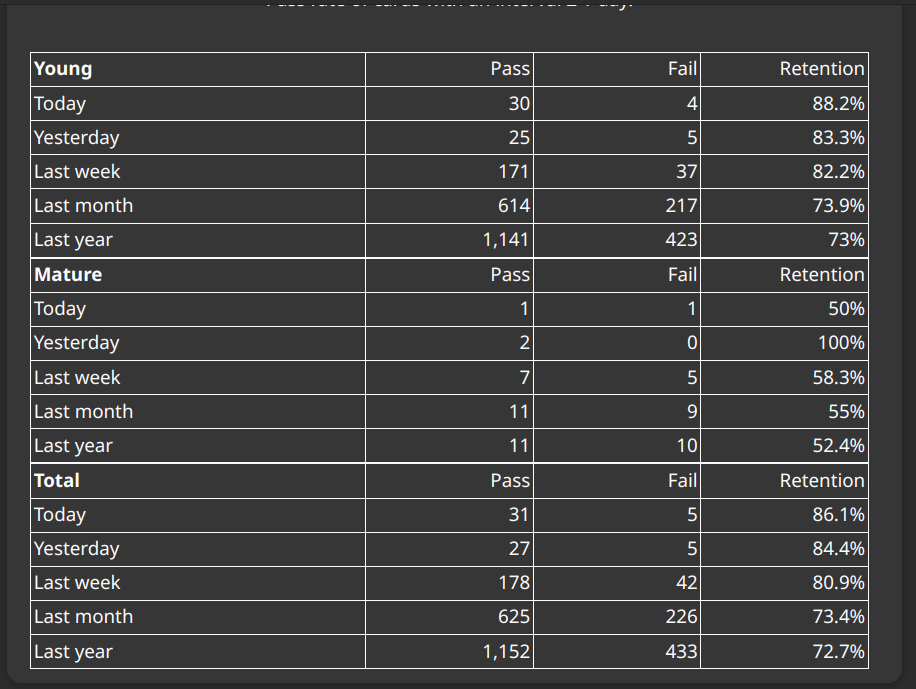
The retention is staying at 73% in general, but the retention for the mature cards is only 48%, which is concerning. I started reading 火星の人 and I see how much this deck has helped me, I basically can read most kanji that I notied were stopping me before. I might even say I’ve learned a large portion of kanji I encounterd regularly (thanks to me sorting everything in a google sheet).

I think I’ll take a pause after day 90 from adding new cards, and do some kind of extra study to make those 260 kanji really stick in my memory so I don’t have to think even a second in order to recall them. I’ll probably start failing all the cards I can’t recall in a blick of an eye (first I’ll recall them slowly and then fail, not just instant fail). I really want to take it down to 10 minutes a day, and maybe add something with less boring repetition so my brain stops falling asleep while it’s doing the work.
Maybe I’ll create a system where I do some reading/listening, then just writing words with kanji I wasn’t able to read. Some kind of a rutine, but one that willl always introduce something new. Basically not a rutine.

I also did some more RP accent training for English and now I speak like Doofenshmirtz, at least from what my sister said. Well, it’s not the first time I feel the accent transition go this way, some sounds are slowly shifting, and getting more natural, some sounds are too different so I cannot use them, a lot of sounds when I say them the old way now sound strange to me, but the new version of them is still not in my core (like word or world, it feels wrong when I say them the old way but it also feels outrageus when I say them the “correct” way). I also started to notice that my writing changed a bit, for example now I tend to write ould instead of just old. The phrase of the week I’ve leared while shadowing is “He is so slow, his speed can only be equated to that of a drunken hedgehog” I use it towards my sister.

At this week’s language exchange my Japanese wasn’t too good, I even felt it was kind of bad for my standards. One time I even didn’t manage to convay the mining I wanted, instead I ended up telling that part of a joke in Italian, which wasn’t too bad I should say. I still use tameguchi, and now after a funny chain of accidents it has become a local meme that I’m basically 失礼 www

Again, thanks everyone for reading!

2 Likes

This week the 3 months goal has been reached :partying_face:

During the three months in which I’ve been doing this activity, I had hard and easier times with it. For the most part hard times were just the occasions where I couldn’t complete the reviews before it has grown late, so I had to do everything at 1-2 am when I wouldn have no powers left. With that said, lately it started to get boring, even during the daytime.

From now on I’ll continue doing reviews every day, but will not add any new cards. As I already started doing 4 days ago. I also started failing cards if I cannot recall them instantly, so I can get more practice with them, moving them closer to being automatic. I’ll try to take the time down to 7-8 minutes, and then I’ll start adding words again so it holds at a spot of 9-11 minutes, which I believe is a perdiod thruout which I can stay forcused consistently even on boring stuff.

But this experiment was not only about doing anki for 3 months!

So I was able to do that, and with that, I fels something in me changing. It’s a small feeling change. I can feel that some concepts that were kind of not in my field of succeeding are now in it. I coulnd’t reaclly do more things at a time then one, for example it was learning Japanese, or learning Programming, but not both. And now, I kind of study Japanese every day, but it’s not the only thing I do. Not every day, but a few times a week I do and make progress in other stuff to, like English, Italian, cooking, going somewhere, thinking/doing small projects. I started going to the park almost every day! which is not because of this activity, but definetly with it’s help.

There’s been a lot of stuff going on, so I won’t be saying that doing this thing only has had this change, it has been a lot of factors comming together, and doing this consistant Japanese thing has been one of those.

On the other hand, I think habits are not the way to go. The more of them are present, the less new stuff it’s possible to get into the life. Of course, they give the structure, which can help a lot to not just sit and scroll all day long, but do something you genuinely like. II find the idea of following what you feel to do at the moment much more apealing, as well as of course much harder. Paradoxically, I noticed that doing things within the box, actually makes it much easier for me to do things outside of the box, and then, from outside of the box, I can create new walls and it’s much easier to work inside this new bigger box, from which I again exit so it’s again much easier than it was, and so on. Generally, the goal for me, is to be in the moment, and do or not do the thing that I truly want to do or not to do at that specific moment, as that thing is most right thing to do at that moment!

Thanks for reading everyone!

4 Likes

Yesterday it’s been 100th day since I started my 毎日Ankiチャレンジ :partying_face:

Strategy with adding no new vocab is working so far. It seems like each time I do anki, I know it will take less time, and therefore I concentrate better. Yesterday I’ve managed to complete all the reviews in 11.5 minutes! I wonder how much time it takes for it to consistantly take only 5 minutes? What kind of graph progression will there be in 10/20 days :thinking: If you have any decks where you folks did something simmilar, could you share how did the graph went down?



One thing I want to try is to lower my desired retention. Now it’s set to 90%, but I feel like I have some 余裕, becase now I can recognise all the kanji when I see them very easily, and I feel like maybe forgetting how to write them is not that bad in a long perspective, as recognition remains for a much much longer time. But for now I’m sticking with 90% just to see how the graph goes down.

Some achivements

This week was full of new achivements!

  • I’ve invited my Japanese neighbour and we talked for two and a half hours, I’ve even managed to speak teineigo all the time, of course regularly forgetting to add です or ます, but othrewise it went pritty well!
    After the 茶会 I’ve asked what she thinks my week points are, and she said that it’s mostly builing teineigo on another teineigo ますのです. I myself feel pain every time I say it. Another the biggest one is 硬い言い方, by which she ment things like me saying 脳みそにきざまれる instead of just 脳に入れる. It’s true, till this day I want to use 姉上あねうえ instead of お姉さん. Thanks Gintama.
    image
    But also she said that my usage of vocab is good enoguh! Eat that Gemini!

  • I found 幼稚園WARS a manga I like!
    It has a few intresting previews, and its アニメ化 is coming out in 2027. I picked it up because it has Sakamoto Days managa feeling, which I like a lot!
    It does not have any furigana, but when I read, I do not notice any words I don’t know! Well, there were three, and I’ve leared them already:
    お遊戯おゆうぎ - 殺し合い
    遊具遊具 - 遊びの道具 (that can be used to kill some people, but it’s not the main meaning)
    極秘ごくひ - 極端に秘密的な
    And I now when I try to recall there were a few new as well that I’ve leared, but I cannot remember what specifically those are.
    Of course, there are probably more words I don’t know then this, but it feels like my basics, got really good at this point, so I don’t really notice them. It feels like a big progress!
    On learnnatively 幼稚園WARS is L25. Acording to my sense of humor raised by stuff like Monty Python this is super funny ラブコメ

Cool PV!

PV with a song I cannot stop listening!

  • I found myself getting excited about not understnading content! Then I also got excited because I understood that it means I usually understand most stuff without thinking about it!
    And ye, I have times where I kind of “oh I don’t seem to be able to read that, shchit” but it goes more unnoticed now, more simmilar to english.

The 謎のコンテンツ is

I’ve been subscibed to this channel for a while, and it’s still a rock to climb, which I’m exceited about! Even a radio about which I was talking earlier now seems like a doable thig if I decide to crack it.

  • Yesterday, I wanted to do some French in the evening, but ended up watching youtube, reading comments, reading manga, talking on italki, all for 6 hours (23:00-05:00 あんまりに酷いな〜) and everything in Japanese!

I feel that this week was really good one! I’ve even managed to make a post not at 1am but before leaving for the language exchange!

Anyhow, thanks for reading, and good luck everyone in your studies!

1 Like

It’s been almost a month since the last post, but I’m here again!
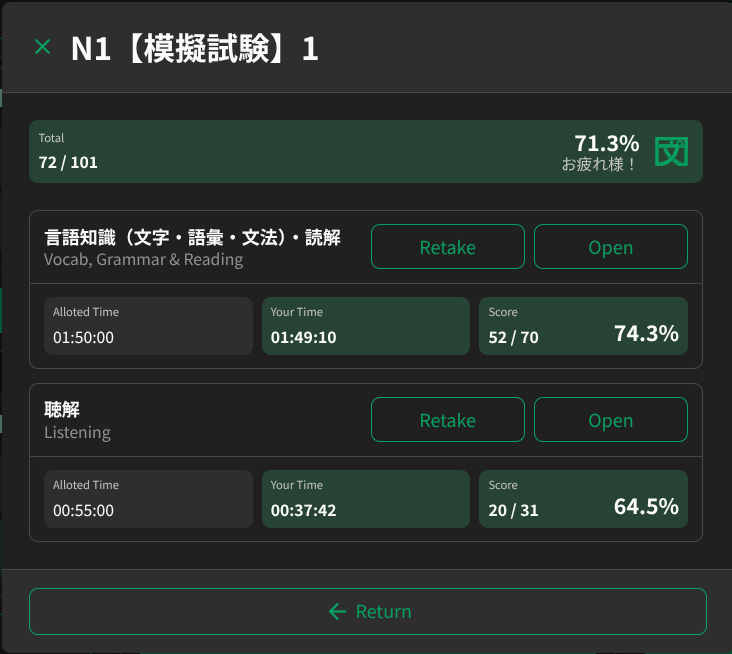
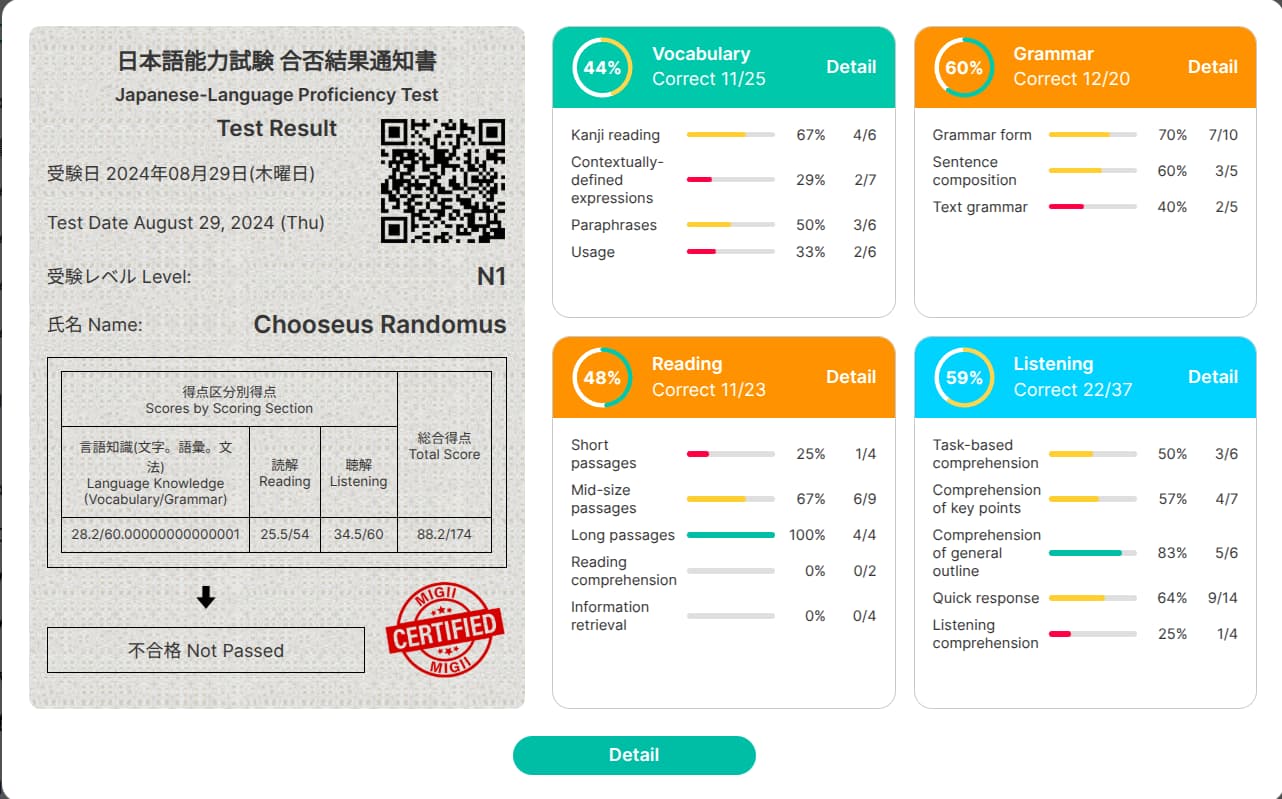
First of all, today I finally got the courage to take the N1 mock test, and here is the result


It’s a ギリギリ pass :partying_face:

Of course, I know the N1 tests here are much easier then the real ones, but still, going from mock N2 75% to mock N1 71% feel kind of good!

The Vocab&Grammar parts were definetly okey, I didn’t know everything but It wasn’t bad. Reading was the easiest part for me, probably it has to do a lot with me doing a lot of random reading with no lookups lately, so it was kind of flowless for the most part (it was one of my recent accivements, that my base reading spead is now listenable).
Listening was really tough though! 40% of what was there I understood perfectly, but threre were so many dialogs that used some field specific words that I don’t know in each sentence! Primarily the vocab used at the office, at work, or 10 sorts of sakura tree in another dialog (sorry for this small spoiler). Listening is a peart of Japanese with which I have problems, I would go as far as to say it’s the best one maybe, as I regularly listen podcasts, watch youtube and anime, talk to people on italki (the last one is not often but if I do I speak a lot), so I was a bit surprised! Probably, it has to do with listening section being on a higer level in respect to another one, as some other users has already mentioned. If you are this July N1 passer, could you please share your experiance with Mock tests vs the real one? How much time did each take, what was the score at the end? Would be super thankfull!

Anyhow, from now on I think I’ll be getting myself prepared for the upcoming December JLPT! With this result as a base 140 days before the exam, I think I might have a pritty good chance at succeeding!

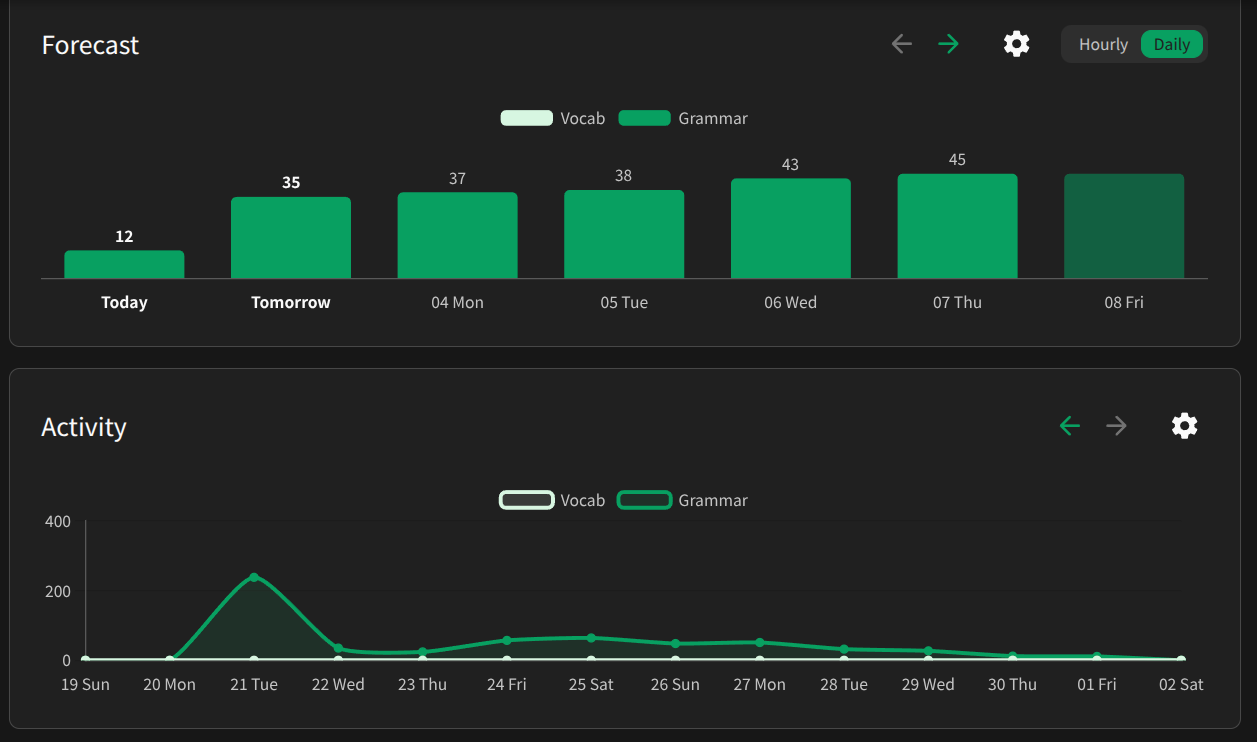
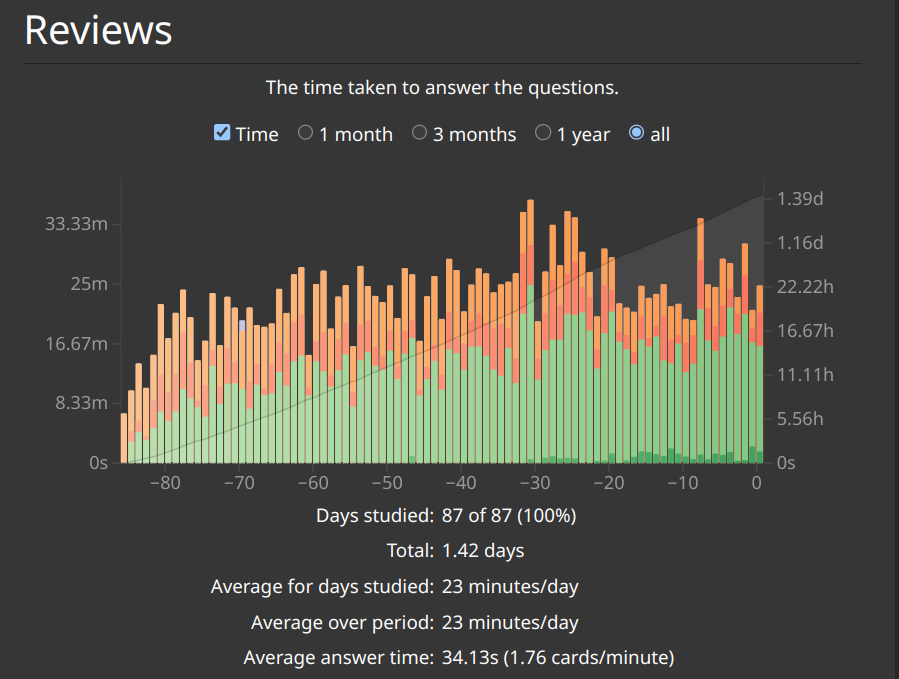
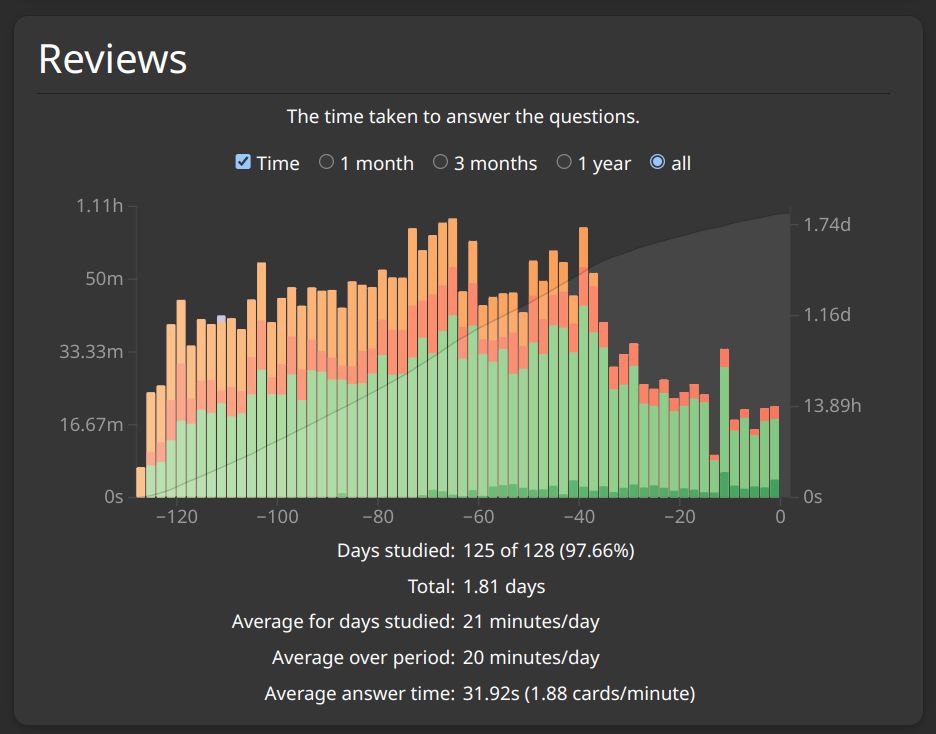
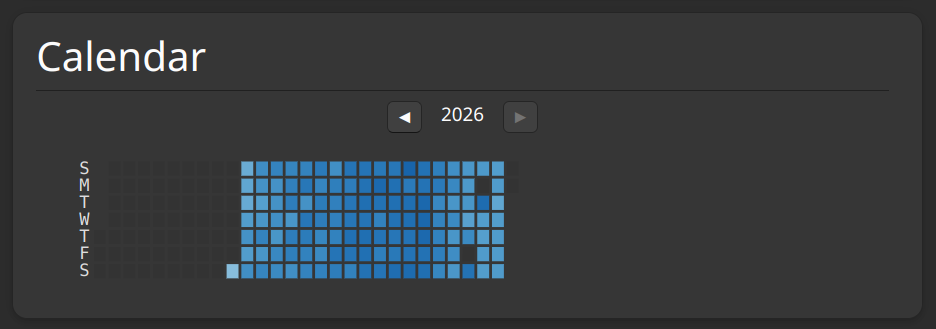
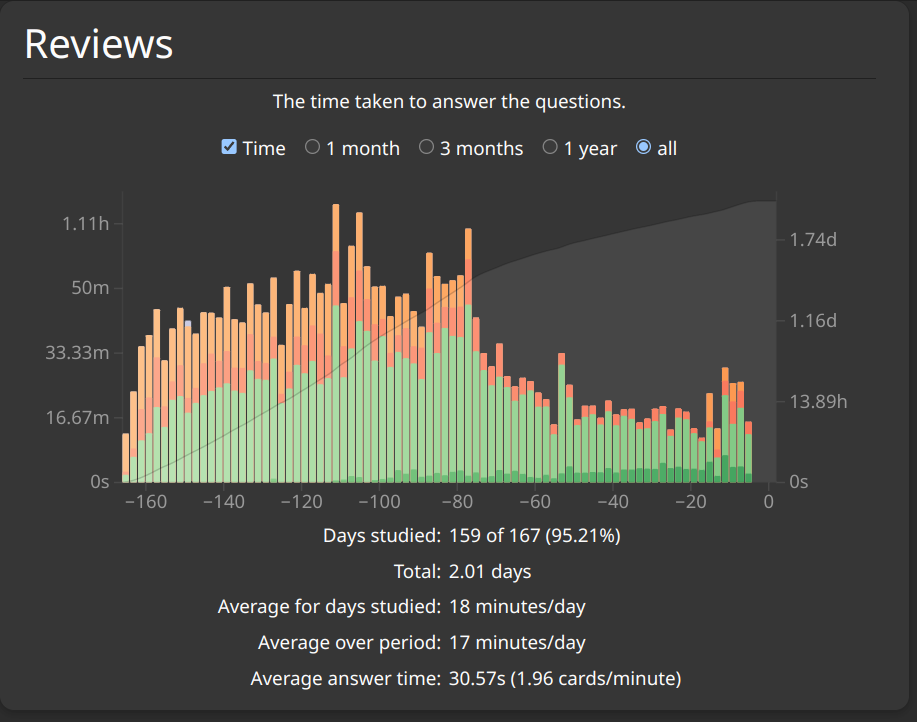
As for my 毎日アンキデッキ it now looks like this:


As you can see I’ve missed two days. I just to do reviews then due to treveling and having so much new stuff.

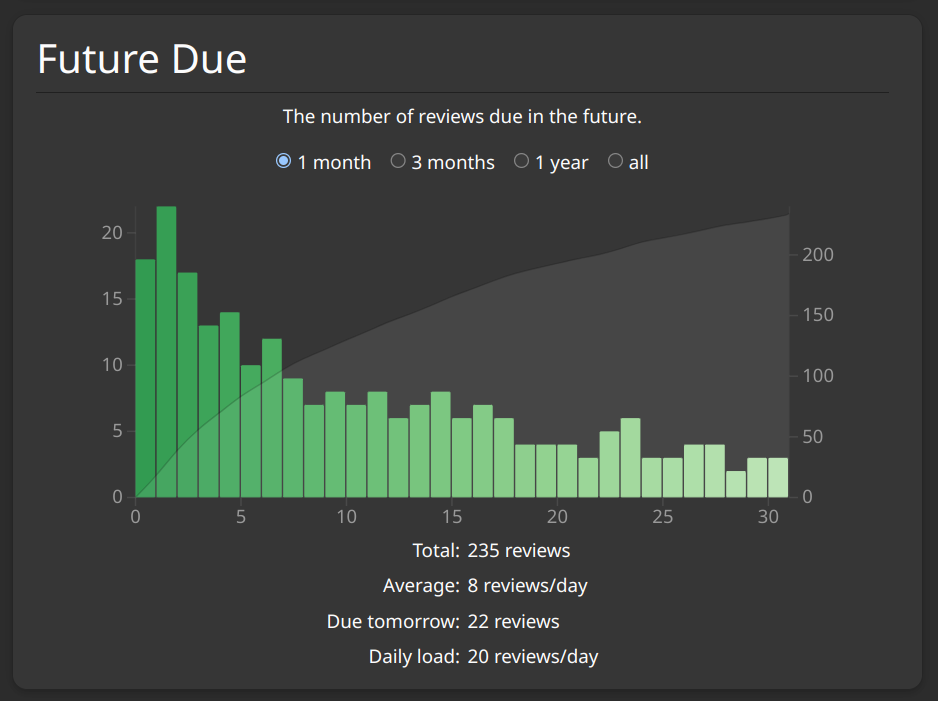
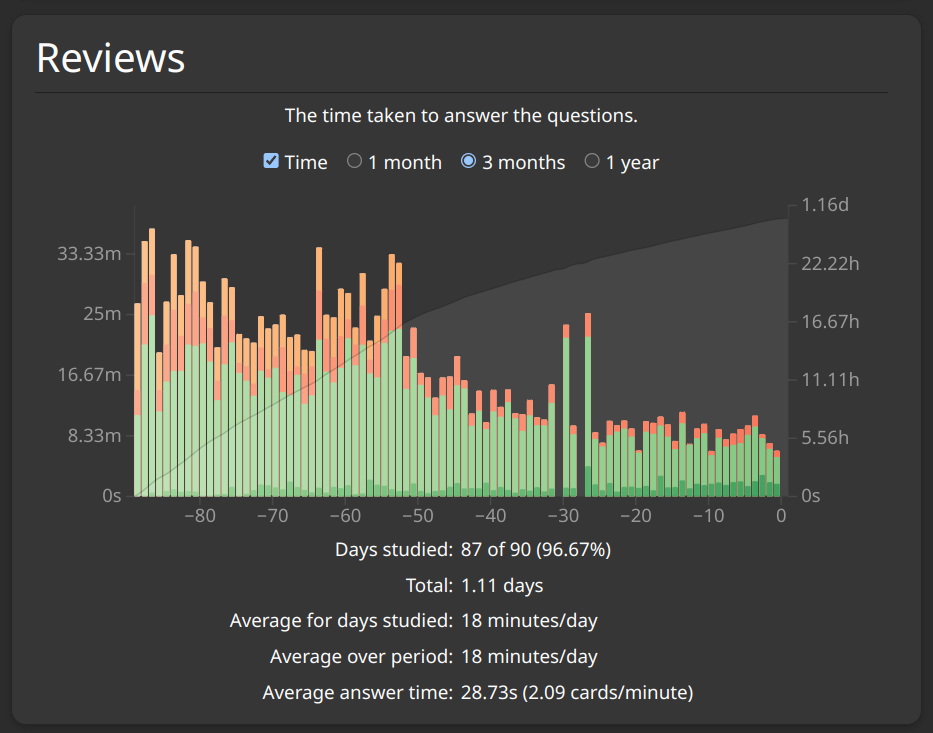
Reviews are getting down but not that fast. Usually now I do reviews for 10 minutes everyday, and there were two days with 6 and 8 minues respectively. Usually there are 20 cards to repeat a day.


On this graph we can see that after 3 days it will go down to 11-14, wich will probably take 5-7 minutes at first. The goal is to get the that spot of less then 10 cards a day, and then I might change the alg a little bit to make reviews more rare, and will start adding 6-7 cards a day, just to see how it goes (again, when it gets to more then 15 minutes I’ll probably stop)

So ye, for now it’s all, I don’t really feel like writing for now, but that could change easily, so who knows!

Good luck everyone :wave:

4 Likes

It’s been 15 days since the last post, so here is what I was able to do:

  • Continued doing anki deck as always, it’s been 143 days since the start, now it takes only 7-8 very pleasant minutes
  • Went through the N1 test I did and decoded unknown points, create cloze type cards with a lot of sentences.
  • Did anki 1 hour a day for 9 days, from todays it’s in the vacation mode
  • Read a dozen volumes of a random manga found online
  • I also started doing another anki deck, primarily because I added a lot of N1 words there, most of them are taken from the N1 mogishken, and some from individual Migii practice excersises.
  • Read 4 chapters (1.3 volumes) of これは経費で落ちません! which is super cool manga about 経理部の森若さん who likes her lifestyle and tries to keep it in status quo while some uneven spendings come in, and she deals with them. Also, I’m not a big expert, but this manga seems to be a slow romance with some aspects of shojo manga. Luckily, for now, the most part of what is happening is work, and the mc trying to deduce what is going on with irregular spendings.
  • Did a lot of anime watching, youtube watching, reading comments, basically all sorts of interactions with the language.

From interesting, this is comparacing of reviews prediction 15 days ago and now:
15 days ago


Now

The progression at this point doens’t look that good to be fair. Though I can already feel that after 6 days I won’t have a day with more then 15 reviews, but it’s getting down really without rushing.


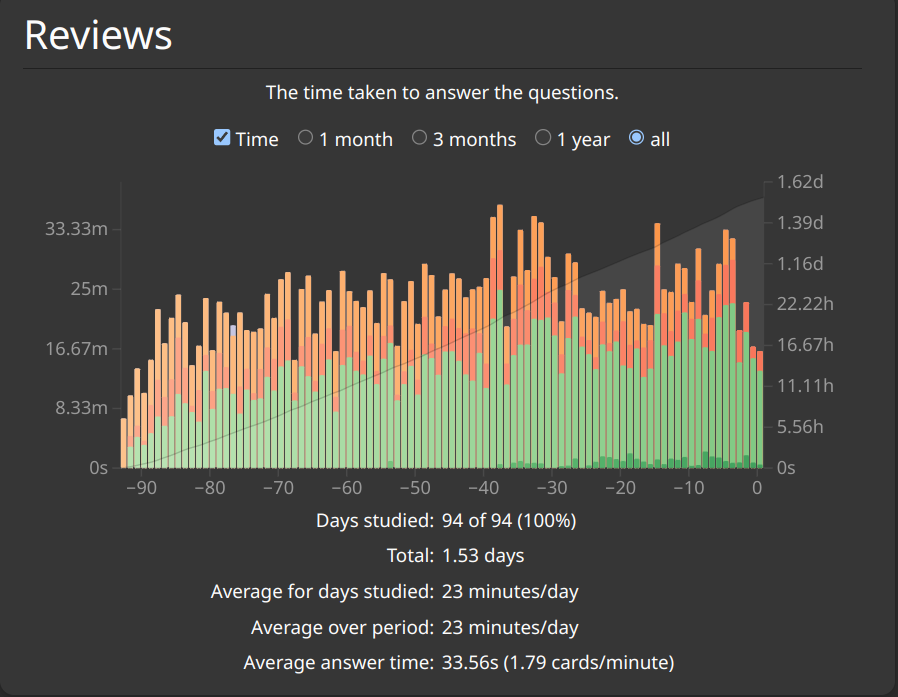
This is 3 months timeline.

A week ago or so I also decided to try Japanese amazon, because I just couldn’t find a few books in other places, namely
これは経費で落ちません!The one I introduced earlier

北欧女子オーサが見つけた日本の不思議。About a foringer person getting used to Japanese traditions.

会話の0.2秒を言語化する。A book of 水野さん from ゆる言語学ラジオ about how human brain works within the 会話.
ちびまる子ちゃんの四字熟語教室。A manga suggested by Asher in another thread

So I registered, and even got a 70% discount as a new user for the first 24 hours! I bought all I wanted, all 5 volumes of 北欧女子オーサが見つけた日本の不思議 btw. Unfortunately for some reason they blocked me that same day saying there’s a suspicious activity -_-
They asked for a bank transfer confirmation thing which I gave them, but they didn’t seem to care much about that, so I understood that it’s time to go back to my roots, and not without the help of many people I’ve managed to find これは経費で落ちません!
Other books on the other hand, seem to be really unpopular, I’ve even tried going as far as using some torents, but the books seem to be quite absent. I really want to read 北欧女子オーサが見つけた日本の不思議 it seems to be on pixiv manga but it feels like there’re only piaces of it, or it’s just written that way, anyhow, probably the best way for me to read it now is to do like:

  1. Create new account
  2. Use another card and buy all that manga
  3. Download it to my ipad, turn off wifi, and screenshot freaking everything!
  4. 返品

I don’t konw if it was legit to write the stuff above, but amazon has sucked so much of my time and energy, that the only thing I feel like doing now is to declare war! Heck, it even has sold me another thing I didn’t want to by, by having a simmilar interface to italian amazon that does another thing!

Well, at the end I’m quite happy with these two weeks!

2 Likes

As this topic is called “Experiments log” I think I have to write some of my most recent ideas I came up with to learn Japanese.

D&D based learning

This idea started forming about a year ago, when I discovered that I can learen all the time if the thing I learn is always new, so I just want to learn it, and can concentrate while learning it.
There’s not much from D&D here, but it was inspired by it so I ended up calling Japanese D&D.

The core thing here, is that I have all the ways in which I can study Japanese written down, and every time I want to study Japanese, I can just toss a dice and study whatevery it rolls, or alternatively just choose what I feel like in the moment. This way I’m escaping the trap of routine, and doing every day something same, which inevitably becomes a burden after a week or two.

With this approach every method that takes part in a list is self-sufficient.

I tried creating such a system, but haven’t succeeded, as it appeared to be quite a complicated task. A lot of methods that can be mesured, reliy heavily on anki, bunpro, basically any kind of srs system, which is just not well suted for this method.

Another thing is, if I try to describe an activity, like reading a book, it’s not one activity, it could be at least three or four based on how you read a book

  1. Read a book without lookups (improve fluency, learn better those words you already know, improve output)
  2. Mild lookups, lookup only the most nececery words (like the former one but with learning new wods a little, can already slow down a lot)
  3. Reading and getting into the every detail of each new word, kanji, grammar point, at this point it is already an analysis rather then reading.
  4. Read quickly and lookup only readings of the words (just came up with this one)

When I wrote that down I understood that I need for that 3 different books for each approach or it will be painfull. Then also some kind of questions apear, like do I take notes? How excecively? Only words or also the grammar? Do I write it on the paper or just hilight things? Then I also wrote that down, but it didn’t look good.

So it ended up kind of difficult to build such a thing, and for now it’s just one project that is waiting for it to be taken again. But I feel like this is the way to go in general, having the list of what you can do and do what you feel like, and not do what you don’t feel like.

I though about writing here more things I came up with, but that way it will become to long for anybody to read except a few people, so I’ll just do a few separate posts. The next one will be really fun!

これは道でござる

2 Likes

Not getting a job but getting an interview in a Japanese company

The core concept

This idea came again from D&D and my old thoughts about looking for employment.

It’s about researching the Japanese market, creating a resume, getting ready for an interview and attending it. Sounds like job hunting, but I try looking at it rather from a side of language learning in action, so let’s dive into my mind and see how it might look!

Finding a bunch of related fields

The first stage is a stage where I have to create a resume, I thought. But the thing is, to create a resume I have to offer myself as a working unit of a field, so instead, firstly I’ll start by highlighting all the fields in which I feel I can fool people by pretending to be a part of that field.

My primary fields are language learning, teaching, and backend web development. But for this challange it’s not what I need. What I’m looking for are the fields about which I have quite a wage understanding, but they are still related to the things I’m good at, so if I read a book or two, and then do some interview preparation practice, it should fool an interviewer into thinking that I’m actually a working unit at that field. For me it would be, marketing, finance, human resources, international connections, etc. I’ll have to find more of those. Just write them down for now and be ready to add some more to them while doing other preperation stuff.

Preliminary market research

The next step would be to make a dive into the Japanese market. I think first it’s good to get a good grasp of it in general, questions like “How many public companies are there?” “How many startups are out there?” “How and when do they hire people?” “How many companies are in fields that I wrote down?” “What do they use to find candidates?” “What do companies look out for in general?”

Grasping the core idea of the market in general is a necessity, as well as creating a good understanding of how many companies are out there that can offer an interview.

It’ll be good to have a spreadsheet with all the companies of Japan that could potentially have an interest in my character (base it on the list from the previous point), this makes it more like a game where I see all the stats.

Deep diving into one field

So now, having a grasp of the market, understanding of what I can propose, and a list of suitable companies, I can start building my character.

First I’ll choose one field about which I feel particularly good, and identify companies specifically for that field. I’ll try to research what skills they need, how the CV should look like, and what experience they want. At this point it should go as deep as possible. Also, at this stage I learn the basics of the field and try to learn stuff that will help me look like I’m a part of it.

Creating an image

After having gathered all the necessary information, I can start creating CVs

In my CV blank, which is my character sheet, I can now put anything I want as long as it’s believable enough. As a baseline, I’ll use my actual age (+3-4 years sometimes maybe), ethnicity (unless I want to fool them with it as well), and level of Japanese, but for other things like education, experience, visa opportunities, location, field of course! I can go as far as my imagination takes me!

And of course I’m not making one CV! It’s interesting to see how the reply rate would change according to having just work experience without a degree vs degree but no work experience. Would I be able to make a CV with no work experience, nor education, but make it just so interesting for a recruiter so they would call me anyhow? A lot can be done here!

Getting ready for the interview

And now I’m getting to the essence of all this. After getting to the interview, I’ll have to demonstrate a lot of things like

  • Keigo, and different levels of it in case it’s a multistage interview
  • Understanding of the culture and work culture
  • Understanding of my subject area

That gives me a good framework of understanding what exactly I have to learn now!

For the Keigo I’ll first try to understand the nuances and how it works within a company on different layers, for now on paper. It’s necessary to start listening to the interview recordings, which I have to find in plenty on youtube. Start taking lessons on italky with someone who has worked in a company, so they can give me assistance with that as well, I can try talking to them in different keigo registers and get corrected. Another thing I want to try is going to a random Italki voiceroom, assigning each person there their workplace and title and without saying a word of warning starting to talk like I’m in the office.

Culture and work culture are mostly regular information gathering, which includes reading articles, watching youtube, and maybe reading a fun how-to book.

Understanding the subject area is probably one of the most beneficial things here. First of all I’ll have to learn about it in Japanese. I’ll probably have to write a few articles in an appropriate register and see where I’m getting stuck or switch to a non-professional tone. I’ll probably have to also learn quite a few phrases really well, as a framework.

So this is where I’m getting a lot of Japanese output practice even before attending the interview itself!

Getting to the interview

As one would expect, before getting to an interview, I’ll have to send my CVs to companies, but just sending CVs would be boring, and probably not that effective. Instead, I’ll choose companies where I would want to have an interview, and I’ll create a cover letter for each of them.
(Now looking it up, I understood that in Japan it’s just a part of the resume, not sure how it works yet, but I have the vision so I’ll continue with it)
So yeah, writing a cover letter and personalising a CV is a perfect opportunity to do a lot of writing practice!

But, to create such a letter, I’ll probably have to dive a little bit deeper into each company, go to their page and see what they do, how big they are, see what people online say about it, and question myself if I really should be going for an interview there?

This step is going to be a balanced letter, because as for now it sounds like it takes a lot of time. I probably won’t do it for each company.

Getting through the interview

In this imaginary step I can define three main objectives.

  • Prepare for the interview
  • Get through the interview
  • Get them hooked for more interactions

After getting an offer for an interview, I shell dig even deeper into the company. Knowing what it does, what it needs, and what the customs are there should help immensely.

I’ll also be recording the interview. While it lasts, the only thing I can do is use all the preparations of mine, all the knowladge and language skills I’ve acquired, trying to be as much in caracter as I can, like Odysseus who returns to Itaka, and seeing a shepherd, who in reality is Afina in disguise, immediately comes up with a 5 page story, teling about his origin, who’s son he is, who’s killed whom from his family, and so to whom he seeks vengeance.

Another very important thing here is, to try and use some tricks, to make their side want to interact more with me. Maybe they can offer some kind of guides before the employment, or better some kind of guided courses where the person would explain something and interact with me (and maybe other people who want to get the job), maybe it could be showing me to more people and making them talk with me, as a part of some kind of procedure. I might even try to get a probationary, for a week or two in a rare case? This point is up to my research, I’ll have to figure out what that possibly could be.

After the interview

After the interview is finished, I’m left with a video recording, which now can serve me for further improvement.

First of all I can identify my language weaknesses and mistakes. Then I can work with them by creating Cloze type cards with mistakes – the usual strategy I use for Italian lessons.

Then I’ll have to figure out what wasn’t that good about the content of the interview, what I didn’t know how to answer, where my facade knowledge was too shallow. I’ll have to identify my weak points in understanding of the subject area and make them stronger for the upcoming interviews.

Afterword

Foohoo, I couldn’t imagine this post becoming so long! Everyone who has read it through – 心の奥底から感謝いたします!

This post was probably the most fun to write for me, I really enjoyed it!
If you folks have any ideas on how to make this even more fun and language related, I’ll be glad to see your responses!

Thanks again for reading and cheers!

1 Like

I’ve just finished reading コンビニ人間.
I didn’t know reading something could feel soo good, or rather I forgot about after discovering it once with another book back in 2020.
I couldn’t stop reading, so ended up reading it all in one day.

Now I need to give this book to my family so we can have a conversation about it, I’m really curiose what they would feel and think about it

Again, I’m just not going to write anything, because there are probably a lot of people who haven’t read it, and I don’t want to make any influence before they read the book, as well as it’s late and I don’t particularly want to write anything, so I’ll just make this little note as a log.

Also, now I feel the neccecery to learn how to put those complex emotions into the words beautifully

3 Likes

I’ve just completed the N1 mock test on Migii (the real test from 2015, as I understood), and man, was it difficult! Ended up not having time even to touch Reading comprehension and Information retrieval.

Everything was above my level, especially in listening, where there were so many unknown words in every audio.

My least favourite part is that they want me to remember little points about each text and audio, about which I don’t care.

For now, I have to decompose this test and see what I got wrong, and do some practice with that. After, I’ll just do another one of those and repeat the process.

As for Anki, I stopped seeing profit in it. I tried adding words again, but just couldn’t find enough, and the retention just wouldn’t get good for the old ones, so even if I were doing less than 10 minutes a day, it was bothering me.

Instead, I started reading. I had an idea to try and read one of those isekai novels from which they make all of those trash anime, and I got my hands on one short one, called 忌み子として捨てられた召喚士、実は世界最強, which is not an anime, but it’s got its manga. I read half of it, and the only thing I could think of is that the author’s writing style looks like a cube, and I even doubted that he is Japanese person because he would use the same 硬い constructions over and over again. That is what is called web小説 from 小説家なろう! as I understood. I stopped.

After that, I went to Crunchyroll and just picked one of the anime where I liked title, it was 村人レベル999 which didn’t sound to bad, plus presumably wasn’t an isekai, but just a power fantasy. The writing there was natural, and the story and characters seemed to make half sense at first! In three days I’ve managed to read 70% of the first volume. But, while it seemed not bad at first, while I was reading, the words and characters were starting to make less and less sense to me, ruining my immersion more and more. It’s still not that bad, but I’m afraid to invest further in this book. I probably should just choose something good… By the way it’s a point where I understood that Mushoku tensei isn’t half bad actually.

Well, I want a good fantasy, but I also want to continue and finish a few volumes, and then watch anime to see how that kind of trash anime is being produced at all stages!

1 Like