and
giving reasons
Structure
- Verb + し
- いAdj + し
- Noun + だ・し
- なAdj + だ・し
 The last し in a sentence can be replaced with から or ので

and
giving reasons
Structure
- Verb + し
- いAdj + し
- Noun + だ・し
- なAdj + だ・し
The last し in a sentence can be replaced with から or ので
Many of the し ~ し sentences contain: (among other things). I can kind of see that this could be implied but it’s not clear, to me, in the grammar description.
彼女は親切だし、綺麗だし、本当に大好き。
She is kind and beautiful (among other things). I really love her.
So I keep getting this mixed with とか-とか.
So does し imply among other things?
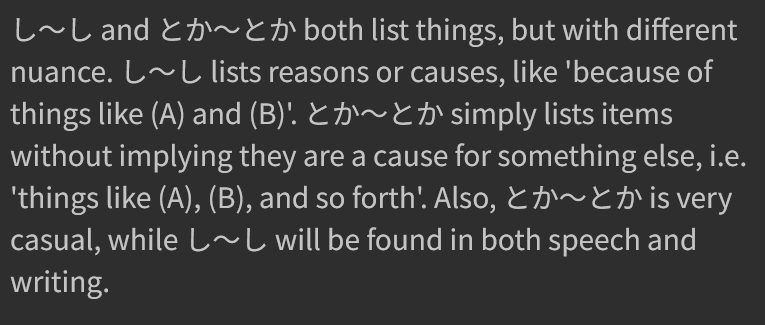
The related grammar section goes into detail about the difference:

I think there is an inconsistency in the sample sentences. Look at this one:
でもやったら上手になるし、将来日本に行けるかもしれないよ。
But if you do do it, you will become proficient (among other things) and in the future you might be able to go to Japan.
The “among other things” modifier describes the phrase that precedes and attaches to the し (becoming proficient), i.e. the REASONS.
But now look at this one:
このツアーで行ったら、バスの乗り放題が付いているし、見物もいっぱいできる。
If you go on this tour, an unlimited bus ride is included and you can also do a lot of sightseeing (among other things).
Now, the “among other things” is supposedly modifying a completely different part of the sentence (the part that follows the し), i.e. the RESULT. I believe the correct version of this one is:
If you go on this tour, an unlimited bus ride is included (among other things) and you can also do a lot of sightseeing .
The two meanings are very different. Please advise.
I apologize if I misunderstand the point, but there’s no comment from the staff yet, so let me try to help.
The part of the sentence that follows し is not necessarily a result/conclusion from reasons enumerated by し.
It could also be a continuation of the same series, just with the last reason not specifically marked by し, から, んだもん, or anything else. Bunpro doesn’t exactly spell this out, and I think it should.
Then how do you know if it’s a conclusion or not? Usually only one possibility makes sense in the context.
Examples:
あの人は美人だし、頭もいい。
She’s beautiful, and what’s more she’s bright.
(DoBJG p396)
Here, she is not bright because she is beautiful (among other reasons). Both are equally reasons for something else implied in the context.
ここのパンはおいしいし、安いし、とてもかわいい
〜し〜し①(並列)|日本語能力試験 JLPT N4文法 : 絵でわかる日本語
The bread is not cute because it is tasty and cheap.
edewakaru tries to make a distinction between し giving reasons (〜し・〜し、〜し②(理由の列挙) : 絵でわかる日本語) and し listing examples (linked above), but I wouldn’t say the distinction is all that clear.
And so, back to Bunpro’s examples, I believe the translation uses the word so when moving on from reasons to result/conclusions, and doesn’t use it when the conclusion is in the broader context outside the sentence.
このツアーで行ったら、(reasons:) バスの乗り放題が付いているし、見物もいっぱいできる。
(omitted conclusion:) だから、このツアーにしよう。
Here も can be additionally taken as a hint that we are still enumerating reasons.
Thanks… I think you are 100% right. That helped a lot. I was focusing far too much on the structure, largely because, as you say, they don’t really explain that the final し can be completely omitted (though they do say it can be mutated to a different word). So I’m now ok with the second example I gave.
However… I now think my first example from above is translated wrong.
でもやったら上手になるし、将来日本に行けるかもしれないよ。
But if you do do it, you will become proficient (among other things) and in the future you might be able to go to Japan.
Putting the “among other things” before the “and” (instead of at the end of the list) makes it sound like the non-exhaustive list of things is only 1 item here (when in fact I think it is 2).
In every other example, the “among other things” comes after the last item in the list (the items in the list being joined by “and”). I think this would be better:
But if you do do it, you will become proficient and in the future you might be able to go to Japan (among other things ).
I know this is unrelated to the し…し topic but Can the ところ here (from an example sentence on the same topic) be thought of as aspects as well? このレストランは高いし、まずいし、何もいいところがない。
I know it can mean place (also as different “parts” as the way Bunpro translated it.)
Also, is it any different from the grammar point of “ところが” here on Bunpro?