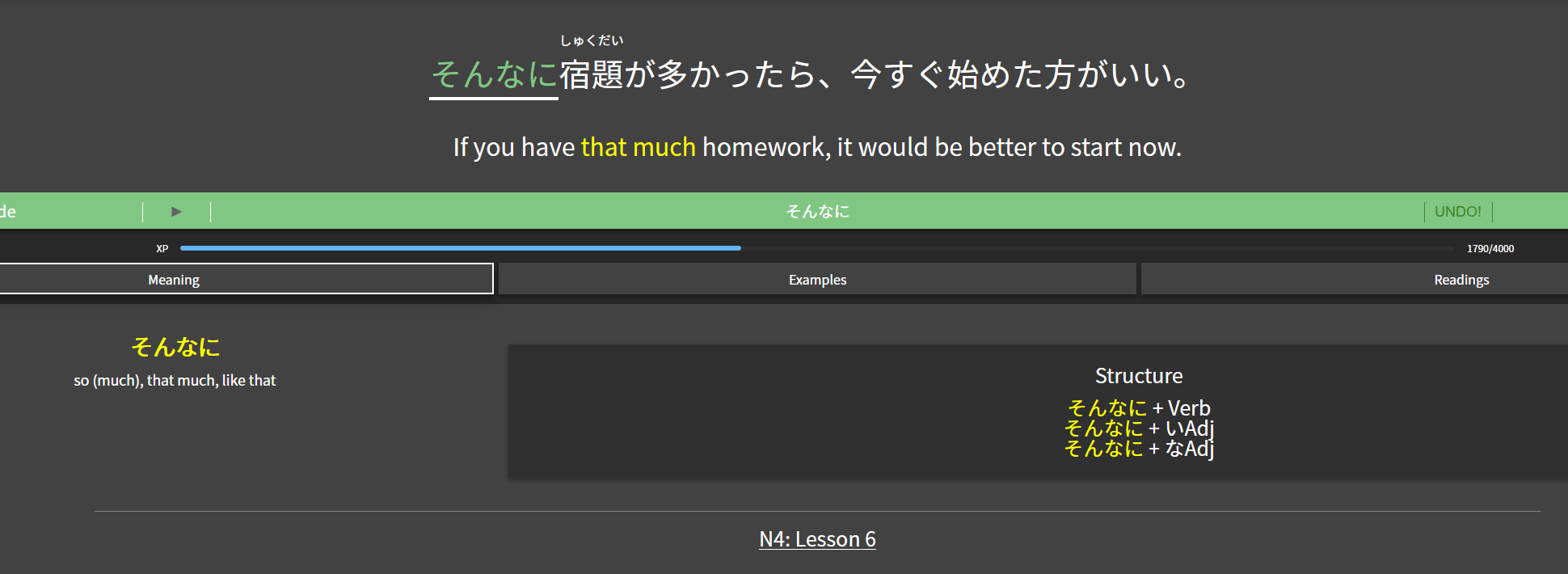
so (much)
that much
like that
Structure
- そんなに + Verb
- そんなに + いAdj
- そんなに + なAdj

I think the そんなに here is referring to the 多, rather than the 宿題.
If you have as much homework as that, …
Hey @Aythreuk (and really sorry for the late answer!)
Like @Pep95 (by the way, great answer!) says, it modifies 多かったら、I have added this piece of information to the nuance so that future learners won’t be troubled over it!
By the way, you can also use そんな, which would modify 宿題、but the meaning would be slightly different.
そんなに宿題が多いのなら、今すぐはじめたほうがいい。
If you have that much homework, it would be better to start now.
そんな宿題が多いのなら、今すぐはじめたほうがいい。
If you have a lot of such homework, it would be better to start now.
(I think it sounds better with 多いのなら)
Cheers!
This view sentence has be confused:
そんなに日本に行きたいなら、行って来たら?
If you want to go to Japan that much, why don’t you?
The [~たら] at the very end I read as a conditional taught in
an earlier lesson. How is this interpreted as ‘why don’t you’?
@deltacat3 Hey! You have every right to be confused. This is actually the contracted たらどう from Lesson 9 (a later lesson). たらどう means “why don’t you…?” and is used for giving advice or suggesting something. We will get that sentence rewritten. I apologize for the confusion. Cheers!
Thanks a bunch for clearing this up <3
Hey 
We have added information about this contraction in the たらどう grammar point, thank you for asking this question!
Cheers,
I could be misunderstanding, but up until now I thought the structure section described literal physical layout. I.e. a ‘+’ sign describes two words being physically connected. And in many cases, this type of physical connection matters, regardless of the deeper semantics, so it’s important to understand what those rules of physical structure are.
So in this case it’s a bit strange to see examples that are そんなに + noun, when that’s not listed as an acceptable structure. I understand that the noun alone is not being modified semantically, but it is structurally attached that way.
I’m not sure what the solution is here. Maybe I’m misunderstanding the structure section, but I don’t think so.
Would it be acceptable to add “そんなに + phrase” as a structural option? I think it’s accurate to say the adverb modifies the entire phrase.
This is something we’ve discussed internally before as sometimes people do get confused about this sort of structure section. Nothing is decided yet, but we do want to try to improve the legibility of the structure sections. If you have any other thoughts then further feedback on this is very welcome!
Thanks. For starters I’ll reiterate that I think “そんなに + phrase” should be an option. An even bigger smoking gun in support of that:
そんなに迷惑をかけたと思っていなかったです。すみませんでした。
I didn’t think that I was causing that much trouble. I’m sorry (for what I did).
I think this is a general problem on other grammar points too, see also here.
But even then, there will still be confusion when the modifier acts directly on a single word that it’s not “touching”. The only way I can think of to solve that is to add some kind of legend or “help” link to the structure boxes, to explain how the structure “math” works (specifically that + doesn’t require physical adjacency).