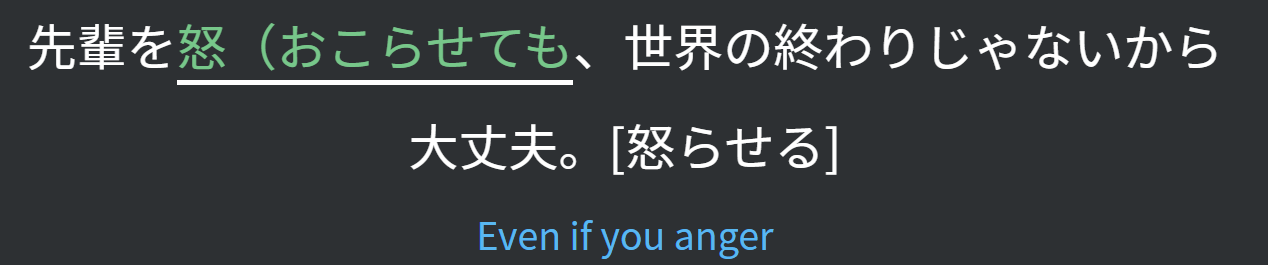
even if
even though
Structure
- Verb[ て ] + も
- Verb[な
い+ く・て ] + も- いAdj[ く・て ] + も
- いAdj[な
い+ く・て ] + も- Noun + でも・じゃなくて・も
- なAdj + でも・じゃなくて・も

even if
even though
Structure
- Verb[ て ] + も
- Verb[な
い+ く・て ] + も- いAdj[ く・て ] + も
- いAdj[な
い+ く・て ] + も- Noun + でも・じゃなくて・も
- なAdj + でも・じゃなくて・も
can you help me understand 遅く なっても (8th sentences)?
it just doesn’t fit to any conjugation in the explained structure
Hey 
It is adjective + なる conjugated:
遅い ーなる→遅くなるーても→遅くなっても
We used it in the example because students are often troubled when なる is conjugated 
(By the way, I changed a bit translation of this sentence, to fit なる meaning a bit better
遅くなっても、是非家に寄ってください。
Even if it gets late, by all means, please stop by the house.)
I hope it helps,
Cheers!
 when things like this pop up would you rather we bump the thread itself or post it in the bugs megathread?
Hi, can you explain the difference between this grammar point and のに (grammar point 130). At a first glance they seem to be interchangeable but I keep making mistakes in reviews not knowing which one to use for a “even though…” type sentence.
It might be helpful to think of のに as “despite”. If you can put “despite” in the sentence, it won’t be asking for ても
Hello, the lesson shows the structure as:
 [な]Adjective+でなくて(1)+も
 Noun+でなくて(1)+も
I wonder why is it not
 [な]Adjective+ではなくて(1)+も
 Noun+ではなくて(1)+も
Thank you.
I wrote a post (very long, admittedly) here attempting to generate discussion about the “fun fact” in this lesson: https://community.bunpro.jp/t/discussion-on-the-in-n4s-even-if-even-though
tl;dr I think the fun fact is wrong when it claims that で is a case-marking particle here. I would really love to get some feedback on this. Thanks!
Hello. Wootau asked this question above and it seems to still be unanswered. Do yall know why the structure section lists the main negative versions for nouns and な-adjs to be:
[な]Adjective+でなくて(1)+も
Noun+でなくて(1)+も
and not just the ない forms + も as shown below:
[な]Adjective+ではなくて(1)+も
Noun+ではなくて(1)+も
Is it because である is used to form the negatives of the noun and な-adj, which would make the negative forms be でない, then でなくて? Thanks
This is very closely related to my comment above (and the long linked thread). And it’s also closely related to this incorrect quote in the lesson:
The combination of the conjunction particle て (or the case-marking particle で) . . .
Let’s examine a number of cases one by one and see how this claim holds up. Eventually we’ll get to your specific Q.
Case 1: positive verb.
食べても, …
A natural translation is “even if I eat, …”
A painfully literal translation is “I eat, and even, …”
The entire conjugated verb is 食べて, and the て is the conjunctive particle, i.e. and. It conjoins the verb to whatever construct follows it.
Case 2: positive noun (note that this is one of the examples from the lesson, and the only noun example given).
電子レンジでも, …
Natural: even with a microwave, …
Literal: a microwave, with, even, …
This is indeed the case-marking particle. So far so good.
Case 3: positive na-adjective
綺麗でも, …
Natural: even if it’s pretty, …
Literal: pretty it is, and even, …
Here is where things get interesting (and where the lesson gets it wrong). The で here is not a case-marking particle. It’s impossible, by virtue of the fact that case-marking particles can only be paired with nouns. Here, で is the て-form of the copula だ (i.e. “is and”). Which means it’s a verb. But interestingly enough, you could argue it’s also a conjunctive particle, since it’s the end of the conjugated verb (but simultaneously, it’s the entire verb, since the verb is only one character, much unlike the earlier 食べて).
Case 2a (bonus): positive noun with copula instead of case-marking particle
Revisiting: 電子レンジでも, …
Depending on the context (i.e. the rest of the sentence), this could have a different meaning.
Natural: even if it is a microwave, …
Literal: a microwave it is, and even, …
Note that sentences like this (describing existence) are vastly more common than sentences marking cases (i.e. Case 2 above). So noun constructs are generally copulas (or conjunctive particles if you want to view it that way), and rarely case-marking particles.
So the lesson’s claims are:
Meaning the line I originally complained about:
The combination of the conjunction particle て (or the case-marking particle で) . . .
Should instead read something like:
The combination of the conjunction particle て/で (note that で is sometimes, with nouns only, instead a case-marking particle) . . .
Basically… it’s almost always a conjunctive particle, regardless of whether it’s て or で (but when it’s で, the entire verb is also wrapped up inside the particle). The case-marking particle case is quite rare and only can happen with nouns.
Moving onto negative cases, things are mostly the same, but anywhere that で is a copula (i.e. all na-adjectives, and most nouns, i.e. the majority of the time)… the full formal construct that is correct, I believe is indeed ではなくて, as was suggested in this thread, which is also accepted in abbreviated form as じゃなくて, and also less commonly as でなくて (which the lesson presents, wrongly IMO, as “the standard case”).
Note that the lesson also does not contain a single example of negative constructs with nouns and na-adjectives, which makes it hard to verify the negative patterns laid out at the beginning. Also note that in the only example of a na-adjective given:
彼女は仕事が大変でも諦めません。
The で is not a case-marking particle (because it can’t be).