
For [ 鈴様はもういらっしゃらないですか] I can’t use [いらっしゃいません], it only accepts the short form [いらっしゃらない], why?
3 Likes
Hey 
Similar to になる case, you only have to express politeness at the end of the sentence, since です is already there (and です expresses politeness) then you just should use いらっしゃらない form since いらっしゃいません is polite and you would use two polite forms one after another.
If there wasn’t です there you could use いらっしゃいません。
So acceptable phrases:
鈴木様はもういらっしゃらないですか。
鈴木様はもういらっしゃいませんか。
I have bolded the parts responsible for politeness
I hope it helps,
Cheers!
7 Likes
Thanks for the reply (and another one in another thread). This really cleared up some confusion for me, somehow it never occured to me that I should only mark politeness at the end and I was always trying to match the conjugations with the rest of the sentence. Thank you again!
1 Like
I don’ quite understand why I cannot say:
田中さんは今本をお読みになっています
They are supposed to be both honorific way of describing a continuous action, so what’s the difference?
2 Likes
@Rafal
Hey and welcome on the community forums  and sorry for the slow answer
Yes, you are right, it is 100% correct!
As a matter of fact, it was on the list of the correct answers, but by mistake, I have added “。” to it so you had to write " お読みになっています。" instead of simply “お読みになっています”.
Thanks to you we were able to fix the bug! Thank you!
Sorry for the inconvenience!
2 Likes
Why is this right
先(さき)に いらっしゃった んですが。
but this wrong with the polite past tense version of the same thing?
先(さき)に いらっしゃいました んですが。
Is it because of the んですが?
2 Likes
@flowsnake
You are right!
It is because the politeness is usually marked only at the end of the sentence (with some exceptions like before が (but/and), けれども(but), and in some cases から、ので, trying to please senpai, client by putting politeness anywhere you can despite the grammar, etc).
So if んですが is already at the end of the sentence, then you don’t have to make いらっしゃる polite.
We have put a sentence like this on purpose, to show that honorific verbs themselves do not have to be necessarily used in polite form.
I hope it helps,
Cheers
2 Likes
Many questions regarding this point, すみません、よろしく御願いします。

-
Why らっしゃいます and not いらっしゃいます? Is this like the speaking contraction: ている→てる? In this case, should なさっていらしゃいますか also be accepted as a correct answer?
-
Why two honorific verbs are being used? Wouldn’t 今何を勉強していらっしゃいますか be honorific enough (@Pushindawood 先生の答え above and Genki II suggests this is the case - if I understood things correctly …) していらっしゃいます is marked as wrong.
You cant combine なさる and いらっしゃる。You cant say していらっしゃる .
The correct answer should be something like 今は何を勉強なさっていますか。When using て form of keigo, it is perfectly OK to use います after it. There are exceptions, but usually limited to highly formal situations, いたしております for example.
1 Like
Why is いらっしゃった not accepted for this sentence?
お客さんがいらっしゃいました。
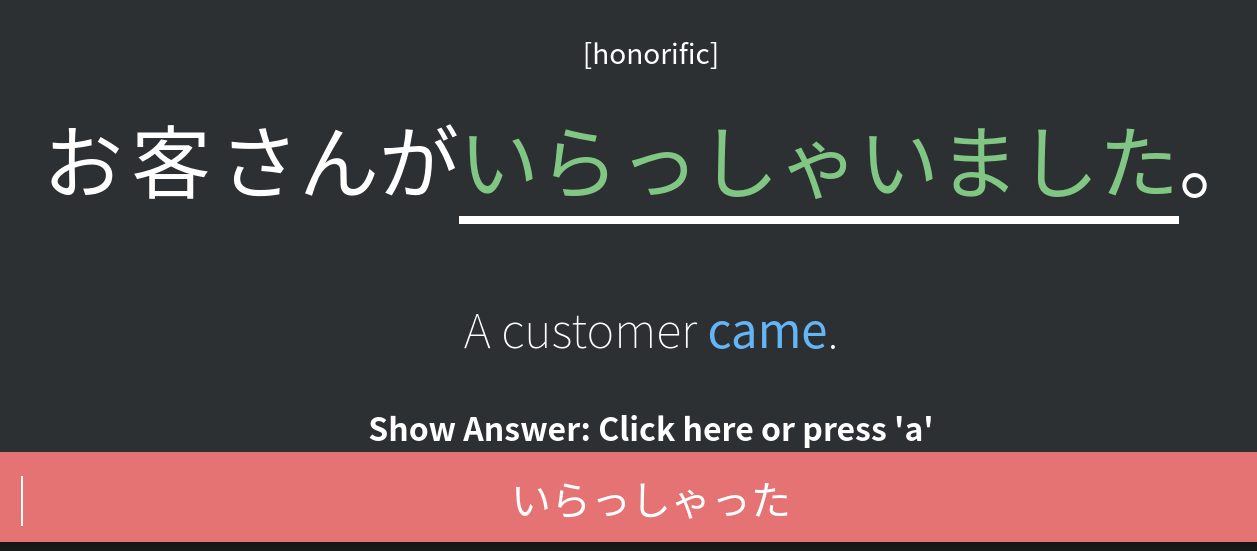
Maybe it’s unnatural to end a sentence without a polite form if the sentence contains an honorific?
1 Like
Hi!
I have a question regarding the example below
日本語を教えていらっしゃると聞きました
Why is いらっしゃる correct here?
The verb 教える is not 居る, 来る or 行く, so how come it fits in this sentence?
The bunpro explanation doesn’t mention any exceptional use of this grammatical structure.
Looking forward to any replies.
Cheers!
It’s not just 教える but 教えている.
Ah, that makes perfect sense now.
Thanks!
Hi! Is this the word used in 行ってらっしゃい? If so, what verb does it replace? Is it 来る, meaning imperative “(you) go and come back”? Or is it いる, meaning something like “be gone (respectfully)”?
Given that we have 行って来ます with 来ます in it, the former seems more likely, but I am still curious
Hey @steffuld !
Yes this is the word used in いってらっしゃい! This word is the combination of 行く in the て-form, and いらっしゃる in its imperative form! Although いらっしゃい is the imperative form and the meaning is close to ‘come’, it has a more welcoming nuance compared to the imperative form of 来る (来い). So a direct translation of いってらっしゃい would be ‘Go and come back home (we will welcome you home)’.
I hope this answers your question!
1 Like
It does! Thank you so much for the explanation!
1 Like
Why is
田中さんは今本をおよみなさっています
marked wrong in the review? I understand it doesn’t count as right for this question, but I don’t get why it’s marked as wrong instead of giving a hint.
2 Likes
Hi there, and welcome to the forums! Although we have listed on the なさる grammar page that it can be paired with the stem form of う and る verbs, in reality this is actually extremely rare. なさる is almost exclusively used either by itself, or when paired with する verbs.
I will add a note to the なさる grammar description about this. になる on the other hand will often pair with either the stem form of う and る verbs, or する verbs.
1 Like
The explanation suggestions that いらっしゃる is used for いる, くる, or いくand also the て form of these verbs but then the examples go on to show it is often used for the て form of many other verbs too eg. 田中さんは今本を読んでいらっしゃる
I think this needs to be made clearer as it is very difficult to know when to use いらっしゃる vs お~になる when those questions come up.
1 Like
In the explanation where it says that this verb can replace いる, くる, and いく, that remains true for the て form of other verbs, as the いる (one of the verbs it can replace) in ている is what it is actually replacing.
It is also specifically mentioned here in the explanation - いらっしゃる may also be used to replace いる, くる, or いく when they are attached to the て-form of another verb.
Hope this helps!
2 Likes