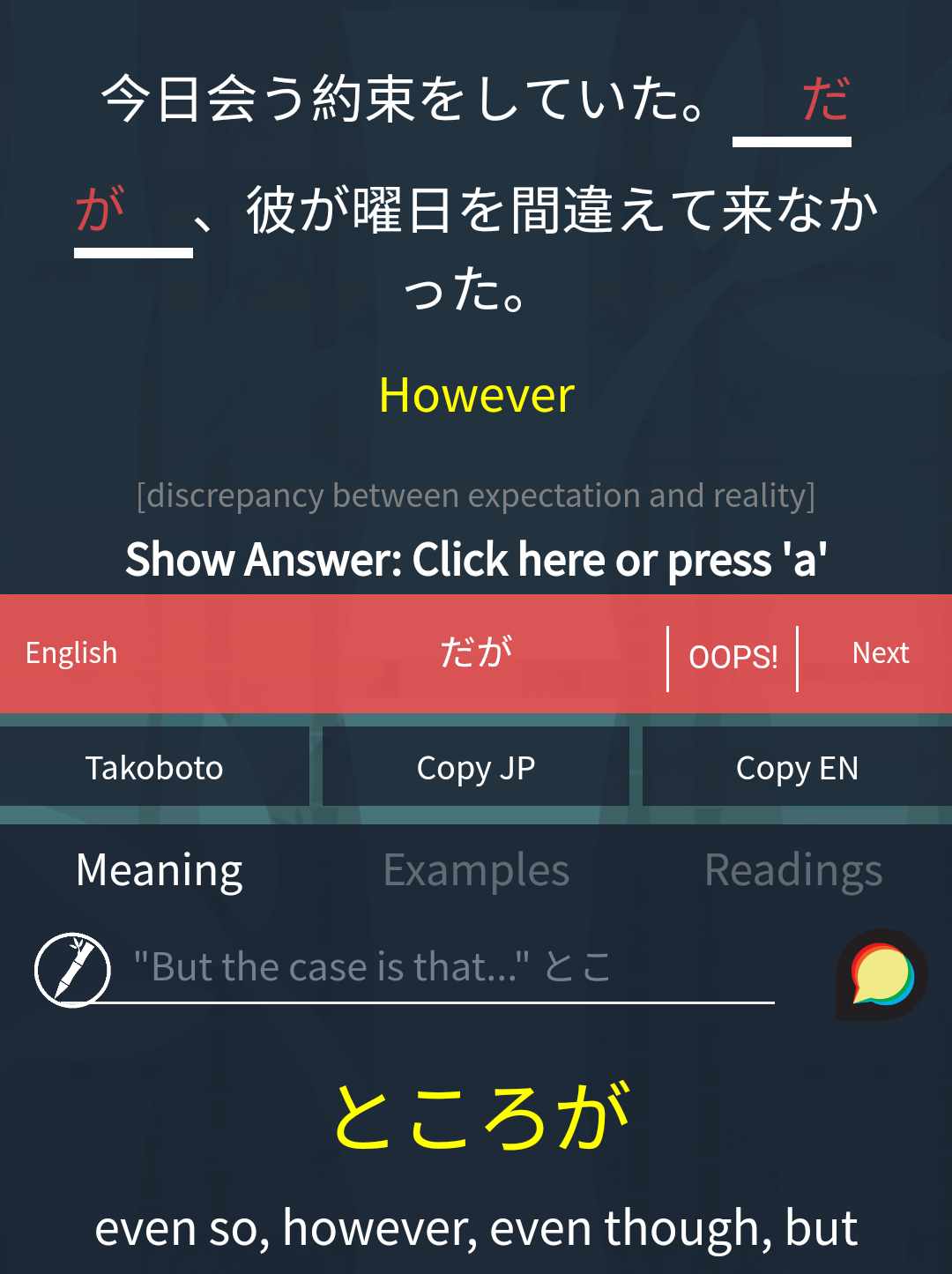
English translation:
even so, however, even though
Structure
Expectation + ところが + Result
Explanation:
Used when there is discrepancy between expectation and actual state/reality.

English translation:
even so, however, even though
Structure
Expectation + ところが + Result
Explanation:
Used when there is discrepancy between expectation and actual state/reality.
I have added だが to alternative answers 
テストに出そうなところを予想して勉強した。ところが、全然違う問題しか出なかった。
I’m a little bit confused with this example.
出そうな = what looks like will appear (what I think will appear)?
出そうなところ=?
I’m pretty sure that in this case ところ refers to areas of study.
So the writer predicted what areas of study would come up on the test and studied them. However some questions regarding totally different areas of study came up.
This might not necessarily help as a resource for usage of the grammar point but I always find it interest to study the etymology of something to understand it better. I hope this is interesting / helpful.
What is the distinction between this point and それなのに? It appears both points connect two phrases A and B, where B is an unexpected result of A. I’m sure there is some nuance that distinguishes them, but I’m having some trouble seeing it from the example sentences. Any insight would be appreciated!
I would say those expressions are completely interchangeable.
ところが might be a bit more formal and objectively stating facts, while それなのに has more emphasis on speaker emotions and is therefore more subjective (and casual).
I also feel (subjective opinion) that ところが is more often used with unexpected results of events.
I hope it helps.
Cheers
Anyone able to tell me the nuance of this grammer point in the following sentences that have been popping up in the news lately?
三重県、静岡県、岐阜県で、40℃以上の「酷暑日」になったところがありました。
東京も38℃以上になったところがありました。
I dont really understand the unexpectedness of the ‘あります’ since it has already been stated that the temperature become higer.
Or should I interpreted this usage in the news in general as something like “Despite all expectations, the temperature became higher then X degrees”?
Or is this a different grammer point after all? 
In this case it’s not an instance of the pattern from this grammar point, but rather a good old noun ところ (place, location, site).
Also in Tokyo there have been areas with temperatures exceeding 38C.
In this grammar point, 「ところが、」starts a sentence. This might not be outlined in the most straightforward way in the structure block, but you can see it in all example sentences.
Thanks for your insights! Makes a lot more sense now.