
すぎる - Grammar Discussion

I’m a little confused with this translation
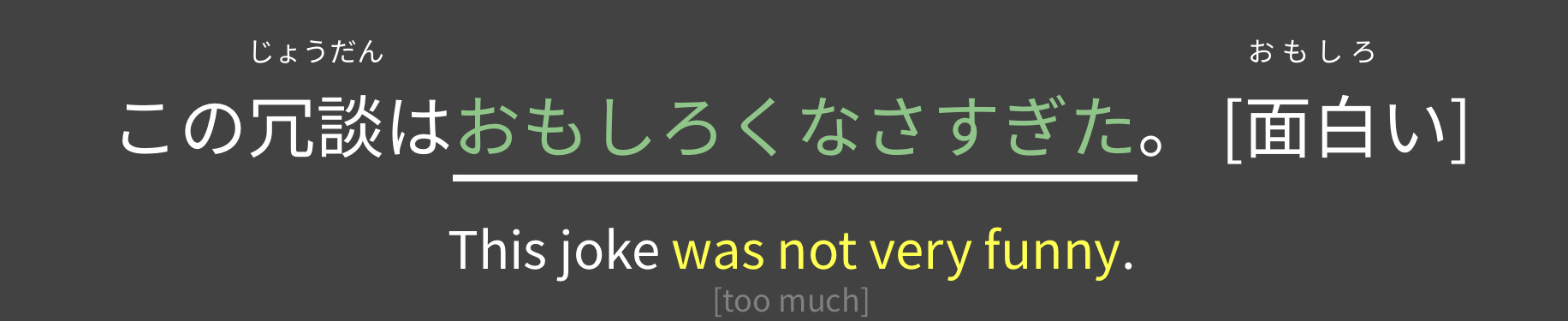
“This joke was not very funny” feels somewhat soft to me (I’m not a native speaker, might be getting the nuance wrong here)

In comparison I would translate the sentence from above as:
“This joke was ‘too much not funny’.” I’d interpret this as “This joke was not funny at all”, which feels quite harsh, but goes along pretty well with the “beyond normal” feeling of すぎる

Am I misunderstanding something?

1 Like

Hey :smiley:

“not funny at all” and “not very funny -> exceedingly not funny -> extremely not funny - too dull” are very similar, but not the same. They differ at degree.

To say not funny at all you would use 全然面白くない、とてもおもしろくない etc.

1 Like

It took me a while to figure out that this grammar point is essentially the verb 「過ぎる」(*). Now that I know this an ichidan verb, it is also clear where the conjugated forms 「すぎた」 and 「すぎない」 come from. But why are there no example sentences utilising the polite verb form 「すぎます」?

(*): I think you should always mention the kanji spelling if there is one available, even if it is not commonly used.

2 Likes

Additional question: Is 「過ぎ」 a regular verb form, or is it just an irregular mutation of this particular verb?

1 Like

It took me a while to figure out that this grammar point is essentially the verb 「過ぎる」(*). Now that I know this an ichidan verb, it is also clear where the conjugated forms 「すぎた」 and 「すぎない」 come from. But why are there no example sentences utilising the polite verb form 「すぎます」?

漢字 spelling has been added. Polite sentences also have been introduced. :+1:

Additional question: Is 「過ぎ」 a regular verb form, or is it just an irregular mutation of this particular verb?

過ぎ is a noun form, basically:

食べすぎる - to eat too much
食べ 過ぎ - overeating

Cheers :+1:

2 Likes

Regarding the example sentence:

これはおもすぎるでしょう。[重い]

Is おもすぎます wrong due to the でしょう?

2 Likes

I got the “That joke was not funny at all” sentence in a review and answered with “その冗談はぜんぜんおもしろくなかった”. Seeing the “[lit. too much not funny]” hint should’ve been enough to make me realize that isn’t what the exercise was looking for, but would that still be a valid translation? Is there a difference in nuance between the two?

1 Like

Hey,
It would work, meaning something along “not funny at all.”

2 Likes

By the way, if you want to get exactly the same meaning you can say:

その冗談は、余りにも面白くなかった。
(too much not funny)

2 Likes

Does anyone happen to have a source that explains why ない becomes なさ when すぎる is used?

I don’t believe I’ve seen this pattern anywhere else, and I’d like to understand if this is truly a one-off, or if it’s part of a deeper (even if antiquated) pattern.

4 Likes

You can see it also in なさそうだ :slight_smile:

I will write more about it in a few days,
Cheers! :+1:

2 Likes

I’ve noticed that the さ doesn’t seem required in すぎる:

Is it also not required in そう? It’s one of the most annoying ghosts for me :3

1 Like

Can there be a bit more elaboration on:

その冗談は おもしろくなさすぎた

From what I understand おもしろい gets turned into おもしろく and then you add な to mean in general “Not interesting” and combined with すぎた, the past tense of too much. (Was too much not interesting) So what is the purpose of さ? It doesn’t seem to be conjugated from either interesting OR too much. I’ve been looking around so sorry if I missed an explanation.

2 Likes

@Aarix
Hey :cowboy_hat_face:

If you have a negative adjective or standalone ない, then you change it to なさ and then add すぎる.
A similar thing applies to そう(though there are some differences like 良さそうだ is correct, while in case of すぎる only 良すぎる is used.)

Examples:
判断材料がなさすぎる。There is too little evidence. (standalone ない, 判断材料がない)
面白くなさすぎる。too much of not being funny (negative adjective, 面白くない)

Generally, it was used with negative forms of adjectives and ない, but people started using it with negative forms of verbs too:
知らなさすぎる

No one really knows why it happens, but according to one hypothesis it is added to add more strength when a word is too short. People just use it this way.

So:
面白い→面白くない→面白くなさ→面白くなさすぎる→面白くなさすぎた

I hope it helps,
Cheers!

8 Likes

Really appreciate the detail explanation! That helps a lot. I was probably confusing it with some sentences that you just add な to such as at the end. It’s a good sentence to remember a few grammar points at once.

1 Like

Hi, I have a question about this example:

この寿司は___。[美味しい]
It looks like there are two correct answers: おいしすぎる and おいしすぎ.
Is the latter just an abbreviation, or do they have different meanings?

すぎ is the stem form of すぎる. Grammatically, it acts like a noun, so it’s not an abbreviation, but the structure of this particular sentence happens to fit both. すぎ is often used in this way; the meaning is the same.

3 Likes

Thanks! I figured that was it, but I’m just having trouble understanding how the grammar functions differently with すぎる acting as a verb compared to a noun. I think I’m having difficulty figuring out what’s going on because “too” is a adverb in English but すぎる is a verb.

I think I understand この寿司は美味しすぎる。
But for this sentence, この寿司は美味しすぎ。, because すぎ is acting as a noun, would it also be correct to say この寿司は美味しすぎです。?
Why is it ok to use すぎる/すぎ in this case but not in others?

I’m just confused :sweat_smile:

I’m a bit confused by the following example sentences:

この寿司(すし)は美味(おい)し すぎる
This sushi is too delicious.

その絵(え)は綺麗(きれい) すぎる
That picture is very beautiful.

According to Genki, 過ぎる usually isn’t used in a complimentary way:

“You use 過ぎる when something is beyond normal or proper, suggesting that you do not welcome it. Thus 親切すぎる (too kind) for example it not a straightforward compliment.”

I’ve counterchecked it with Tae Kim’s and A Dictionary of Basic Japanese Grammar and couldn’t find an example like the two sentences above.

I guess, the complimentary usage is more casually/slangy (?).

1 Like

I came here to ask the same as @febLey, having just read the same in Genki.

I also assume it’s casual/slang, but could anyone with more experience weigh in?