
~(の)姿 - Grammar Discussion

figure・shape
appearance・looks
wearing・dressed in
presence

Structure

  • Noun + (の) + 姿すがた
  • Verb + 姿

[姿すがた is used to express shapes and figures, outward appearances, or someone’s attire. It is also often used to express someone’s presence or lack thereof]

[の cannot be omitted in every case, it is best to only omit の in kanji compounds you have already seen]
View on Bunpro

1 Like

image

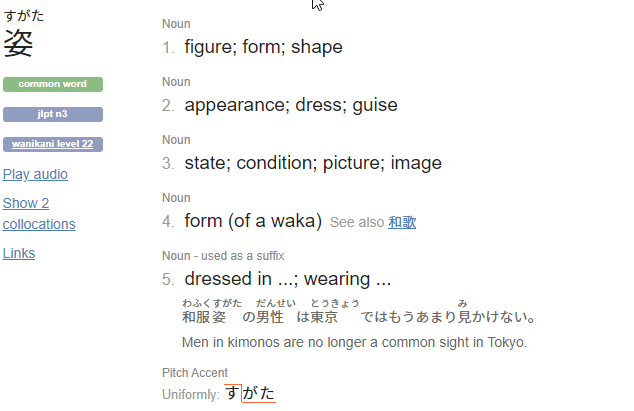
Am I correct in assuming that 姿 when used to mean ‘dressed in …; wearing …’ does not need の before it as it used a suffix?

The sentence I just got in my reviews for this grammar point: あの人は顔も綺麗だし、立ち姿も美しい。

The grammar writeup for this states that 姿 is supposed to be used with the attributive form of verbs and attached to nouns with の, but in this sentence 立つ is in its stem form. Upon some searching, it seems like this form has a number of fixed compound nouns that use the stem form instead of the attributive form to attach to 姿.

My question: is what I found the correct explanation for what’s going on here? If not, please correct me.

If I am right, I would like to offer that this grammar point should mention, at least in some minor way, these compound nouns that break the mold of what is taught on the grammar page.