だって - Grammar Discussion

Hey :grinning:

Xなければ is negative ば form (negative conditional), meaning “if (someone does) not (do) X then”.
It is used in Xなければいけない(ならない、etc), the “must” construction, but if we were to translate it a bit more literally, it means "if not X then it will be not good (いけない - “not good” in this case).

So なければ can be either contraction of the must construction, or simple negative ば form itself. It all depends on the context.

In this case, we don’t have any context so we have to use common sense:

Even ice cream can do you good. That is if you eat too much.

doesn’t make much of sense, so alternative:

Even ice cream can do you good. That is if you don’t eat too much.

is the correct translation.

I hope it helps,
Cheers :+1:

3 Likes

Thanks for the explanation! I forget to break Xなければいけない down; it’s too easy to fall into the trap of just seeing it as one glob. o.o;

3 Likes

I think this grammar point could be segmented a bit more; I’m having a bit of trouble with distinguishing the “i heard” and the “even though” definitions.

4 Likes

@darkness_rising
Hey :slight_smile:

think this grammar point could be segmented a bit more

I agree! We will split it as soon as possible.
For now, I think you can use the following tips:

if だって follows a noun (but not a noun at the end of a sentence) then it means even.

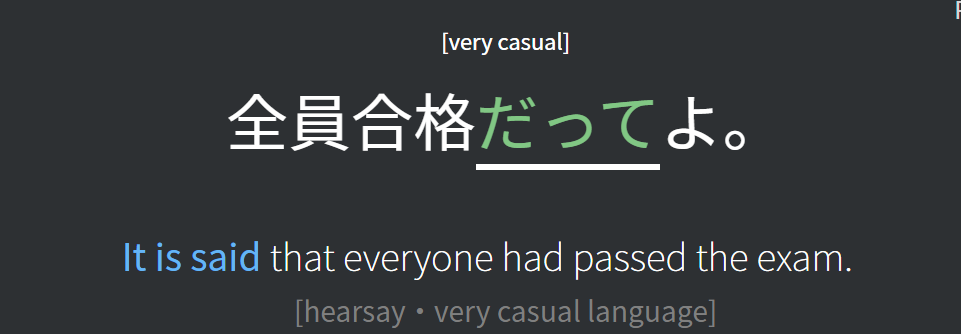
if だって is used at the end of a sentence, then it expresses hearsay, “I
heard…” :blush:

If だって is at the beginning of a sentence, then it means “because”.

I hope it helps (for now!)
and thank you for the great feedback,

Cheers!

5 Likes

I think I encounter another usecase of だって in the wild:

先生だってうそは言わないだろう。

I think it means “Teachers (without exception) would not lie.”

From goo.ne dictionary:
疑問・不定を表す語、または、数量・程度を表す語に付いて、例外なくそうである意を表す

Would this not be more along the lines of “Teachers, like, don’t lie!” ?

You know, like, the way english speakers like, put “like” in, like, everything?

This is the context:

進学指導で、「きみの成績なら、あの大学に入れる 確率は10%だね」と言われたら、どうか。あなたは、自分を入れない90%の側に置いてあきら めるのではないか。それとも10%の側に置いてチャレンジするだろうか。
確かに数値はうそをつかない。先生だってうそは言わないだろう。だが、先生は、過去の数値を示しているだけで、あなたがどちらの側に当てはまるかは判断していない。

I think that could work as literal translation (which is good when we want to analyze the source language). It’s surrounded by plain forms so the informal register doesn’t seem off.

Is it not being used in the the sense of also, too or as well? For example one of the sentences Jisho offers is “女性だってエッチしたい” translated as “Women want to have sex too.”. So when they say "確かに数値はうそをつかない。先生だってうそは言わないだろう"are they not saying that the numbers don’t lie and the teacher also doesn’t?

1 Like

That だって in the jisho sentence means even which is covered by bunpro.
(Even) women wants sex, too.

女性だってエッチしたい translates pretty well to “women want to have sex too”, but there is no distinction in this English translation for 女性だって and 女性も. That’s why I suggested ‘like’.

Yeh of course I don’t just eat crap. I, like, eat fruit and stuff!
当たり前におやつしか食わないわけないよ。俺だって果物などは食うよ

I check the goo.ne dictionary again and “likeness” and “without exception” are listed under the same numbered point so you do have a solid point there. I think that the word “even” in English do share that [similarity] semantic feature with the other meanings after all.

1 Like

「月に_だって_行けるかもしれない。」
You can probably even go to the moon.

Should there be a に here or am I missing something? 月に isn’t a noun, is it?
Can だって be put after anything to mean “even”, not just nouns?

1 Like

Yes, using にだって is definitely valid.

月 is a noun. When だって is used as “even” it is a binding particle. I don’t know if this is an actual rule, but it seems to be true that you can use any binding particle after the に particle. eg. には, にも, にでも, にこそ, にしか, and にさえ are all valid combinations to use.

When it means “even if” (as a conjunctive particles which is different than be used as “even” being a binding particle) it comes from たって which can be used with verbs. たって can become だって when following a gx / nx / bx / mx sound.

3 Likes

Ahh, okay. I knew there were particle combinations involving に but didn’t know that にでも/にだって were valid combinations; something in my brain was telling me にも was good enough for some reason.

1 Like

Two helpful resources I came across on YouTube:

1 Like

Why is だそうだ not accepted here ?

Because そうだ is not very casual, just regular casual. :wink:

Got it. A hint would help though (“more casual than this”)

1 Like

Example sentence question:

父親だって、たまには<一人ひとりでのんびりしたいときもある。is what it says is the correct answer.

But the help page says that I should have (なん) before a noun, and when I try that it says “try removing something from the front.”

There are parentheses on the help page, but I’m confused because of the linkage between the noun and the expression.

Hey @larrydeluca !

なん will be added between a noun and だって when it is used at the end of a sentence to express hearsay.

Since this だって comes in the beginning of the sentence, adding なん would sound unnatural since this is not expressing hearsay.

I hope this helps!