
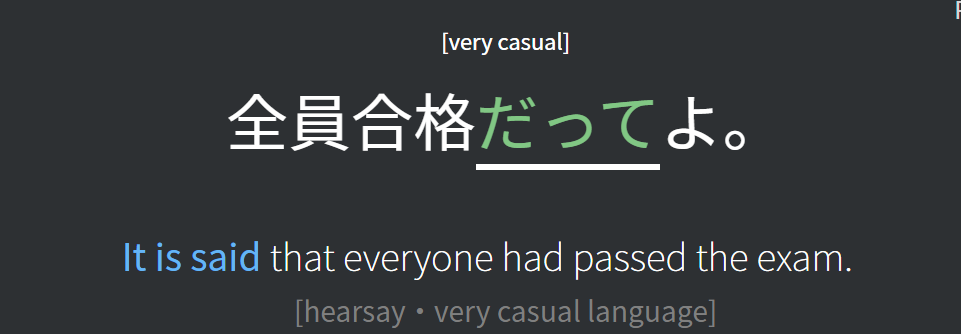
Why is だそうだ not accepted here ?
Because そうだ is not very casual, just regular casual. 
Got it. A hint would help though (“more casual than this”)
1 Like
Example sentence question:
父親だって、たまには<一人
But the help page says that I should have (なん) before a noun, and when I try that it says “try removing something from the front.”
There are parentheses on the help page, but I’m confused because of the linkage between the noun and the expression.
Hey @larrydeluca !
なん will be added between a noun and だって when it is used at the end of a sentence to express hearsay.
Since this だって comes in the beginning of the sentence, adding なん would sound unnatural since this is not expressing hearsay.
I hope this helps!
I have a question regarding the hearsay nuance.
In the explanation it says, "At the end of a sentence, だって is used to express hearsay, in a similar way to ‘I heard that’, or ‘it was said that’, in English. In these cases it will be preceded by なん. "
However, there are example sentences that omit なん.
全員合格だってよーIt is said that everyone had passed the exam.
「たけしさん、海外旅行だって?」ーIs it true (what I have heard) that Takeshi is on vacation abroad?
Why in these cases is なん omitted?
Thank you!
1 Like
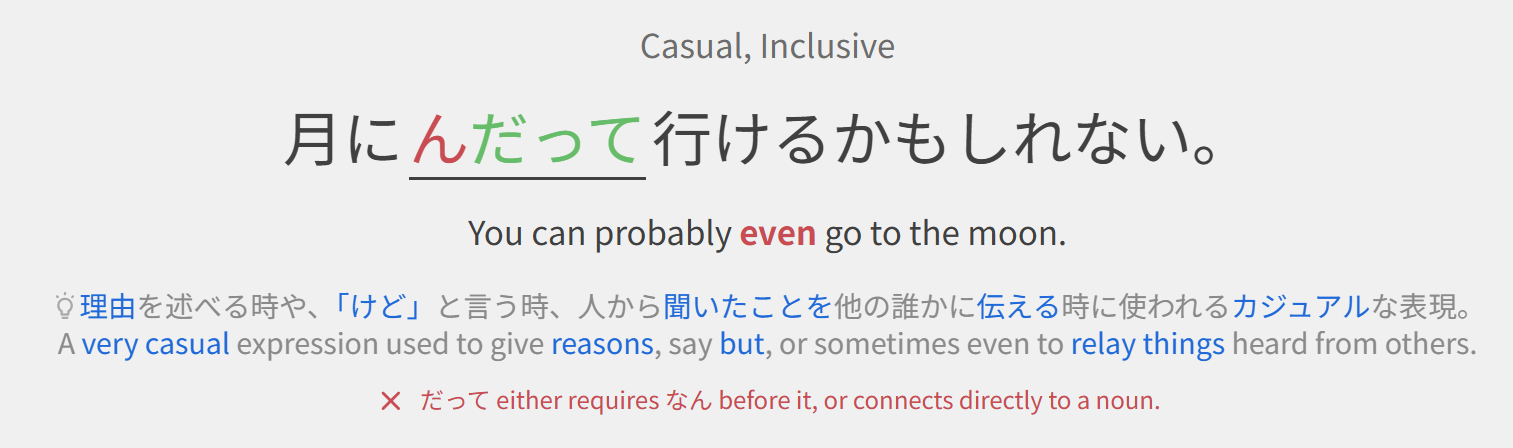
The red text at the bottom of the image below is not even accurate for that review. According to the red text, unless there is a noun preceding the だって, then it requires a なん before it. Obviously my understanding here sucks… I guess it’s still attaching to the noun, it’s just sharing that attachment with the other particle に. But it’s hard for me to think of that as a “direct” attachment when there’s something in between them. EDIT: That was all wrong.
I think this lesson is lacking. It does not explain the mechanics of why the phrase connects to “noun+particle” the way that this review question requires. The lesson explicitly talks about how different the semantics and syntax are for when it appears at the beginning vs the end of a sentence. But it doesn’t explain this third case where it’s in the middle, acting, apparently, as a particle… which I did not expect (I had to talk to an LLM to figure that part out).
1 Like
This lesson mixes 3 very different uses, and 5 years ago there was an idea to split it (だって - Grammar Discussion - #9 by mrnoone)
To borrow a dictionary explanation (だって(ダッテ)とは? 意味や使い方 - コトバンク), the usage in the sentence 月にだって行ける, in the meaning of “even”, is a connecting particle (係助詞) like は・も・でも・から etc, and is used to provide an example:
[係助]
名詞・副詞、一部の助詞に付く。
「でも」に似るが、語調がより強い。
① ある事柄を例示し、それが他と同類、または、同様であるという意を表す。…もやはり。…でも。
「ここからだって見える」
Connecting particles can follow not only nouns, but nouns with particles too, e.g. 誰でも・誰にでも.
だって in the beginning of a sentence is a conjunction (接続詞), and usually means なぜかというと.
だって at the end of a sentence is a sentence-ending particle (終助詞), and so it can be optionally combined with なん (which is nothing else than explanatory の).
2 Likes
splitting it would def help me, I still struggle with understanding だって