
〜よう/〜おう + が/と|まい + が/と - Grammar Discussion

even if
no matter what
whether or not

[emphatic]
volitional + が/と

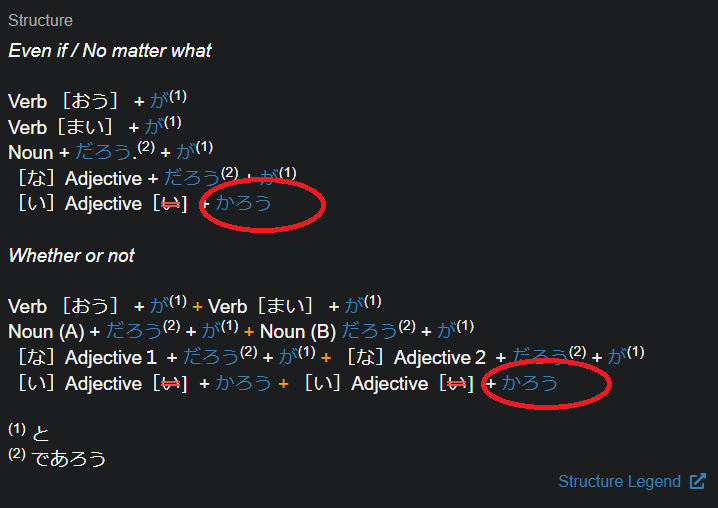
Structure
Even if / No matter what

  • Verb [ volitional ] + /
  • Verb[negative volitional ( まい )] + /
  • Noun + だろう / であろう + /
  • な-Adjective + だろう / であろう + /
  • い-Adjective[] + かろう

Whether or not

  • Verb [ volitional ] + /
    + Verb[negative volitional ( まい )] + /

  • Noun1 + だろう / であろう + /
    + Noun2 だろう / であろう + /

  • なAdj1 + だろう / であろう + /
    + なAdj2 + だろう / であろう + /

  • いAdj[] + かろう + いAdj[] + かろう

[Used to express strong feelings (I will never stop loving you) and unchangeable truths (even if students do not come to school, I will still teach)・Stronger than ても]
View on Bunpro

Why not split up this grammar point into a ‘even if/no matter what’ and an ‘whether or not’? That way we’d get more opportunities to practise each one. As it is right now, I doubt two sentences is enough to master the ‘even if/no matter what’ version.

3 Likes

Are が・と supposed to be missing from the structure details for 形容詞?

Judging from this example sentence, it shouldn’t be.

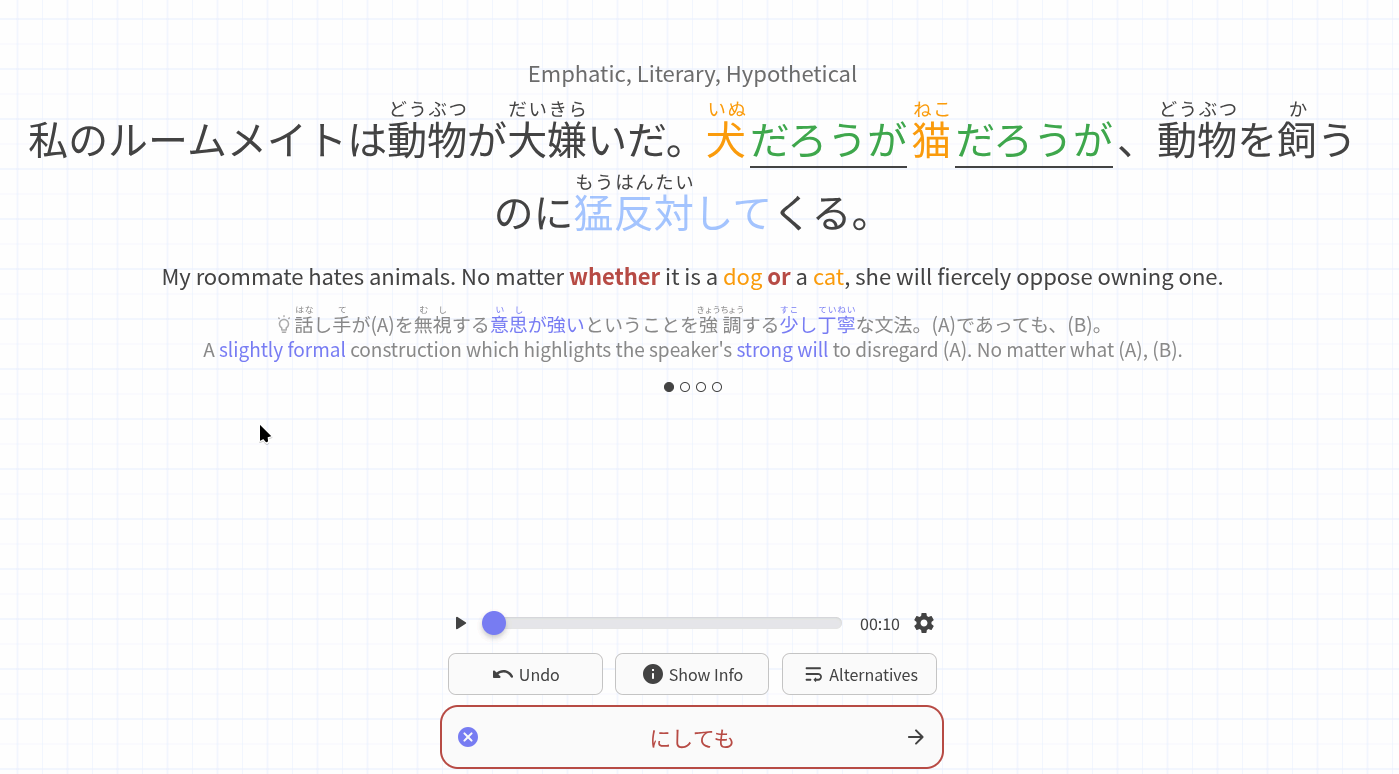
日本語の勉強は難しかろうが易しかろうが、流暢に話せるようになるまで勉強する。

What’s the difference with “にしても”?

Why can’t I use it here?

This grammar point is A Lot.

I’ve never encountered Adjective[]+ かろう before now.

Is there a chance this can be worked on a bit? I’m finding it really hard to get my head around this because this part:

使い方・接続

Even if / No matter what

Verb [おう] + (1)
Verb[まい] + (1)
Noun + だろう.(2) + (1)
[な]Adjective + だろう (2) + (1)
[い]Adjective[]+ かろう + (1)

Whether or not

Verb [おう] + (1) + Verb[まい] + (1)
Noun (A) + だろう (2) + (1) + Noun (B) だろう (2) + (1)
[な]Adjective1 + だろう (2) + (1) + [な]Adjective2 + だろう (2) + (1)
[い]Adjective[]+ かろう + (1) + [い]Adjective[]+ かろう + (1)

(1) と
(2) であろう

Is too much information to absorb…

2 Likes

Tough call I think…

Up until this point, かろう has not been introduced for adjectives at all, so that should be a fun-fact more than anything. I would say the easiest way that we can condense this is to focus the scope of the article, while making it less about the various forms it can appear in.

We do have かろう, but it is not something that is strictly covered in the JLPT, for now at least.

Probably the best way to handle it would be introducing まいが as the exception to the doubling rule, with verbs, and then simply introducing the rest as structures that double, as all of those (apart from かろう) should be very familiar for everyone by that point.

2 Likes

Thank you so much for replying! That sounds like it would help a lot.

1 Like