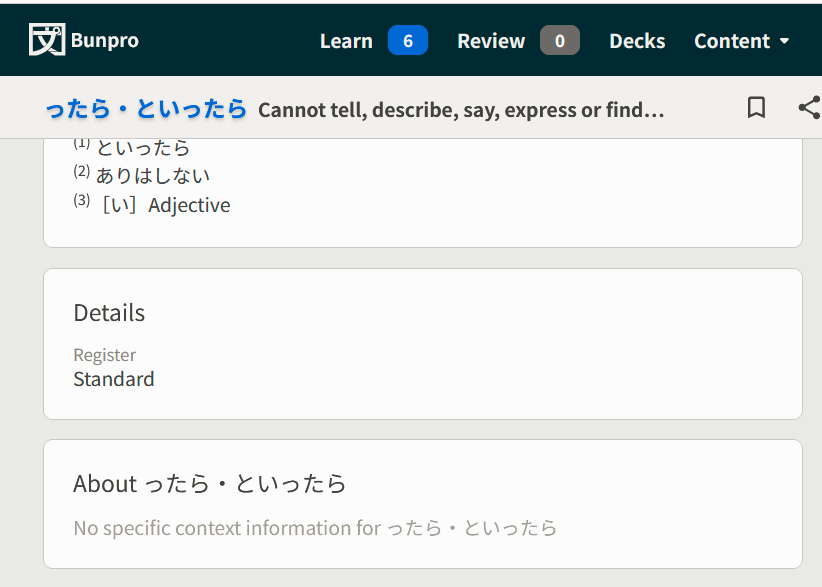
たら-といったら - Grammar Discussion

cannot tell/describe/say/express/find words for how
words cannot express
too … for words
extremely

:warning: と言ったらありはない is a written
rarely used variant

Structure

More common:

  • Noun + ったら/といったら + ありゃしない/ありはしない
  • いAdj/(いAdj + さ) + ったら/といったら + ありゃしない/ありはしない

Less common:

  • Verb + ったら/といったら + ありゃしない/ありはしない
  • なAdj + ったら/といったら + ありゃしない/ありはしない

View on Bunpro

The about section of this grammar point is really confusing and I think wrong. It says it’s comparing ったらない and といったらない, but it’s actually comparingったらない (a previous grammar point) and ったらありゃしない (the current grammar point) right?

Also, a breakdown of the components of ありゃしない would be helpful.

Agreed. There’s almost zero information here compared to other grammar entries. Also how is this different from “ったらない”?

Not sure if this is a bug or if the explanation is being re-written, but there currently is no information about this point at all right now:


@Asher tagging for visibility in case it’s a bug. Thanks!

Here is a good explanation to use until Bunpro updates this point: https://hanabira.org/japanese/grammarpoint/~といったらありゃしない%20(〜to%20ittara%20arya%20shinai)

@Asher @Fuga sorry for bothering you guys, but would it be possible to get an update on when/if this grammar point will get an explanation? Thanks!

2 Likes

This is a duplicate of another grammar point and will be removed at some point. ったらない・といったらない (JLPT N1) | Bunpro

2 Likes

Ahh that makes a lot of sense. I was looking at the other point earlier and wasn’t sure if they were different. Thanks so much for confirming, I appreciate it!

1 Like

Maybe I have a brainlag, but why 来て in the following sentence.

上司:「君は毎日毎日、会社に遅刻して来て。見苦しいったらありゃしないぞ。」

If there was a comma, i would have understood it as an “and”. If there was an いる/る that would have made sense too (especially when I look at the translation).
What am I missing?