
@Isurandil492
B y the way, I have fixed it on site, but forgot to mention:
It should be 暖かい, instead of 温かい.
The first one is used for weather and climate in general and the second one for things like water, tea, solid objects etc.
I read in the lesson for 〜だ that you can’t use い-adjectives with だ. I thought that was true here as well. Is it?
(My question was the one about pork, and it had an い-adjective before I was supposed to put だけど.)
1 Like
嫌い is a な-adjective, not an い-adjective.
2 Likes
@mattbacon, like @seanblue says, it is the tricky な adjective, which seems to be い adjective at first sight.
There are also other ones, the most common ones are:
- きれい 綺麗 beautiful, clean
- あんせい 安静 rest
By the way, we used 嫌い on purpose, so learners would realize that there are also なadjectives like that. The sooner the better.
I have added a note about that under the sentence 
1 Like
Is it one of those fancy notes that only shows up when you answer with a specific wrong answer? I love those.
2 Likes
Both ways, under the example sentence and when you provide the wrong answer.
I am glad that you like them
3 Likes
So this is a question involving both けど and けれども。 I hope it’s ok to put it here because my grammar books aren’t currently helping.
During reviews I used 「ですけれども」 in a sentence after an い adjective (At least I believe it was, I didn’t capture it, unfortunately) and got it wrong. Taking a look at the grammar details I saw the chart where だ+けど and です+けれども are only listed after な adjectives and nouns. I made my first grammar note to “be aware” and moved on feeling empowered. Yay!
…When…I ran into this sentence: 「その店は高い____、美味しいでしょう」my answer けけれども was correct (although it was looking for けど) but ですけど, ですけれど, and ですけれども are also listed as alternative answers. I feel like I’m missing something. Is it that the first part of this specific sentence is an independent clause and the other sentence (that I can’t remember) was not?
In other words, are there any extra examples/help to explain when to use だ・です before けど・けれど・けれども?
Many thanks for any help anyone can give!
1 Like
In 「その店は高い____、美味しいでしょう」, note that it ends in a polite form. This means that (for this grammar at least) it’s okay to use both けど by itself and ですけど earlier in the sentence. It’s possible that in your earlier review, the sentence ends in plain form. In that case, it would be wrong to use です earlier in the sentence since it would be inconsistent in the level of formality.
2 Likes
Thanks, that clears it up a bit I think. In other words, です can come in based on the formality, even if it’s an い-adjective or a verb?
If I’m interpreting this correctly: だ・です can optionally appear before けど even if the preceding word is a verb or いーadjective, depending on formality. But, if it’s after a noun or な-adjective, だ・です will reliable appear (are required) before けど. Like in the chart?
I hope that makes enough sense to be correct…or correct if I’m wrong  I really appreciate the help.
1 Like
@reverie
Hey and welcome on the community forums 
Like @seanblue says, as a rule of thumb, the polite form (which is expressed through です with adjectives (both kinds)/nouns or ます with verbs) should be used only at the end of the the sentence (main clause).
We have to remember, that だ (unlike です) is attached only to nouns and なadjectives. いadjectives and verbs are simply left as they are.
So
安いだけど、いい。
毎日シャワーを浴びるだけど、今日は浴びない。are wrong
But:
安いですけど、いいです。
毎日シャワーを浴びますけど、今日は浴びません。are possible
PS (This might be confusing/advanced)
毎日シャワーを浴びる。だけど、今日は浴びない。(two sentences)
毎日シャワーを浴びるのだけど、今日は浴びない。(using の/ん) are also correct, since の・ん is technically like noun, and in the first case, we have two separate sentences.
So let’s say we have example:
安いけど、いい。Cheap, but good.
便利だけど、高い。Convenient, but expensive.
毎日シャワーを浴びるけど、今日は浴びない。I take shower everyday, bot not today.
夏だけど、寒い。 It is summer, but it is cold.
If we want to make it polite using our rule of thumb:
安いけど、いいです。
便利だけど、高いです。
毎日シャワーを浴びるけど、今日は浴びません。
夏だけど、寒いです。
If we want to be extremelly polite (and not that gramatical), we can use polite form not only at the end of the clause but also in subordinate clauses. So:
安いですけど、いいです。
便利ですけど、高いです。
毎日シャワーを浴びますけど、今日は浴びません。
夏ですけど、寒いです。
Are possible.
HOWEVER, we would break the rule if we used polite form in the subordinate clause, but not in the main clause (at the end of the sentence).
安いです、いい。
便利ですけど、高い。
毎日シャワーを浴びますけど、今日は浴びない。
夏ですけど、寒い。
These are ungramatical.
3 Likes
Wow, thank you for the full run down. This is super helpful and I finally could see the two issues I was having that were making things extra hard (the formality issue and conflating だand です).
The full explanation, especially regarding subordinate clauses, even nipped another issue in the bud, too. I actually am starting to get it! やったー! (๑˃̵ᴗ˂̵)و ヨシ!
Thanks so very much 
3 Likes
I’ve just tried to answer the following with でも :
秋 だけど 、暖かいです。
As far as I can tell, that would work in this sentence, so how is the best way to tell which is the right answer? Is でも more polite than だけど?
Thanks,
Cris
1 Like
でも comes at the beginning of a sentence, while けど comes at the end of the first clause in a sentence. So in this case you can’t use でも. If you wanted a similar example using でも you’d have to say something like:
秋です。でも、暖かいです。
4 Likes
Ah, I see. Thanks very much 
1 Like
I am confused as to what it means when けど is at the end of a sentence. For example, I am currently reading a Manga in which a character is introducing himself with “[name]だけど”.
What would the meaning of けど be in this sentence?
1 Like
Can you provide the previous and following sentence to add a bit more context?
Without context, I cannot tell much, but one possible context is when you pick up the phone and ask why someone is calling you, like this:
田中だけど、(何か(用が)ありますか)?
It’s Tanaka, (do you need something)?
So the dialogue in question comes from the beginning of the Manga “聲の形”, where 2 people (a boy and a girl) meet each other. When the girl recognizes the boy, she runs away, the boy follows her and screams “小6ン時の石田だけど”.
Spoiler
It is later revealed that the boy used to bully the girl heavily 6 years prior
I’ve just bumped into this very same problem!
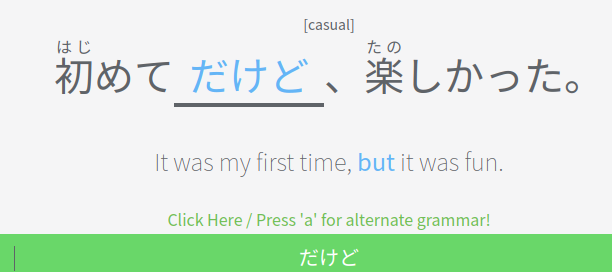
Do you need to add a だ before けど after all て-form verbs, or just 初めて?
Or is only 初めて possible here?
Are all て-form verbs considered to be nouns?
Is this worth mentioning in the grammar explanation?
Sorry, so many questions! Hope someone can help! Thank you!
I also encountered some instances in which けど with the meaning of “but” doesn’t quite suit.
In this video the other uses of けど made much more sense. けど Is Not Always But
Quick Summary:
けど as a particle marks the situation (A) and transferring to the main point of the sentence (B).
Example:
皆さん、明日田中さんの誕生日会があるんです(A)けど、行きますか(B)?
→ The situation is that tomorrow is Tanakas birthday (Situation)[けど], do you want to go there (Main Point).
Effect: Before make a decision, here is the situation we are talking about.
Another Example:
さっき田中さんにメロンもらったんだけど、食べる?
→ Tanaka gave me a melon just now (A → Situation)[けど], do you want to eat it? (B → Main Point)
I think that also this concept applies pretty well to the translation of “but” and helped me a lot understanding these occurrences in the examples above or if someone picks up the phone and says “[Name], だけど” like stated in the posts above.
田中だけど(A → Situation)、(何か(用が)ありますか(B → Main Point))?
It’s Tanaka, (do you need something)?
→ establishes shared context to the caller and receiver of a call
Just wanted to share, because i found it incredible useful for me 
2 Likes